49 works in this view — arrow keys or swipe to move between them.
Dance in Art
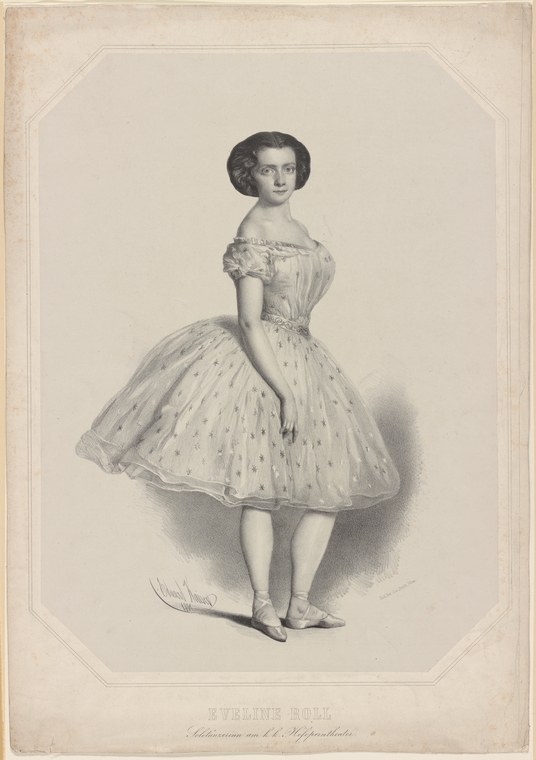
Eveline Roll, Solotänzerinn am K. K. Hofoperntheater
Unknown artist
- Collection:
- Prints depicting dance
- Source:
- New York Public Library
- Rights:
- Public domain — free to use, share and adapt.
- Recorded as:
- Public Domain
This print documents a professional female dancer from a major European opera house at the height of the Romantic ballet period, offering visual evidence of costume, bearing, and professional identity that cannot be recovered from text alone. It represents the way dancers themselves were presented as subjects of artistic attention—not as abstract symbols of beauty, but as named individuals with verifiable professional positions and institutional affiliations.
What you are looking at
A young woman stands alone against a plain background in a three-quarter pose, facing the viewer with her body turned slightly to the right. She wears a full-skirted dress of the Romantic era, with a fitted bodice, off-the-shoulder neckline with ruffled sleeves, and a voluminous skirt decorated with small dot or flower patterns that extends to mid-calf. The skirt is caught in mid-movement, billowing outward in a way that suggests recent motion or a moment of pause mid-gesture. Her dark hair is parted and smoothed back from her face. She stands in a relaxed but graceful posture, one arm held softly at her side, the other extended with gentle articulation. The image is rendered in fine black line work with careful shading that suggests the three-dimensionality of the figure and the weight and texture of the fabric. The plain background and framing device—a decorative rectangular border—focus attention entirely on the dancer and her costume.
The dancing
The figure stands in a neutral, upright position with only minimal rotation of the torso and a slight backward tilt to the upper body that conveys ease rather than exertion. Her weight appears to rest evenly on both feet, with the legs straight but not rigid. The arm positions are modest and controlled—one rests naturally at her side, the other extended with a gentle curve, neither raised dramatically. Her posture and frame suggest classical training and restraint rather than overt virtuosity, with the body in a state of graceful readiness rather than active movement.
The dance depicted
This is a portrait of a soloist from the Imperial Court Opera in Vienna during the Romantic ballet period, likely from the mid-nineteenth century. The dress, pose, and presentation style are consistent with Romantic ballet of the 1840s–1860s, when soft tutus, off-shoulder necklines, and ethereal femininity dominated the aesthetic. The modest stance and the absence of any dramatic lift, turnout, or extreme extension suggest this may document the dancer in a character or demi-caractère role rather than in a technical display. The inscription identifies her as a solo performer (Solotänzerinn) at a major court institution, indicating she held a professional position of some status.
How it was made
This is a lithographic print, a technique that allowed for the production of multiple impressions from a single stone. The delicate line work and the subtle gradations of gray achieved through careful shading demonstrate the precision possible in lithography. The decorative border and the presentation of the figure as a formal portrait suggest this was part of a series—likely a theatrical souvenir or part of a documented record of the Vienna Court Opera's personnel. Lithography's accessibility and the relative economy of production made it ideal for the circulation of theatrical portraits among patrons and in the press.
About this work
This is a mid-nineteenth-century lithographic portrait of Eveline Roll, a dancer at Vienna's Imperial Court Opera (K.K. Hofoperntheater). The work documents the appearance and costume of a professional soloist at one of Europe's most prestigious dance institutions during the height of the Romantic ballet era. Roll stands alone, posed with grace and restraint in a full-skirted Romantic dress, her appearance fixed for circulation among the opera house's audience and patrons. The work belongs to a tradition of theatrical portraiture that made famous dancers into public figures and accessible personalities, and it serves as valuable documentation of how dancers of her rank dressed and carried themselves in the professional context of the 1840s–1860s.
How to look at it
The artist has frozen the dancer in a moment of repose rather than climactic movement—she is not mid-jump or at the apex of a grand gesture. This choice emphasizes her costume, her professional bearing, and her identity as a named individual rather than an idealized type. Notice the specific attention to the texture and weight of the fabric, the careful articulation of the neckline and sleeves, and the way the skirt is shown in a state of gentle disturbance that suggests either recent motion or the moment just before sustained movement. The plain background and the formal framing make this a portrait first and a record of dance second—the emphasis is on the dancer as a person and professional, not on the virtuosity of her art.
The artist
The artist is not recorded in the catalogue. The quality of the lithography and the formal nature of the presentation suggest a professional theater or music press, likely based in Vienna or another major German-speaking city. The style is consistent with mid-nineteenth-century theatrical portrait prints, a substantial commercial genre that employed skilled lithographers to produce portraits for sale to opera and theater patrons.
The period
This portrait dates to the height of the Romantic ballet era in Europe, when dancers—especially female soloists—achieved unprecedented celebrity and cultural status. Vienna's Imperial Court Opera was a major center for dance innovation and the employment of internationally recognized performers. During this period, the full-skirted Romantic tutu, off-shoulder costume, and ethereal aesthetic seen in this portrait had become the dominant visual language of ballet. Theatrical portraiture of named dancers became a popular commodity, circulated among patrons and the public as souvenirs and as documentation of contemporary performance.
Where it lives
The print is held in the New York Public Library's collection of prints depicting dance. It is a theatrical souvenir or documentary print of the type produced commercially for distribution to opera patrons and the public during the nineteenth century.
Dance in this work
Questions about this work
Who was Eveline Roll?
She was a solo dancer (Solotänzerinn) at Vienna's Imperial Court Opera (K.K. Hofoperntheater) during the mid-nineteenth century. The inscription on this print is her primary surviving record. She would have been a professional performer of some rank and recognition to merit this formal portrait.
Why was she depicted in this particular pose?
The pose emphasizes her grace and professional bearing rather than technical virtuosity. This is consistent with nineteenth-century theatrical portraiture, which aimed to present dancers as individuals and public figures rather than as abstract performers. The relaxed stance suggests this may document how she appeared in character roles or in the informal moment of costume and professional identity rather than in the moment of peak technical display.
What does the costume tell us about Romantic ballet?
The full skirt, off-shoulder neckline, and soft silhouette are all hallmarks of Romantic ballet aesthetics (c. 1840–1860). The modest length (mid-calf rather than ankle-length or knee-length) and the careful decoration suggest a costume tailored for a professional opera house and probably for a character role or demi-caractère performance rather than for the great ballerinas in pointe technique.
Why would a dancer have a printed portrait made?
Theatrical portraits were popular souvenirs sold to opera and theater patrons, giving fans a way to remember or collect images of favorite performers. They also served as professional documentation and publicity for the dancer and for the institution. For a major opera house like Vienna's, commissioning a portrait through lithography was a mark of professional status and celebrity.
More dance artwork





