49 works in this view — arrow keys or swipe to move between them.
Dance in Art
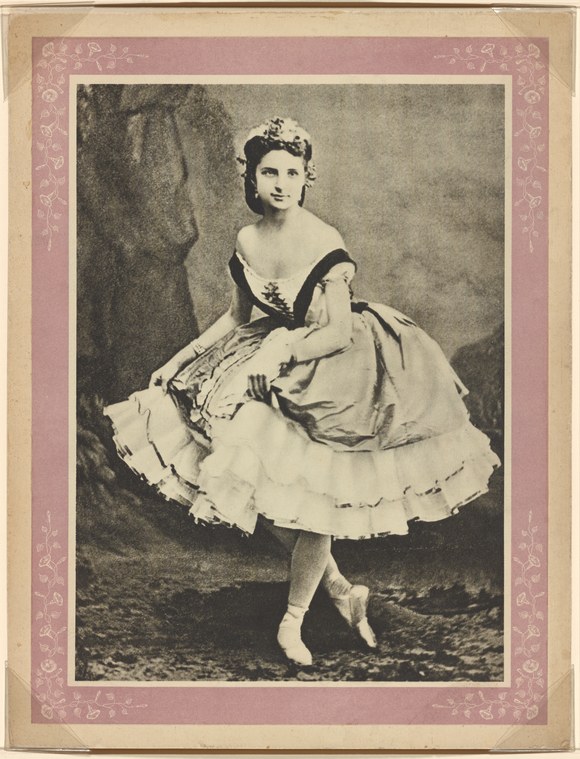
Mademoiselle Fioretti de l'Opéra
Unknown artist
- Collection:
- Prints depicting dance
- Source:
- New York Public Library
- Rights:
- Public domain — free to use, share and adapt.
- Recorded as:
- Public Domain
It is one of the rare surviving photographs of a Paris Opera dancer from the Romantic era, capturing both the technique and the presentation conventions of classical ballet at a moment when the tradition was shifting. The carte de visite format itself is historically significant: these images shaped how dancers were seen by the public and how performance was transformed into commodity.
What you are looking at
A young woman in a pale tulle ballet skirt and dark corseted bodice stands in a classical ballet pose, her weight on one leg with the other extended in an attitude or arabesque position. She wears her hair styled in the fashion of the 1860s–70s, arranged on top of her head with curls, and holds her arms in the soft, rounded port de bras typical of Romantic ballet. The studio setting is sparse and theatrical: a plain draped backdrop in dark tones creates depth, while the floor is unadorned. The photograph is mounted on a decorative card with a mauve border featuring ornamental floral patterns at the corners, a presentation format characteristic of theatrical publicity materials and cartes de visite. The lighting is soft and even, flattering to the dancer's form and the delicate texture of the tulle skirt.
The dancing
A single dancer occupies the frame, isolated and centered. Her supporting leg is straight and turned out in proper ballet alignment; her working leg is lifted high in a développé-like position with the foot pointed. Her upper body is held upright with the slight forward inclination typical of Romantic era deportment. Both arms are held in a gentle, rounded position—one slightly forward and one to the side—characteristic of the épaulement and port de bras of the period. The pose is neither mid-movement nor frozen at maximum extension, but rather a composed, presentational attitude intended to display the dancer's line and the costume.
The dance depicted
This is a Romantic ballet dancer, most likely French or performing in France, documented in the 1860s–70s. The Romantic tutu—reaching approximately to the ankle, with layers of pale tulle—and the dark corseted bodice are canonical costume elements of works like *Giselle* and *La Sylphide*. The dancer's name, Mademoiselle Fioretti de l'Opéra, suggests she was a corps de ballet or demi-soloist at the Paris Opera during the waning years of the Romantic era. The photograph records not a performance moment but a formal studio portrait, the way dancers were marketed to audiences as images. Such cartes de visite were collected, exchanged, and displayed.
How it was made
This is a photograph mounted on a printed decorative card. The photograph itself appears to be an albumen print or similar collodion-era process, rendered in silver tones on cream stock. The card mount—with its elaborate mauve border and corner ornaments—is a commercial product, suggesting this was a published publicity portrait sold or distributed through theaters or studios. The photographic process allowed detail impossible in engravings: the texture of tulle, the precise line of the dancer's leg, the arrangement of her hair. Such cartes de visite became ubiquitous in the 1860s and 70s, making performers' images portable and collectable.
About this work
This is a studio portrait of a dancer in the Paris Opera ballet, documented in the 1860s–70s during the last decades of the Romantic ballet era. The image preserves not a performance but a formal presentation—the dancer posed in a classical attitude, framed to display both her body and her costume. It belongs in a dance archive both as evidence of how Romantic ballet dancers were trained and positioned (the technique and aesthetic), and as a window into how performance was commodified and circulated: the dancer as image, marketed through cartes de visite that reached a mass audience. The photograph records a specific historical moment—the decline of Romantic ballet in Europe and the rise of photographic documentation—and a specific dancer whose name survives only on the card mount.
How to look at it
Observe the dancer's pose: it is neither the apex of a jump nor the moment of greatest extension, but rather a composed, frontal attitude designed to show the line of the leg and the flow of the costume. This reflects a deliberate choice by the photographer—to present the dancer as trained and disciplined rather than as a figure caught in dynamic motion. Note how the costume (the tulle skirt, the dark bodice) frames and directs attention to the dancer's legs and torso. The theatrical backdrop and the formal mounting on a decorated card indicate this is a commercial product, meant for display and circulation, not a candid or documentary photograph.
The artist
The photographer is not recorded. The carte de visite was a mass-market format, and many such portraits were produced by commercial studios in Paris, often in partnership with theaters. The print house that produced the card mount is not identified on the surviving object.
The period
The 1860s–70s were a period of decline for Romantic ballet in Western Europe, even as it remained a staple of the Paris Opera's repertoire. Photography had recently become technically and economically feasible for portraiture, and theatrical cartes de visite became a craze: dancers, actors, and singers were rendered as collectable images, distributed to fans and sold in theaters. This democratized access to performance imagery but also commodified the dancer's body in new ways. At the same time, ballet technique was becoming increasingly standardized and codified, and the Paris Opera school was the model for classical training across Europe.
Where it lives
The work is held in the New York Public Library's collection of prints depicting dance. It is catalogued as a carte de visite, a format typical of theatrical publicity materials from the 1860s–70s. The name and theater affiliation are preserved only on the card mount itself; no other archival information is currently recorded.
Dance in this work
Questions about this work
What dance is this?
This is not a photograph of a dance being performed, but a studio portrait of a ballet dancer. The costume and pose indicate she was trained in classical Romantic ballet, likely at the Paris Opera. The photograph documents how the dancer was presented to the public, not how she danced in performance.
Who was Mademoiselle Fioretti?
No other records of this dancer have been identified. Her name appears only on the card mount. She was likely a corps de ballet or demi-soloist at the Paris Opera in the 1860s–70s, but her career and biography remain unknown.
What is a carte de visite?
A carte de visite is a small photograph mounted on a decorated card, typically 2.5 by 4 inches. They became a craze in the 1860s–70s and were sold, collected, and exchanged like modern trading cards. Theatrical performers—dancers, singers, actors—were among the most popular subjects.
When was this photograph taken?
The style of dress, hair, and the photographic process suggest the 1860s–70s. No date is recorded in the catalogue, but the theatrical fashion and the carte de visite format are consistent with this period.
More dance artwork





