49 works in this view — arrow keys or swipe to move between them.
Dance in Art
Fanny Cerrito
Unknown artist
- Collection:
- Prints depicting dance
- Source:
- New York Public Library
- Rights:
- Public domain — free to use, share and adapt.
- Recorded as:
- Public Domain
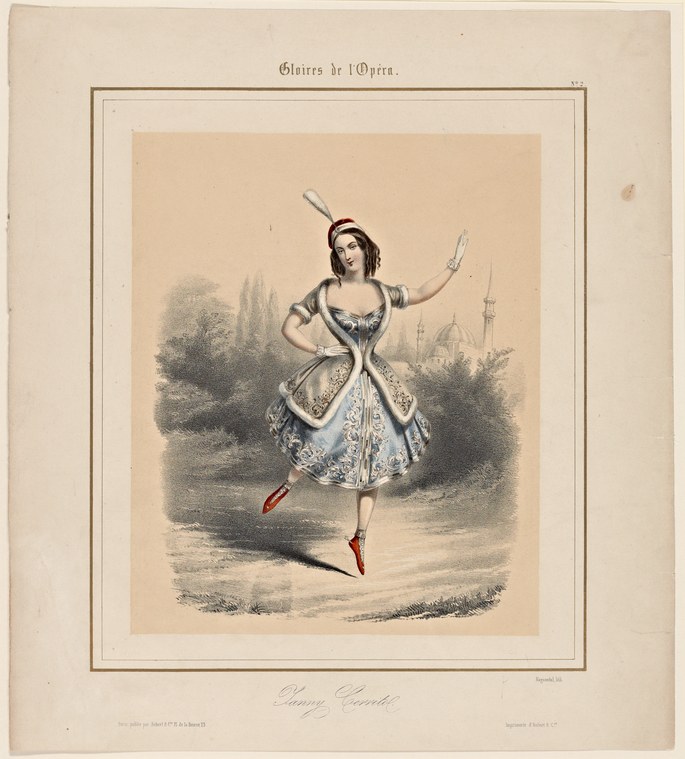
Fanny Cerrito was one of the most important ballerinas of the Romantic era, and this print provides visual evidence of how she was seen and marketed to the public. For historians of dance and of 19th-century popular culture, such prints are invaluable documents of performance, costume, and the female body as presented on stage during a transformative period in ballet history.
What you are looking at
A woman in theatrical costume performs a solo dance against a landscape background. She wears a white dress with elaborate embroidered or patterned decoration on the bodice and skirt, cinched at the waist, with a contrasting darker (possibly blue or green) underdress visible at the hem. Red heeled shoes accent her feet. A feathered headdress adorns her hair. Her pose is dynamic: one leg is raised or extended, her arms are positioned asymmetrically—one raised to shoulder height with palm open, the other extended downward—in a movement suggesting a turning or pivoting moment. The background shows a romantic landscape with trees and what appear to be distant towers or architectural elements, rendered in soft gray tones that suggest a stage set or idealized setting rather than a realistic location. The overall composition is a three-quarter-length figure study, centered in the frame and framed by a simple rectangular border.
The dancing
The dancer's weight appears to be shifted onto one leg while the other is lifted or extended, suggesting a moment of elevation or controlled rotation. Her torso is upright and her arms are held in an open, flowing position rather than pressed against her body—the raised arm is relaxed rather than tensioned, and the lower arm extends with a gesture that seems to acknowledge or address the space around her. Her head is tilted slightly, following the direction of her gaze and the movement of her body. The posture suggests control and grace rather than explosive energy, with an emphasis on line and extension through the limbs.
The dance depicted
This appears to be a Romantic-era ballet performance, most likely a solo variation or divertissement from a narrative ballet of the 1840s–1850s. The figure is identified in the inscription as Fanny Cerrito, the renowned Italian-French ballet dancer who was a leading prima ballerina of the Romantic period. Cerrito was known for her technical brilliance, elevation, and the ability to blend French and Italian ballet styles. The pose—with its emphasis on open arms, extended line, and dynamic yet controlled movement—is consistent with the Romantic ballet vocabulary of the period. The exotic or Oriental-inspired costume (suggested by the headdress and patterned dress) indicates this may be from a specific ballet role, possibly from works such as *La Fille du Danube* or another vehicle created to showcase her talents.
How it was made
This is a hand-colored lithograph or engraving, a medium well-suited to capturing and disseminating images of celebrated performers to a broad public audience. The technique allowed for fine detail in the costume and facial features while using soft shading to create depth in the background landscape. The combination of line work (visible in the figure's outline and the dress embroidery) with subtle color washes is typical of mid-19th-century theatrical prints. Such prints were a major form of popular entertainment and celebrity culture, sold separately or in albums, and served as both souvenirs and promotional materials for dancers and their performances.
About this work
This is a portrait print of the Romantic ballet dancer Fanny Cerrito, captured mid-performance in a characteristic pose that displays both technical command and theatrical presence. The work documents a specific moment in dance history when ballet was the dominant form of theatrical dance in Europe and when individual dancers—especially women—became objects of intense public fascination and admiration. As a lithograph, it is part of a vast body of theatrical imagery that circulated in the 19th century, allowing audiences who had not attended live performances to own and study images of the greatest dancers of the age.
Cerrito was a major figure in Romantic ballet, and this print represents the aesthetic values of the period: the idealization of the female dancer as ethereal and otherworldly, the emphasis on technical refinement and graceful extension, and the costume as a marker of exoticism and fantasy. The print captures not just a person but an ideal—the dancer as a figure of beauty and grace, preserved in a moment of perfect control.
How to look at it
The viewer should attend to the precision of the dancer's line—the extended leg, the open arms, the tilted head—which conveys both technical mastery and theatrical presence. The moment captured appears to be one of suspension or pivot, a point of visible control within a fluid movement. The exotic costume and landscape setting alert the viewer that this is a performance image, not a realistic document, and the formal framing and pose suggest this is both a portrait of an individual performer and a type—the idealized Romantic ballerina. The soft rendering of the background keeps focus on the figure while the careful detail in the costume indicates the importance of dress to the theatrical effect.
The artist
The artist is not recorded in the catalogue. However, the style and technique are consistent with the work of mid-19th-century theatrical print makers and lithographers who specialized in celebrity portraits of dancers and opera singers. Such prints were often unsigned or attributed only to the publisher. The work was likely commissioned by a theater management or print publisher to capitalize on Cerrito's fame and touring popularity.
The period
This print dates to the height of the Romantic ballet era (approximately 1840s–1860s), when ballet was at the peak of its popularity in Europe and when the ballerina—rather than the male dancer—became the central focus of both artistic and public attention. Works like *Giselle*, *La Sylphide*, and *Swan Lake* defined the aesthetic: ethereal heroines, pointe work, and elaborate costumes suggesting fairy-tale worlds. Fanny Cerrito was one of four great rival ballerinas of this period (alongside Marie Taglioni, Carlotta Grisi, and Lucile Grahn), and their performances generated intense competition and publicity. Lithographic prints of dancers were mass-produced and eagerly collected, making them a significant form of visual culture and celebrity merchandise of the 19th century.
Where it lives
The work is held in the New York Public Library's collection of prints depicting dance. It is part of a larger body of 19th-century theatrical imagery documenting performers and performance styles of the period.
Dance in this work
Questions about this work
Who was Fanny Cerrito?
Fanny Cerrito (1817–1909) was an Italian-French ballet dancer and one of the most celebrated prima ballerinas of the Romantic era. She was known for her technical brilliance, especially in jumps and turns, and for her ability to blend different national styles of ballet. She performed across Europe and created many roles in narrative ballets. She was a rival and contemporary of Marie Taglioni.
What is the costume she is wearing?
The costume suggests an exotic or Oriental-inspired character, typical of Romantic-era ballets which often placed heroines in fantasy settings (fairy forests, Eastern kingdoms, etc.). The embroidered bodice, patterned skirt, feathered headdress, and red heeled shoes are all consistent with mid-19th-century stage costume for a principal dancer. Without knowing the specific ballet, we cannot identify the exact character, but the style indicates a dramatic or character role.
What is a lithograph and why were dancers printed this way?
A lithograph is a print made by drawing on stone; it was faster and cheaper to produce than engravings and allowed for hand coloring. Lithographic prints of celebrity performers were mass-produced and sold to the public, much like photographs or posters today. They were souvenirs, promotional materials, and a form of entertainment in themselves, allowing people who could not attend the theater to own an image of their favorite dancer.
What does her pose tell us about Romantic ballet technique?
The open arms, extended line, upright posture, and apparent elevation or suspension suggest the Romantic ballet emphasis on ethereal grace, extension, and control. Unlike earlier ballet forms, Romantic ballet valued the appearance of weightlessness and fluidity. The pose is not frozen or stationary but captures a moment within an arc of movement—a hallmark of how 19th-century ballet was represented in visual art.
More dance artwork





