49 works in this view — arrow keys or swipe to move between them.
Dance in Art
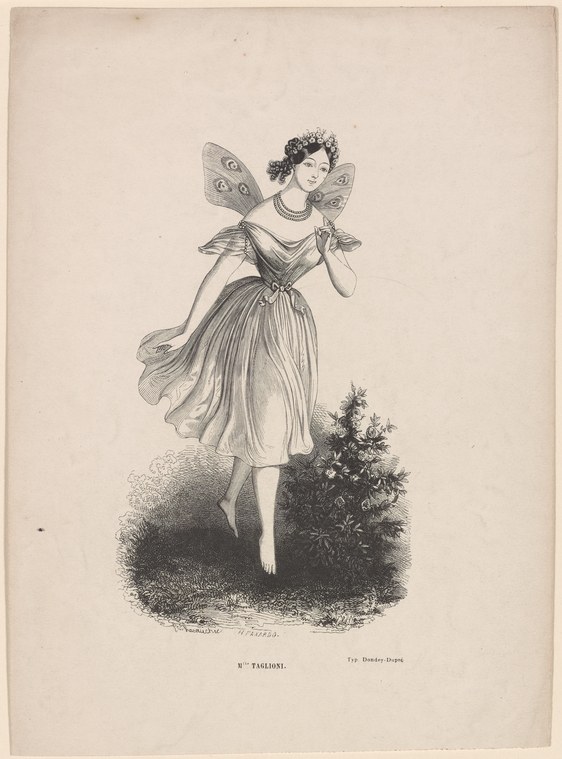
Mlle. Taglioni
Unknown artist
- Collection:
- Prints depicting dance
- Source:
- New York Public Library
- Rights:
- Public domain — free to use, share and adapt.
- Recorded as:
- Public Domain
Taglioni was the first global ballet star and the Sylphide was the role that made the Romantic ballet possible. This engraving is one of the primary visual documents of both. For dancers and historians, it shows the silhouette, costume, and pose that defined the aesthetic for generations—the elongated line, the airborne suspension, the emotional inwardness that Romantic choreography prized.
What you are looking at
A young woman in classical dress floats weightlessly above a rocky outcrop, her body tilted forward in an attitude of suspended motion. She wears a draped Greco-Roman peplos or chiton in pale fabric, with a jeweled collar and a wreath crowning her curled hair. Enormous translucent wings—detailed with intricate feathering and eye-spots in the manner of Romantic-era fairy imagery—extend from her shoulders. Her left arm is raised and bent, the hand near her face in a gesture of dreamy reverie; her right arm hangs at her side. One leg extends behind her in a graceful line while the other bends beneath. The setting is minimal: a rocky, shaded base rendered in heavy stippled shadow occupies the lower third of the composition, while the upper two-thirds remain blank paper. The print is a formal portrait—a celebrity image of a named dancer in costume.
The dancing
The figure's body is arched in a pose of weightless elevation characteristic of Romantic ballet. The raised arm and tilted head suggest an inward emotional state rather than a dynamic traveling movement. The extended back leg and forward-inclined torso position the body as if ascending or suspended mid-leap. The pose emphasizes verticality and elongation—the figure appears to be en pointe or at the highest point of a jump, with the wings adding to the illusion of aerial lift. The composition isolates a single dancer against empty space, directing all attention to the body's line and the impression of effortless flight.
The dance depicted
This is a portrait of Marie Taglioni, the Swedish-Italian dancer who dominated European ballet in the 1830s–1840s and was the defining artist of Romantic ballet. The image almost certainly shows Taglioni in the role of the Sylphide, the ethereal fairy-spirit she created in the 1832 ballet *La Sylphide*, choreographed by Filippo Taglioni (her father). The costume—the white draped tunic, the wings, the wreath—and the weightless hovering pose are all signatures of that role and that era. The print captures the Romantic ballet ideal: the dancer as supernatural being, neither fully human nor fully ethereal, suspended in a moment of impossible grace. Taglioni was famous for her technical command of pointe work, her lightness, and her ability to embody the otherworldly sylph archetype.
How it was made
This is an engraving or steel engraving—a technique permitting fine linear detail and wide circulation. The artist has used stippled shading (many small dots or marks) to define the rocky base and the shadow beneath the figure, while leaving the upper composition open. The translucent quality of the wings is conveyed through fine parallel lines and the visible eye-spots characteristic of period fairy iconography. As an engraved portrait distributed by a commercial print publisher (likely Dondey-Dupré, whose name appears at the bottom), this was a mass-produced image circulating among theatregoers, dance enthusiasts, and collectors of theatrical celebrity imagery. The print was inexpensive and durable, making it far more accessible than a painting.
About this work
This is a named portrait engraving of Marie Taglioni as the Sylphide, the role that defined her career and crystallized the Romantic ballet aesthetic. Created in the early-to-mid 19th century when Taglioni was an international star, the print documents both the costume and the ideal of weightless, ethereal female beauty that Romantic ballet embodied. The image is a primary artifact of theatrical celebrity culture and of the visual language through which ballet was circulated and consumed by the public.
The work belongs in a dance archive because it is documentary evidence of how a foundational ballet role was conceived and performed at its moment of creation. It shows the Romantic ideal made visible: the dancer as supernatural being, the body as instrument of illusion, the technology of pointe work and jumping in service of an artistic vision of transcendence.
How to look at it
Attend to the pose: this is the frozen instant at the apex of a jump or the sustained hover of a trained body held aloft by technique. The artist has chosen the moment of maximum lightness and elongation—the body appears to defy gravity. Note the wings: they are not functional; they are a costume element signaling the supernatural, made visual through careful engraving technique. The blank space around the figure is essential: it isolates the dancer and emphasizes the vertical line and the impression of aerial suspension. The face—turned inward, remote, dreaming—shows Taglioni's famous expressiveness, the emotional inwardness that Romantic choreography demanded.
The artist
The engraver is not recorded in the catalogue. The print is attributed to Dondey-Dupré, a Parisian print publisher active in the early-to-mid 19th century who specialized in theatrical celebrity portraiture. This was a common business model: publishers commissioned engravings of famous performers in celebrated roles and sold them to the public in editions. The quality of the engraving—the precise delineation of fabric and feathering, the controlled use of stipple—suggests a skilled practitioner of the commercial engraving trade.
The period
This print dates to the Romantic era in dance and visual culture, approximately 1830s–1840s. The Romantic ballet movement elevated the female dancer as the primary focus of choreography, emphasizing ethereal qualities, supernatural narratives, and technical displays of elevation and weightlessness. Visual artists—engravers, lithographers, painters—were central to circulating the image of the Romantic ballerina. Engravings like this one were sold in theater lobbies, through print shops, and by subscription. They functioned as both souvenirs and promotional materials, fixing the image of famous dancers for audiences who had seen them perform and for those who never would. The Romantic period saw the rise of the ballerina as celebrity and cultural icon, and mass-produced prints were the primary medium through which that celebrity was distributed.
Where it lives
The print is held in the New York Public Library's collection of prints depicting dance. The inscription at the bottom reads "Mlle Taglioni" and credits the publisher "F. Dondey-Dupré." This is a commercial theatrical print, one of many such portraits produced in Paris during Taglioni's performing years.
Dance in this work
Questions about this work
Who was Marie Taglioni?
Taglioni (1804–1884) was a Swedish-Italian dancer who was the first truly international ballet superstar. She revolutionized ballet technique and aesthetic, pioneering the rise of pointe work as a fundamental technical requirement and embodying the Romantic ideal of the ethereal, supernatural ballerina. She performed across Europe and Russia and was celebrated for her lightness, technical precision, and emotional expressiveness.
What is the Sylphide and why is it important?
*La Sylphide* (1832) was the first great Romantic ballet and the role that made Taglioni immortal. The story—about a man who falls in love with a supernatural forest spirit—was the template for dozens of later ballets. The Sylphide established the vocabulary of Romantic ballet: the ethereal female protagonist, the pointe work, the transporting atmosphere. The role remained central to ballet repertory and still is danced today.
What do the wings mean?
The wings identify the Sylphide as a supernatural being—a fairy or sylph inhabiting a forest. They were part of the costume Taglioni wore in the ballet. The wings shown here—with eye-spots and feathering—are stylized fairy wings typical of early 19th-century Romantic imagery, signaling the otherworldly nature of the character and the ballet's escape from the everyday world.
Why are so many copies of this engraving in collections?
Taglioni was a celebrity, and her image sold. Publishers produced thousands of copies of engravings like this one in various sizes and states. They were inexpensive, durable, and in high demand from theater-goers, collectors, and fans. Many have survived because they were printed on good paper and stored carefully.
More dance artwork





