49 works in this view — arrow keys or swipe to move between them.
Dance in Art
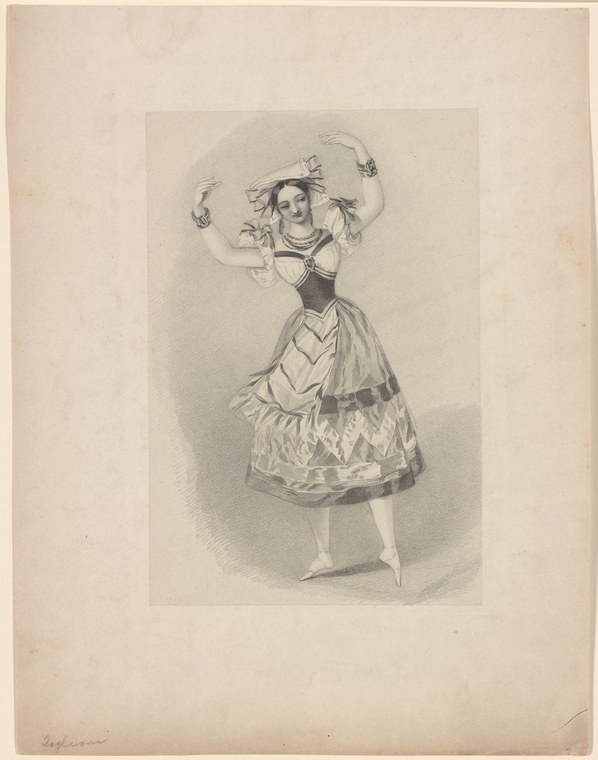
La napolitaine
Unknown artist
- Collection:
- Prints depicting dance
- Source:
- New York Public Library
- Rights:
- Public domain — free to use, share and adapt.
- Recorded as:
- Public Domain
This drawing preserves a moment of nineteenth-century performance practice that would otherwise be lost to time. It shows us not only how a Romantic-era dancer was costumed, but also the kind of pose and arm carriage that defined elegance in ballet during its most historically significant period. The care taken in rendering the drawing suggests the performer was notable enough to merit professional documentation, making this a trace of an individual artist whose name has been lost but whose movement remains visible in the record.
What you are looking at
A single female dancer in a three-quarter standing pose, drawn in graphite on paper with subtle tonal shading. She wears a mid-nineteenth-century performance costume: a fitted bodice with a decorative bow at the center front, and a voluminous skirt with horizontal bands of pattern or trim at the hem. Her arms are raised in a graceful, curved position above her head, with the forearms gently curved as if holding something light—possibly ribbons or scarves, which appear as delicate lines extending upward from her hands. Her posture is elegant and elongated, her body weight clearly on one leg in a pose suggesting suspension or a moment of flight. The figure is centered on the page against a neutral background, rendered with fine line work and careful modeling of light and shadow to suggest the form beneath the costume. The drawing style suggests this is a preliminary study or a finished presentation drawing, the kind used to document a dancer's costume and signature movements for theatrical records or artistic purposes.
The dancing
A single dancer in a standing position with marked asymmetry: one leg appears to support the body weight while the other is subtly extended or lifted, creating a sense of elevation. Both arms curve upward and outward from the sides of the body, meeting above the head in a graceful arc—a position suggesting either a classical port de bras or the stylized arm carriage of pantomime. The torso is upright and elongated, the neck extended upward. The overall frame is light and ethereal rather than grounded; this is a dancer depicted in a moment of apparent weightlessness or peak extension. The costume—bodice, bow, and gathered skirt with decorative bands—suggests theatrical training and a performer of some professional standing.
The dance depicted
The title *La napolitaine* (The Neapolitan Woman) and the costume point toward a character dance of the mid-nineteenth century, likely Romantic-era ballet. The graceful arm carriage, the lifted posture, and the emphasis on elegance over technical display align with the aesthetic of 1840s–1850s ballet. The pose might represent a moment of choreography from a pas or variation, frozen at an apex of movement. The dancer's evident training, the formal costume, and the careful documentation of her appearance and pose suggest this is a record of an actual performer in a known role—a practice common in theatrical circles of the period, where such drawings served as mementos and promotional records. Without inscription or signature visible, attribution and the dancer's identity remain uncertain, though the quality of execution suggests a professional artist working in the theater world.
How it was made
This is a graphite drawing on laid or wove paper, likely a finished study rather than a preliminary sketch, as evidenced by the careful tonal modeling, the refined line work, and the completeness of costume detail. The artist has used fine hatching and careful gradation to suggest form and volume, particularly in the drapery of the skirt and the modeling of the limbs. The medium allowed for the precise rendering of the costume's decorative elements and the subtlety of the dancer's pose. Such drawings were typical of theater documentation in the nineteenth century, circulated among dancers, impresarios, and ballet enthusiasts, and often preserved in albums or collections. This work comes from the New York Public Library's print collection, where it is catalogued among dance-related prints—suggesting it was acquired as part of a collecting tradition focused on theatrical and dance imagery.
About this work
This is a mid-nineteenth-century graphite study of a female dancer in Romantic-era theatrical costume, titled *La napolitaine*. The drawing depicts a single figure in an elegant, suspended pose, her arms raised and curved above her head in a graceful arc, her body weight lifted and refined. The costume—fitted bodice with a decorative bow and a gathered skirt with horizontal trim—places her squarely within the ballet tradition of the 1840s–1850s, and the pose itself appears to document a specific choreographic moment or signature movement. The work is a formal, finished drawing rather than a casual sketch, suggesting it served a documentary or commemorative purpose in theater circles, recording the appearance and movement of a performer in a known role. Such drawings are invaluable records of how dancers actually moved and dressed, and of the aesthetic values of Romantic ballet.
How to look at it
Attend to the pose itself: this is not a standing position but rather a moment of suspension, captured at the apex of a movement. The raised arms and the lifted body suggest either a jump at its peak or a held extension meant to convey effortlessness and grace. Notice how the artist has used the shape of the skirt—with its gathered folds and decorative bands—to complete the silhouette and to emphasize the verticality of the figure. The bow at the bodice and the careful rendering of the costume details tell us this is a formal stage dress, not a practice costume, and that the performer was someone of professional standing. The fineness of the line work and the subtle tonal transitions suggest this was a work made with care, possibly from life or from detailed observation of the dancer in performance.
The period
This drawing dates to the Romantic era of ballet, likely the 1840s–1850s, when the aesthetic ideals of weightlessness, grace, and otherworldly femininity dominated European and American theatrical dance. It was an era of rapid growth in professional ballet, the codification of pointe work, and the rise of the ballerina as a public celebrity. The character dance *La napolitaine* would have been a popular item in the repertory of major ballet companies, often danced as a divertissement or as part of a larger work. Drawings like this served multiple purposes: they documented the performer, they could be distributed as theatrical souvenirs, and they were collected by aficionados of the dance. The level of artistic finish and the theatrical subject matter indicate that this drawing was made by someone with access to dancers and studios, likely a practicing theater artist or a trained draftsperson employed in the ballet world.
Where it lives
The drawing is held by the New York Public Library as part of its print collection devoted to dance. It arrived as part of the institutional collecting tradition of the late nineteenth and twentieth centuries, when libraries and museums began systematically preserving dance-related imagery. The work is catalogued simply as *La napolitaine* with no artist attribution and no date; it bears a signature or mark in the lower left corner of the page, but this has not been conclusively identified.
Dance in this work
Questions about this work
What is a character dance and why was *La napolitaine* popular?
Character dances were theatrical pieces based on the folk traditions or national styles of a particular region—in this case, Naples and the southern Italian tradition. They were popular in Romantic-era ballet as lighter, more dramatically varied pieces, often performed as divertissements or entr'actes. The Neapolitan style was associated with earthy charm and vivacity, contrasting with the ethereal quality of the classical white-ballet pieces that dominated the era. Dancers built their reputations partly on their ability to embody different national characters.
How do we know this is a professional dancer and not a study figure?
The costume is clearly a finished theatrical dress, not a practice garment: the fitted bodice, the decorative bow, and the bands of trim on the skirt are all elements of formal stage wear. The pose is also polished and dramatic rather than functional—it is the kind of position meant to be seen and admired from a distance, not to convey a practical action. The care and finish of the drawing itself—the fine line work and the subtle tonal modeling—suggest the subject was someone worthy of professional documentation.
Why would a dancer commission or keep such a drawing?
Theatrical drawings served multiple purposes in the nineteenth century. They could be distributed as souvenirs to fans, used in theater playbills or programs, kept as records by dancers themselves of their roles and costumes, or collected by impresarios and choreographers as references for future productions. Such drawings were also highly valued by collectors of theatrical memorabilia, making them both practical tools and objects of affection within the dance world.
More dance artwork





