49 works in this view — arrow keys or swipe to move between them.
Dance in Art
Dance on music covers
Unknown artist
- Collection:
- Prints depicting dance
- Source:
- New York Public Library
- Rights:
- Public domain — free to use, share and adapt.
- Recorded as:
- Public Domain
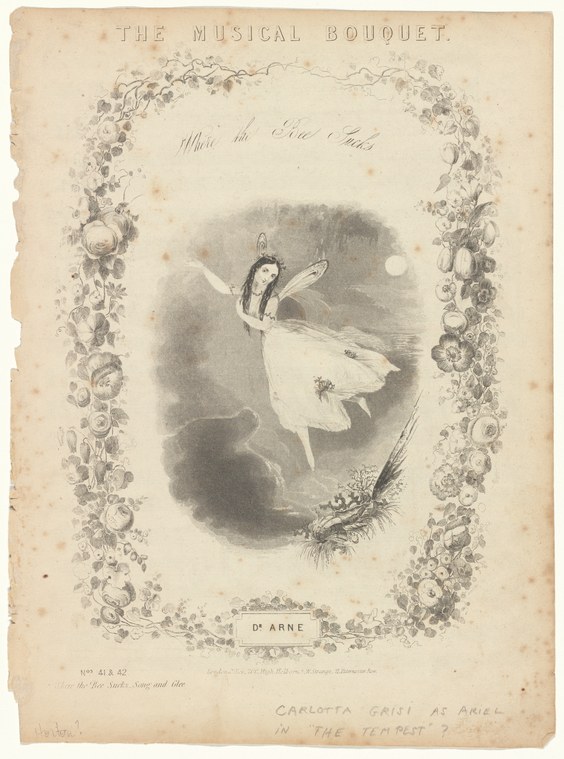
Grisi was a legendary dancer of her time, and this print preserves her image in a role that defined the Romantic ballet repertoire. For historians and dancers, it offers direct evidence of how leading performers of the 1840s were dressed, posed, and presented to the public—revealing the conventions of Romantic ballet aesthetics through a dancer who helped establish them.
What you are looking at
A ethereal female figure in white pointe shoes and a pale tutu hovers in the upper portion of the composition, her body angled in profile with one leg extended and arms raised in an attitude of weightlessness and grace. The dancer appears to be captured mid-leap or in an aerial moment, silhouetted against dark atmospheric shading that suggests either night sky or theatrical lighting. She floats above a rocky outcrop or natural formation, rendered in darker tones at the lower edge of the frame. The entire scene is enclosed within an ornate decorative border of flowers, leaves, and scrollwork in the manner of 19th-century theatrical prints, with 'THE MUSICAL BOUQUET' printed at the top and what appears to be credits or attribution at the bottom—this is clearly a cover from a sheet music or theatrical program publication.
The dancing
A single dancer in classical ballet posture: the body is in profile, one leg extended behind in a line suggesting a développé or attitude position, the arms rounded and raised. The pose emphasizes verticality and lift despite the apparent suspension in air. The dancer's frame is elongated and refined, the weight distributed as if defying gravity. The lightness of the rendering—fine outlines and pale tones—emphasizes the dancer's delicacy and ethereal quality characteristic of Romantic-era ballet idealization.
The dance depicted
This is Romantic ballet, almost certainly a depiction of a sylph or supernatural character—the aerial pose, the white tutu, and the ethereal rendering all point to works like La Sylphide (1832) or similar fairy-tale ballets of the mid-19th century. The notation 'CARLOTTA GRISI AS ARIEL IN THE TEMPEST' (handwritten at the base) identifies this as a portrait of the famous Italian dancer Carlotta Grisi performing Ariel, the spirit from Shakespeare's play, likely from an 1847 ballet adaptation. The pose captures the essence of how Romantic ballet dancers were meant to appear: weightless, otherworldly, inhabiting an imaginary realm rather than the ordinary stage.
How it was made
This is a lithographic print, evident from the tonal gradations, the soft edges, and the characteristic way the darker shading blends into lighter areas. The medium allowed for subtle atmospheric effects and the romantic diffusion of form that gives the dancer her ghostly quality. The ornamental border is printed as part of the same sheet, indicating this was a commercial theatrical publication—sheet music covers, theatrical programs, or souvenir prints of celebrated performances. The technique's versatility made such covers affordable and widely circulated among the theatre-going public and music consumers.
About this work
This is a mid-19th-century theatrical print depicting Carlotta Grisi, one of the era's most celebrated ballerinas, in a Romantic ballet role. The image represents the genre at its height: the supernatural subject, the ethereal white costume, the impossible grace of the pose, and the lithographic technique all work together to capture what audiences understood Romantic ballet to be—a glimpse into an imaginary realm where human dancers became spirits and sylphs. The work belongs in a dance gallery because it documents not just a moment of performance, but an entire aesthetic ideology: the way a specific era imagined the body could transcend its earthly nature through dance and theatrical artifice.
How to look at it
Notice the deliberate contradiction between the rocky, earthbound platform below and the dancer's weightless suspension above. The artist has chosen the moment of maximum lift—the instant before descent, the instant of transcendence. The ornamental border frames this impossible moment as something rare and precious, as if the dance itself deserves the decorative reverence normally reserved for religious or noble subjects. The pale, almost ghostly rendering of the figure against darker atmosphere is not accident but aesthetic choice—it makes the dancer seem to glow from within, reinforcing the Romantic ideal of the ethereal female body.
The artist
Not recorded. The work is attributed to 'D'Arne' at the bottom of the print, likely the lithographer or publisher's mark. The publication as part of 'The Musical Bouquet' series suggests this was a commercial print house operation in London or another major theatre city, producing affordable theatrical souvenirs.
The period
This belongs to the height of the Romantic ballet era (1830s–1850s), when European and American audiences were fascinated by ballets featuring supernatural and exotic characters. Carlotta Grisi (1819–1899) was one of the most technically accomplished and celebrated dancers of the period, known for her roles in La Sylphide and Giselle. The adaptation of Shakespeare's The Tempest into a ballet was part of a broader 19th-century trend of translating literary classics into dance—a way of merging the prestige of literature with the growing sophistication of ballet as an art form. Lithographic prints like this were the primary means of circulating images of famous performers before photography became widespread.
Where it lives
Held in the New York Public Library's collection of theatrical prints. This is a commercial theatrical souvenir print from The Musical Bouquet series, a 19th-century publication that issued affordable lithographic portraits and scenes from fashionable stage productions.
Dance in this work
Questions about this work
Was Carlotta Grisi really dancing on air like this?
No. This is an idealized artistic rendering, not a documentary image. However, Grisi was famous for her extraordinary elevation and the illusion of weightlessness that audiences remarked on. The print exaggerates this quality to create the supernatural effect appropriate to the role of Ariel. Romantic-era lithographers routinely rendered dancers more ethereal and impossible than stage reality, as part of the genre's aesthetic conventions.
What is The Musical Bouquet and why was this print published?
The Musical Bouquet was a series of inexpensive theatrical prints published in England in the mid-19th century. They featured portraits of celebrated performers from London stages, often in character costume. These were marketed to theatre-goers as souvenirs and to music-lovers who purchased piano arrangements or vocal scores of dances and arias—the print would appear on the cover of sheet music. They functioned as the era's equivalent of celebrity photographs or merchandise.
How do historians know this is Ariel and not another Grisi role?
The handwritten inscription at the base of the print identifies it: 'CARLOTTA GRISI AS ARIEL IN THE TEMPEST.' Historical records confirm that Grisi performed in a ballet version of The Tempest in London in 1847, choreographed by Jules Perrot. The inscription is contemporary evidence or near-contemporary annotation identifying both dancer and role.
More dance artwork





