49 works in this view — arrow keys or swipe to move between them.
Dance in Art
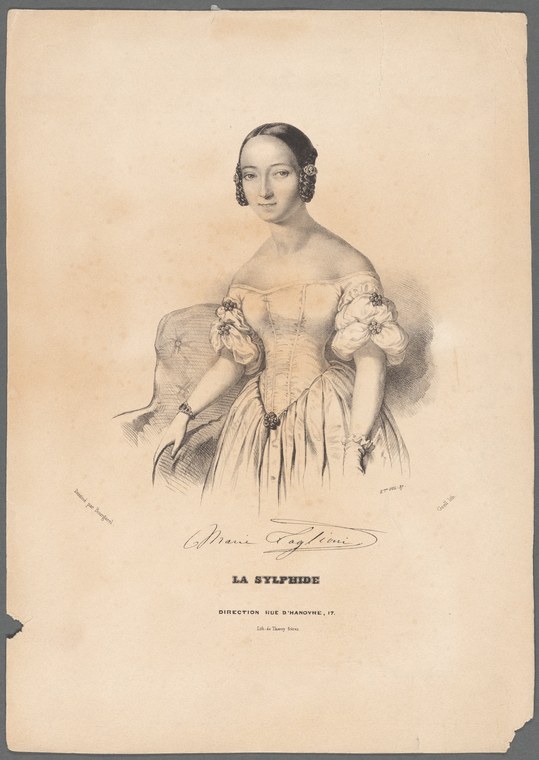
Marie Taglioni [facsimile signature], La sylphide
Unknown artist
- Collection:
- Prints depicting dance
- Source:
- New York Public Library
- Rights:
- Public domain — free to use, share and adapt.
- Recorded as:
- Public Domain
Taglioni was the first ballerina to rise to celebrity status through technical mastery and the box office, and *La Sylphide* was the role that secured her fame. This print documents both the dancer and the character that came to define Romantic ballet aesthetics—the pale, weightless tutu-wearing figure that became the visual archetype for the genre. For historians of dance, Taglioni's physique and carriage, visible here, provide rare evidence of the actual body and training of the most influential ballerina of her era.
What you are looking at
A three-quarter-length portrait of a woman in Romantic-era dress, shown from approximately the waist up against a plain background. She wears a pale, off-shoulder ball gown with puffed sleeves and fitted bodice, drawn with careful attention to fabric drape and gathering. Her dark hair is parted and smoothed close to the head in the fashion of the 1830s–1840s. The artist has captured her with a calm, direct gaze toward the viewer, her posture upright and composed. A facsimile signature reading "Marie Taglioni" appears below the image, along with the title "LA SYLPHIDE" and a publication note crediting "DIRECTION DUE D'ARNONE." The work is rendered as a lithographic print, with fine cross-hatching and tonal gradation creating volume in the face and figure against the cream paper.
The dancing
The sitter is shown frontally, shoulders slightly turned, with both arms positioned gracefully at her sides—one arm bent softly at the elbow, the other resting along her body. Her posture conveys the upright, aligned spine expected of a trained dancer, with no weight shift visible. The positioning suggests the formal stillness of a studio portrait rather than a moment caught mid-movement, though her frame implies the muscular control of a professional dancer. There is a single figure only, presented as an individual.
The dance depicted
This is a portrait of Marie Taglioni, the Swedish-Italian prima ballerina who created and starred in *La Sylphide* (1832), one of the foundational works of Romantic ballet. The title and signature confirm this is documentation of the dancer in her most famous role. Taglioni's costume here—the pale, ethereal off-shoulder gown with puffed short sleeves—is the iconic Romantic tutu of the Sylphide character itself. The image records not the dance as performed but the figure and costume that defined the role, presenting Taglioni as the embodiment of the character.
How it was made
This is a lithographic print, identifiable by the technique's characteristic fine crayon work and tonal gradation. Lithography allowed rapid, economical reproduction of performance documentation, and the publication note confirms commercial circulation ("Direction due d'Arnone" indicates a Parisian publisher). This print type was a standard vehicle for promoting prima ballerinas to a literate, middle-class audience in the 1830s–1840s; multiple examples of nearly identical compositions exist, suggesting this was a commercial portrait series rather than a unique artwork.
About this work
This lithographic print documents Marie Taglioni, the dominant figure of Romantic ballet, as the Sylphide—the ethereal sprite who gave her name to *La Sylphide* (1832). The print is a performance portrait: it records the dancer's face, figure, and costume in the role that defined her career and Romantic ballet itself. The work belongs to the archive of Romantic-era dance documentation, a period when lithography made it possible to distribute images of famous dancers to a broad paying public. Taglioni's composed, formal posture and the ethereal palette of her gown encapsulate the Romantic ideal of the ballerina as otherworldly spirit rather than merely accomplished technician.
How to look at it
Attend to Taglioni's costume: the short, full skirt, off-shoulder neckline, and puffed sleeves that became synonymous with Romantic ballet. Notice her posture—the lifted spine, squared shoulders, and elongated neck that signal her training and professional status. The print shows her at rest rather than in motion, but the formal, composed bearing gives insight into how Romantic-era dancers held themselves off-stage as well. The lithographic technique creates a softness and luminosity that reinforces the ethereal quality the Romantic ideal demanded of its prima ballerinas.
The artist
The artist is not recorded in the catalogue. The print bears only the publisher's mark (Direction due d'Arnone, a Parisian lithographic house). Taglioni portrait lithographs were produced by commercial print shops in Paris and London throughout her career; these were unsigned commercial products, not fine art prints, and attribution was not a priority. The print belongs to the category of theatrical documentation and promotional material rather than fine printmaking.
The period
The 1830s saw the emergence of Romantic ballet as the dominant form in European dance. *La Sylphide* (1832) marked the shift from the demi-caractère and narrative modes of Regency ballet toward the ethereal, supernatural, and emotionally heightened aesthetic that defined the genre for the century. The print dates from this moment, when lithography had made the reproduction and distribution of theatrical portraiture both feasible and profitable. Taglioni's dominance on stage coincided with the rise of the prima ballerina as celebrity and the visual culture that accompanied stardom—prints, engravings, and portraits circulated in the same way theatrical photographs would later.
Where it lives
This print is held in the New York Public Library's collection of prints depicting dance. The publication information (Direction due d'Arnone) indicates it is a commercial lithographic product from a Parisian print house, likely produced in the 1830s or shortly after the premiere of *La Sylphide*. The print is a standard item of theatrical ephemera—mass-produced, unsigned, and issued for public sale.
Dance in this work
Questions about this work
Was this printed during Taglioni's lifetime?
Almost certainly. Taglioni dominated the stage from the early 1830s through the 1850s, and Taglioni portraits were produced throughout her career and immediately after her retirement. The style and publication information are consistent with production in the 1830s–1840s, when she was at the height of her fame.
What is the Sylphide character?
*La Sylphide* tells the story of a Scottish mortal man who falls in love with a supernatural sylph (air spirit) and abandons his earthly bride. The Sylphide became the prototype for the Romantic supernatural heroine—weightless, ethereal, tragic. Taglioni's interpretation set the standard for the role.
Why does Taglioni look so serious?
This is a formal studio portrait, not a scene of active dancing. The composed, frontal pose and direct gaze were conventions of professional portraiture in the 1830s. The stillness also emphasizes her training and professional status—she is not a fashionable amateur but a disciplined technician.
Is this a lithograph?
Yes. The fine crayon work, tonal gradation, and printed notation are characteristic of lithographic printing, which allowed commercial mass production of theatrical portraits for sale to the public.
More dance artwork





