49 works in this view — arrow keys or swipe to move between them.
Dance in Art
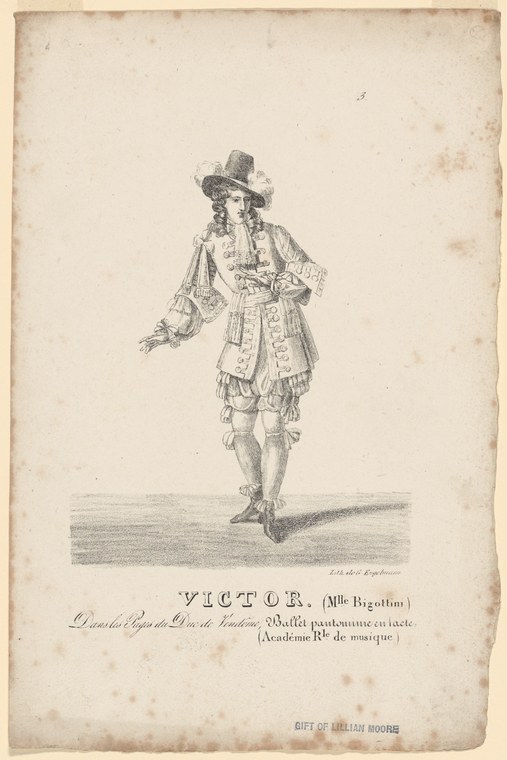
Victor (Mlle Bigottini) dans Les pages du duc de Vendôme, ballet pantomime en 1 acte
Unknown artist
- Collection:
- Prints depicting dance
- Source:
- New York Public Library
- Rights:
- Public domain — free to use, share and adapt.
- Recorded as:
- Public Domain
This is a named documentation of a specific performer in a specific role at a documented moment in the history of French theatrical dance. Mademoiselle Bigottini was a real dancer of note; this engraving records not just a costume but her embodiment of a character and role. For historians of early 18th-century French academic ballet, pantomime, and the evolution of theatrical male roles, this is primary evidence of how performers dressed, presented themselves, and were celebrated.
What you are looking at
A single male dancer stands at center stage against a plain background, posed in a moment of theatrical presentation. He wears the ornate costume of early 18th-century French court or stage dress: a richly decorated coat with deep pleats from the waist, ornamental buttons or fastenings down the front, and what appears to be lace or decorative cuffs at the wrists. His breeches are fitted and end above the knee; his legs are clad in stockings or hose, and he wears heeled shoes typical of the period. A wide-brimmed hat with feathering or plumage sits on his head. His posture is upright and deliberately composed, with weight balanced on both legs in a stance that suggests neither active movement nor repose, but rather the formal presentation of a costume and character. One arm hangs naturally while the other gestures outward in a courtly manner. The figure occupies a shallow stage space defined by a thin ground line; the background is entirely plain, focusing all attention on the costume and deportment. The engraving is executed in fine line work with careful cross-hatching to indicate form and fabric texture, and includes a French inscription below identifying the subject.
The dancing
A single figure in an upright, formally balanced stance with weight distributed evenly. The posture is presentational rather than dynamic—the body is neither in motion nor in repose, but rather composed for formal viewing. One arm drops to the side while the other extends outward in a restrained, courtly gesture. The head is lifted, facing forward. The overall frame suggests the formal presentation of character and costume rather than the execution of a specific dance step or movement; this is portraiture in dance dress.
The dance depicted
This is a portrait of a named dancer in a character costume from a theatrical ballet or pantomime. The title identifies the subject as Mademoiselle Bigottini performing the role of Victor in *Les pages du duc de Vendôme* (The Pages of the Duke of Vendôme), a ballet pantomime in one act. The costume—the brocaded coat, breeches, stockings, heeled shoes, and feathered hat—places this firmly in the early 18th-century aesthetic of court dance and stage ballet of the French academic tradition. The presentation is that of a costume study or character portrait rather than a action image, designed to document and celebrate the performer and role.
How it was made
This is an engraving, identifiable by the fine parallel lines and cross-hatching used to model form, texture, and shadow across the entire figure. The technique allows for precise rendering of fabric ornament and architectural detail in the costume. The relatively small scale and portable format suggest this was a reproductive print, likely circulated to document performances, actors, or roles—common practice in 18th-century theater publicity and archival records. The inscription in French below the image confirms its theatrical documentary function.
About this work
This is a costume portrait engraving of a professional dancer—Mademoiselle Bigottini—in the role of Victor from an early 18th-century French theatrical ballet pantomime. The image documents both the performer and the formal costume language of the period's academic stage dance, when male roles in ballet were often performed by men in elaborate court dress. The engraving format and presentation suggest it was created to circulate knowledge of the performance, the role, and the dancer's interpretation—a form of theatrical documentation and celebrity publicity that was standard practice in Paris during this era. The work sits at the intersection of dance history, theater history, costume history, and the history of reproductive print culture.
How to look at it
Observe the formality and stillness of the pose—this is not a frozen moment of action but a formal presentation of character and costume. Notice the precision with which the engraver has rendered the ornament of the coat, the texture of the stockings, the construction of the heeled shoe. The choice to show the figure frontally, upright, and in isolation against a plain ground is the convention of theatrical portraiture of the period—the focus is on documenting the performer and role, not on depicting a moment of narrative or dance action. The slight outward gesture of one arm suggests courtly bearing and aristocratic manner rather than a dance step.
The artist
The artist is not recorded in the catalogue. The style of the engraving—fine line work, careful cross-hatching, formal composition, French inscription—is consistent with professional theatrical documentation prints produced in Paris in the early 18th century, likely commissioned by theater management or the performer herself. Such prints were often produced by skilled reproductive engravers rather than known named artists.
The period
This work dates to the early 18th century, a period of rapid development and codification of French academic ballet following the establishment of the Académie Royale de Danse in 1661. By this time, ballet was increasingly theatrical and narrative-driven, moving away from pure court dances toward pantomime and dramatic roles. Male dancers wore elaborately decorated coats, breeches, and heeled shoes derived from court fashion but adapted for the stage. The role of the male dancer as a virtuoso performer and celebrated personality was becoming established; prints like this one served to publicize and immortalize both the dancer and her interpretations of specific roles.
Where it lives
This engraving is held in the New York Public Library's collection of prints depicting dance, where it is catalogued as a theatrical document. The inscription, printing technique, and formal presentation are consistent with prints produced in Paris in the early 18th century and likely circulated as theater publicity or documentation.
Dance in this work
Questions about this work
Who was Mademoiselle Bigottini?
Mademoiselle Bigottini was a professional dancer active in French theater in the early 18th century. This engraving documents her in the role of Victor in a theatrical ballet pantomime, suggesting she was notable enough to merit printed portraiture—a marker of professional status and celebrity in the period.
What was *Les pages du duc de Vendôme*?
The title indicates a theatrical ballet pantomime in one act on a theme drawn from the court and entourage of a historical or legendary duke. Details of the work itself are not documented in the available record, but its classification as a ballet pantomime places it in the theatrical dance genre that was dominant in Paris during this period.
Why is the figure dressed as a man?
In early 18th-century French theater, female dancers regularly performed male roles in breeches roles or characters, particularly in court and noble parts. The costume here—breeches, coat, and heeled shoes—marks the character as male or noble, and Bigottini as a performer of significant skill and status capable of taking such parts.
Is this a portrait or a dance image?
It functions as both. It is a portrait in that it documents and celebrates the performer, but it is a dance-specific portrait in that it shows her in costume and in a formally posed stance that evokes theatrical bearing and courtly manner. The boundary between portraiture and dance documentation was fluid in theatrical prints of this period.
More dance artwork





