49 works in this view — arrow keys or swipe to move between them.
Dance in Art
A. Bournonville
Unknown artist
- Collection:
- Prints depicting dance
- Source:
- New York Public Library
- Rights:
- Public domain — free to use, share and adapt.
- Recorded as:
- Public Domain
Bournonville's method remains the foundation of ballet training in Denmark and elsewhere, and his ballets are still performed by international companies. A portrait of him is a portrait of continuity—a visual record of the man whose decisions about how to train and present the body fundamentally altered the course of theatrical dance. For anyone studying 19th-century ballet, this image anchors a name to a face and a historical moment.
What you are looking at
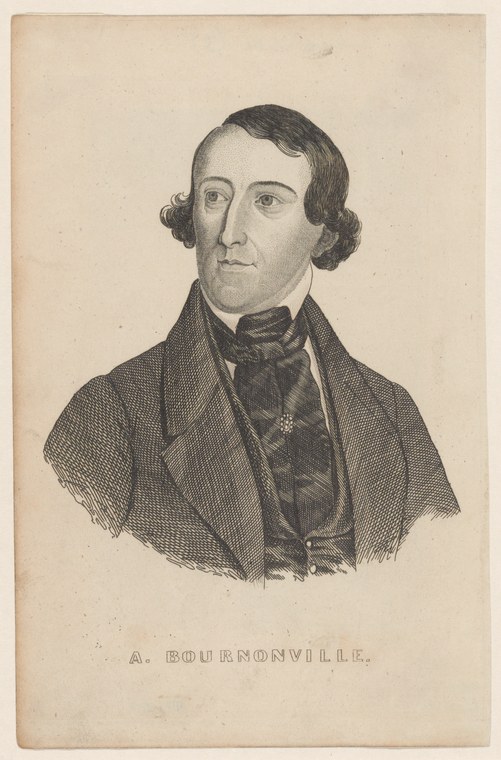
This is a portrait engraving of a man identified as A. Bournonville, rendered in the formal stipple-engraving technique characteristic of 19th-century theatrical portraiture. The subject is shown as a three-quarter bust against a plain background, dressed in the refined fashion of the mid-to-late 19th century: a dark jacket with a fine cross-hatched weave, a patterned waistcoat or cravat at the neck, and what appears to be a small decorative pin or medal. His hair is dark and carefully styled in the fashion of the period, parted and curled slightly at the ears. The face is rendered with considerable attention to detail—sharp cheekbones, direct gaze, and a composed, dignified expression. There is no action, no dance being performed; this is a record of a person's likeness, likely made for circulation among theatre-goers or in company archives.
The dancing
A single male figure, shown as a head-and-shoulders portrait. The posture is upright and formal, with shoulders squared and the body turned slightly to the viewer's left. The expression is thoughtful and austere, with no gesture or movement implied. The quality of the rendering—the careful modeling of the face, the precision of the costume details—suggests someone of professional standing and social rank.
The dance depicted
This is a portrait of Auguste Bournonville (1805–1879), the legendary Danish ballet master and choreographer, though the engraving does not depict him dancing or teaching. Bournonville was the director of the Royal Danish Ballet and the creator of the Bournonville Method, one of the most influential codified systems of classical ballet technique. He was a reformer who emphasized clean, precise footwork, a turned-out but controlled aesthetic, and an integration of pantomime with dance that became the foundation of Romantic ballet in Northern Europe. The portrait itself records his appearance during his period of greatest fame and influence, likely in the middle decades of the 19th century.
How it was made
This is a copper-plate engraving, executed in the stipple-and-line technique that was the standard for portrait reproduction in the 19th century. The artist is not recorded in the catalogue, though the quality and finish suggest a professional printmaker working for a publishing house or theatre management. The technique allowed for wide distribution of the image and positioned Bournonville within the visual culture of ballet itself—his portrait would have circulated among dancers, patrons, and theatre-goers as a marker of his celebrity and authority. Stipple engraving was labor-intensive but produced images of remarkable tonal subtlety, ideal for rendering the refined face and costume of a man of taste.
About this work
This is a formal engraved portrait of Auguste Bournonville, the 19th-century Danish ballet master and codifier of classical technique. The image records not a moment of dance but the professional identity of one of ballet's most consequential figures—a man who shaped how bodies moved on stage and how ballet was taught and understood. Bournonville's method remains in use today and his ballets are still performed, making this portrait a record of one of the art form's principal architects.
The work belongs in a dance gallery not because it depicts dance but because it documents a person whose impact on dance was permanent. For historians and practitioners of ballet, the face in this portrait is inseparable from the codified positions and steps they learn; for audiences, it represents the taste and vision that shaped the ballets they watch. This is a portrait of authority in dance.
How to look at it
Look at the precision of the engraver's hand in rendering the face—the careful attention to the contours of the cheekbones, the direct gaze, the composed mouth. This level of detail was expensive and time-consuming; it signals that Bournonville was considered worth that investment. Notice too the formality of the costume and the upright carriage: this is not a casual or intimate portrait but a public image, designed to project authority and taste. The unsigned name at the bottom is a label, not a signature—it tells you who this man is, as if presenting him to an audience that may not recognize his face but certainly knows his name.
The period
The Romantic era in ballet (c. 1830–1870) was the period of Bournonville's greatest creative authority. He was a contemporary of Marie Taglioni and other stars of the Romantic stage, but unlike many Romantic choreographers, Bournonville survived the era with his method intact and codified. His approach emphasized clarity, speed of footwork, and an ethereal but controlled aesthetic—quite different from the Italian Cecchetti tradition that would later dominate. The 19th century was also the era of mass-produced theatre portraiture: engravings like this one were distributed to audiences and collectors, creating a celebrity culture around dancers and choreographers. This portrait belongs to that visual economy.
The engraving technique itself was becoming obsolete by the late 19th century with the rise of photographic reproduction, so this image likely dates to the mid-century, when Bournonville was at the height of his power in Copenhagen. His influence on Scandinavian and Northern European ballet was immense and long-lasting, and this formal, dignified portrait captures the gravitas with which he was regarded by his contemporaries.
Where it lives
The work is held in the New York Public Library's collection of prints depicting dance. The catalogue record provides minimal information; the artist remains unidentified and the date is uncertain, though stylistic analysis suggests mid-to-late 19th century. This is one of many theatrical portraits circulated during the 19th century for sale to audiences and collectors.
Dance in this work
Questions about this work
Who was Auguste Bournonville?
Bournonville (1805–1879) was a Danish ballet master, choreographer, and teacher who led the Royal Danish Ballet for much of the 19th century. He created the Bournonville Method, a codified system of classical ballet training that emphasizes precise footwork, turnout, and the integration of pantomime with pure dance. His ballets and method remain influential today, particularly in Scandinavian ballet companies.
What is the Bournonville Method?
The Bournonville Method is a system of ballet training and choreography that prioritizes clean, fast footwork, controlled turnout, and a particular quality of movement that values clarity and precision. It differs from other major systems (like Cecchetti or Vaganova) in its emphasis on a lighter, more ethereal aesthetic and its integration of pantomime. It is still taught in ballet schools, especially in Denmark and other Northern European countries.
Why is this just a portrait and not a dance scene?
This is a celebrity portrait—a record of Bournonville's likeness for circulation to theatre-goers and collectors. In the 19th century, theatres sold engraved portraits of famous dancers, choreographers, and performers as merchandise. The purpose was to capitalize on the fame of the person depicted, not to document their performance. Bournonville's influence on dance is so immense that a portrait of him belongs in a dance collection even though it depicts no dancing.
How do I know this is an engraving and not something else?
The image shows the characteristic marks of copper-plate engraving: fine parallel lines (cross-hatching) to create tone and shadow, crisp detail in the face and costume, and the regular, almost textile-like quality of the stipple work on the jacket. Engravings like this were made by hand-incising lines into a copper plate, inking it, and printing it on paper. This technique was standard for theatrical portraiture before photography became widespread in the late 19th century.
More dance artwork





