49 works in this view — arrow keys or swipe to move between them.
Dance in Art
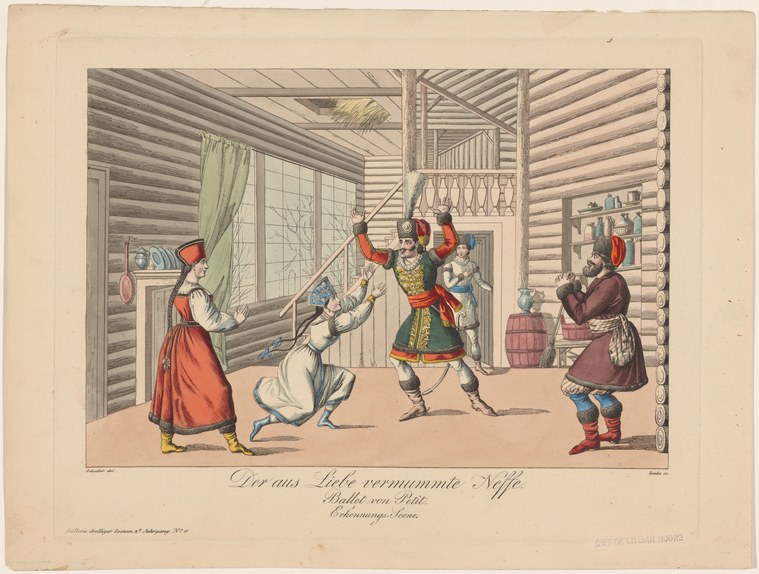
Der aus Liebe vermummte Neffe: Ballet von Petit, Erkennungs-Scene
Unknown artist
- Collection:
- Prints depicting dance
- Source:
- New York Public Library
- Rights:
- Public domain — free to use, share and adapt.
- Recorded as:
- Public Domain
This is a rare visual record of a specific 18th-century ballet performance, preserving not only the narrative content and moment chosen by the artist but also the precise details of costume, setting, and theatrical convention that would otherwise be lost. For historians of dance, it documents the centrality of pantomime and gesture to theatrical dance of the period, and the importance of narrative and spectacle over pure technical display. The engraving also demonstrates how theatrical productions were memorialized and circulated in print culture, reaching audiences beyond the theater itself.
What you are looking at
This hand-colored engraving depicts a scene from a theatrical ballet, likely an 18th-century court or professional production. The setting is a log cabin interior with horizontal wooden walls, a window with green curtains, and domestic furnishings including shelves, a barrel, and hanging garments. In the center of the floor, a male dancer in elaborate costume—red coat with yellow trim, stockings, and a tall red hat—gestures animatedly toward a kneeling female figure in a red dress and matching headdress. To the left, a woman in similar dress watches from the side; to the right, two more figures observe from the interior. The scene is brightly lit and the composition emphasizes the theatrical spectacle of the central male figure's exaggerated pose—arms raised and body twisted in a moment of apparent recognition or revelation. The title indicates this is a recognition scene (Erkennungs-Scene) from a ballet called "Der aus Liebe vermummte Neffe" (The Nephew Disguised for Love), and the setting and costumes suggest a pastoral or rustic theme common to 18th-century theatrical dance.
The dancing
The male dancer in the center commands the composition with a high, emphatic arm gesture and a twisted torso that conveys surprise or joy. His posture is upright but unstable—leaning slightly forward as if mid-pivot. The kneeling woman has assumed a pose of submission or supplication, her body angled toward him. The standing figures on either side are less active, positioned as witnesses. The arm positions and overall bodily tension reflect the conventions of 18th-century theatrical gesture: readable, exaggerated, and designed to communicate emotion to an audience at distance. The dance does not appear to involve a partnered hold in the classical sense; instead, the interaction is gestural and spatial.
The dance depicted
This is a scene from a theatrical ballet of the 18th century, almost certainly a pantomime ballet or ballet d'action rather than pure dance. The title "Der aus Liebe vermummte Neffe" suggests a narrative of disguise and recognition typical of the comic or pastoral ballets that were popular in German-speaking courts and theaters of that period. The "Erkennungs-Scene" (recognition scene) is a stock dramatic moment in which a disguised character is revealed. The dance vocabulary appears minimal; the scene is principally dramatic pantomime, with the central figure's raised arms and twisted torso conveying emotion and surprise rather than displaying technical virtuosity. This reflects the theatrical ballet convention of the era, in which dance and drama were interwoven and in which the emotional content of the narrative took precedence.
How it was made
This is a hand-colored engraving, a technique that allowed for precise line work and fine detail. The print would have been made from an engraved copper plate and then colored by hand—a labor-intensive process that increased production cost and limited circulation. The technique is well-suited to theatrical documentation, allowing a clear record of costume, setting, and composition while the hand-coloring adds liveliness and specificity to dress and lighting. The quality and detail of execution suggest this was a professional production intended for a cultivated audience, likely distributed as a memento of a specific performance or as promotional material for the ballet.
About this work
This engraving documents a moment from a theatrical ballet performed in the 18th century, most likely in a German-speaking court or city. It is a recognition scene—a moment of dramatic revelation in which a disguised character is discovered. The work belongs to the tradition of narrative ballet or ballet d'action, in which mime, gesture, and dramatic action were as important as steps and technique. The hand-colored engraving format suggests it was a professional production record, distributed to patrons and admirers. It sits at the intersection of theatrical design, dance history, and social documentation, offering a window into how narrative dance was staged, costumed, and circulated in the 18th century.
How to look at it
Attend first to the central male figure and his explosive gesture—the raised arms and twisted torso freeze a moment of emotional climax, typical of 18th-century theatrical ballet at the moment of recognition or revelation. Notice how the other figures are arranged as witnesses, their attention directed toward the central action. The setting—the log cabin interior—is equally important: it tells us this is a pastoral or rustic narrative, grounding the spectacle in a specific fictional world. The hand-coloring is not merely decorative; it emphasizes the theatrical lighting and the bright, warm tones of the costumes, which would have been visible from the audience's distance.
The period
This work dates to the 18th century, an era in which ballet was undergoing significant transformation. The rise of narrative ballet, pioneered by choreographers like Jean-Georges Noverre, had created a demand for dramatic action and emotional expression in dance. Pantomimic gesture became increasingly refined and codified. At the same time, the engraving and hand-coloring of theatrical scenes became a popular and profitable business, creating a visual record of important productions and allowing performances to be 'published' and enjoyed by those who had not attended. The German theaters and courts were active patrons of ballet during this period, and German-language titles suggest a significant local dance culture.
Where it lives
This work is held in the New York Public Library's collection of prints depicting dance. It is a hand-colored engraving and almost certainly served as a memento or documentation of a specific theatrical production.
Dance in this work
Questions about this work
What is a recognition scene in 18th-century ballet?
A recognition scene (Erkennungs-Scene in German) is a moment in narrative ballet when a disguised or hidden character is revealed. It is a stock dramatic device in comedies and pastoral tales, often marked by exaggerated gesture and emotional expression from the dancer. Such scenes were opportunities for performers to display their mastery of pantomime and to move audiences emotionally rather than to execute difficult steps.
How was this print made and colored?
This is a hand-colored engraving, made by incising a design into a copper plate with a burin tool, inking the plate, and printing it on paper. The outlines and details came from the engraving; the colors were applied by hand afterward, likely by skilled colorists who worked from a painted model. This process was expensive and slow, which means the work was likely made in limited numbers for a wealthy or institutional audience.
What was the theatrical context of this ballet?
This ballet is likely from the 18th-century German theater world, which was active in developing narrative ballet and pantomime. The German title and the log-cabin setting suggest a comic or pastoral story, possibly influenced by Italian commedia dell'arte traditions or German folk narrative. The ballet would have combined spoken dialogue, pantomime, and dance in a way that is quite different from the story ballets of the 19th century.
More dance artwork





