49 works in this view — arrow keys or swipe to move between them.
Dance in Art
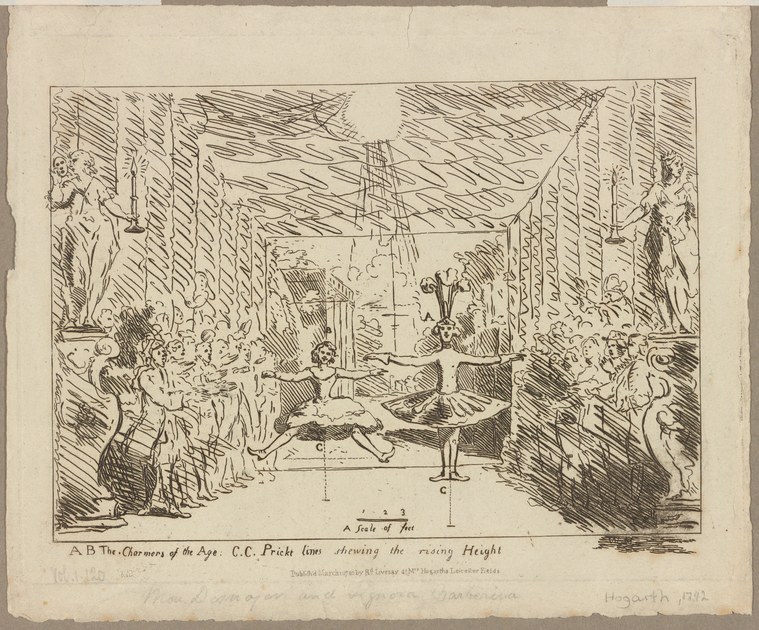
A B the charmers of the age
Unknown artist
- Collection:
- Prints depicting dance
- Source:
- New York Public Library
- Rights:
- Public domain — free to use, share and adapt.
- Recorded as:
- Public Domain
The image documents how trained dance was presented and witnessed in the court setting: as a formal spectacle before assembled spectators rather than as participatory social dancing. It shows the professional or semi-professional status dance had achieved by the early eighteenth century, and captures the architectural and social context in which dance was performed for elite audiences.
What you are looking at
A grand interior hall, ornately decorated with classical pilasters and a coffered ceiling, presents an eighteenth-century court entertainment. At center, a single figure in light drapery executes a dramatic pose with one leg extended and arms raised. Clustered figures line both sides—on the left a group of women in full skirts and men in period dress watch with animated attention; on the right, similarly dressed spectators occupy the space. The architectural setting emphasizes formality and ceremony: the perspective recedes sharply toward a distant aperture, and classical statuary in niches frames the scene. The engraver has rendered light flooding from above, creating deep shadows in the architectural recesses that contrast with the brightly lit central floor where the performer stands. This is evidently a demonstration or exhibition before a refined audience—the posture of the watching figures, their clustering without dancing themselves, and the solitary performer all suggest an act of display rather than social participation.
The dancing
The central figure strikes an emphatic fifth-position-like stance with elevated leg and extended arms in a classical port de bras, suggesting trained technique. The figure's body is upright, weight planted, the limbs arranged in deliberate elongation. The surrounding crowd is static and postural—no other dancers are visible in motion. The audience members cluster in groups, their postures indicate observation and commentary; some gesture toward the performer. This is a performance moment: trained technique on display for an assembled court.
The dance depicted
This depicts a court dance or choreographed exhibition of the baroque era, likely a moment from a dance spectacle rather than a social dance. The figure's pose—elevated leg, full extension, formal placement—is consistent with early eighteenth-century trained dancing, possibly a courante, minuet variation, or demonstration of posture. The caption 'A B the charmers of the age' suggests this is a named performer or entertainment. The singular focus on one dancer before assembled spectators indicates this is a professional or court performance rather than reciprocal social dancing. Without inscription identifying the specific dance, the gesture and setting point to baroque court dancing (historic-baroque) or a theatrical presentation.
How it was made
This is an engraving, executed in line with the characteristic hatching and parallel-line shading of eighteenth-century printmaking. The medium allowed sharp linear definition of the architectural detail and the figure's extended form, and the tonal depth created through dense cross-hatching in the background. Engravings of this type were produced as single sheets or bound into printed books documenting court entertainments and spectacles. This print's clean line and careful perspective suggest it was made for circulation among educated audiences—likely a record of a specific performance or dancer of note.
About this work
This engraving records a moment in a court dance spectacle of the early eighteenth century, probably from a documented entertainment. A single performer executes a formal pose of classical technique before an assembled audience in a great hall. The print is a type of documentary image—capturing not the dance itself but its presentation as a public event, frozen at a moment of display. It belongs to the visual archive of baroque and early Enlightenment court culture, where dance was a form of trained performance and courtly display.
How to look at it
The artist has frozen a single pose—a moment of maximum extension and clarity. Note how the architectural setting frames and emphasizes the figure: the point of the composition is to display the dancer's form against the geometric clarity of the classical hall. The surrounding spectators are rendered as an audience, not as fellow dancers; your eye is directed to the solitary performer. This is the convention of dance documentation: the printed record of a star turn or a named performer's specialty.
The artist
The artist is not recorded. The print's style, technique, and subject matter are consistent with early eighteenth-century German or English print production. The formal architectural engraving and the use of the medium to document court entertainments suggest training in the tradition of ornamental and narrative prints documenting aristocratic life.
The period
By the early eighteenth century, dance was firmly established as a courtly art form, with trained dancers and documented choreography. The image dates to the era of the minuet's dominance in court life and the rise of the professional dancing master. Baroque court culture placed enormous value on the display of refined deportment and trained movement. This print captures that moment when dance was shifting from pure social participation toward staged performance and demonstration.
Where it lives
The print is held in the New York Public Library's collection of prints depicting dance. It is catalogued without artist attribution or firm date, but the inscription and style place it firmly in the early eighteenth century. It is part of a historical archive of dance imagery used by dancers, historians, and students of court culture.
Dance in this work
Questions about this work
What dance is being performed?
The specific dance is not named in the caption beyond 'A B the charmers of the age,' which appears to reference a performer or entertainment series. The pose—extended leg, elevated arms, formal stance—is consistent with baroque court dances such as the minuet or courante, but the image alone does not specify which.
Is this a social dance or a performance?
This is clearly a performance or demonstration. The solitary dancer and the assembled, stationary spectators indicate this is a formal display before an audience, not reciprocal social dancing. The architectural grandeur and the positioning of the figure on an open floor emphasize its status as a spectacle.
How do we know this is an engraving?
The technique is visible in the linear hatching, parallel line work, and the tonal depth created through cross-hatching—hallmarks of engraved plates. The sharpness of the line, the precise architectural detail, and the shallow bite of the lines are consistent with copper-plate engraving rather than etching or other print methods.
What does the classical architecture tell us?
The ornate hall with pilasters, statuary, and coffered ceiling signals this is an aristocratic or royal court setting. Dance was a courtly art, performed in the grandest spaces before elite audiences. The architecture itself is part of the meaning: the dancer's body is framed as a refined object within a refined setting.
More dance artwork





