49 works in this view — arrow keys or swipe to move between them.
Dance in Art
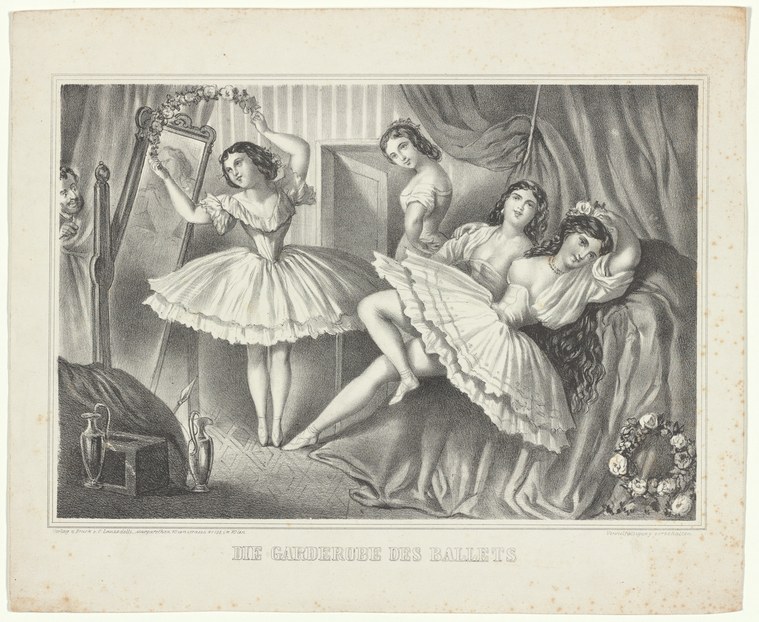
Die Garderobe des Ballets
Unknown artist
- Collection:
- Prints depicting dance
- Source:
- New York Public Library
- Rights:
- Public domain — free to use, share and adapt.
- Recorded as:
- Public Domain
Dancers and historians depend on images like this to understand not just what ballet looked like, but how it felt and what it demanded of the body. The engraving reveals the Romantic tutu as a practical and sometimes cumbersome garment, the pointe shoe as a tool requiring physical adjustment, and the dressing room as a space where hierarchy, intimacy, and labor intersected. It documents the often-invisible female labor that made male spectacle possible.
What you are looking at
This engraving depicts a richly furnished interior where ballet dancers prepare for performance. A standing dancer in the center adjusts her pointe shoes or stockings, wearing a voluminous tutu with multiple layers of tulle. To the right, a reclining dancer reclines on draped fabric, attended by two younger dancers or attendants who adjust her costume. The setting is theatrical and intimate: heavy curtains frame the scene, decorative flowers lie scattered on the floor, ornamental vessels and what appears to be a ballet shoe or slipper rest on a low surface to the left. The composition suggests a backstage moment—the controlled informality of the dressing room rather than performance itself. The engraver has lavished attention on textures: the crisp folds of tutus, the weight of draped velvet, the play of light across bare shoulders and arms.
The dancing
Five female figures occupy the composition. The central standing dancer is caught in an active moment, her body slightly twisted as she leans forward to tend her feet, suggesting practical preparation rather than formal pose. Her arms are raised and bent, engaged in the task at hand. The reclining figure to the right is supported by pillows and fabric, her body relaxed and elongated in a pose of ease; the two attendants bend toward her in gestures of service or adjustment, their bodies angled to the horizontal axis of her repose. A fifth figure appears partly visible at the left edge. The spatial relationships emphasize hierarchy and activity—the central dancer is self-directed; the others attend to comfort or adjustment.
The dance depicted
The image documents the ballet world of the mid-nineteenth century, specifically the social and physical reality of the dressing room rather than the stage itself. The title *Die Garderobe des Ballets* (The Wardrobe of the Ballet, or more likely *The Dressing Room of the Ballet*) indicates that the subject is the dancers' private space and costume ritual. The tutus visible here—particularly the voluminous construction and the pointe shoes—are consistent with Romantic ballet of the 1840s–1860s. The image captures the invisible labor of ballet: the binding of feet, the adjustment of costume, the physical strain concealed by performance. This is not a depiction of a dance step or style, but rather an ethnographic glimpse of how ballet dancers inhabited their bodies and spaces offstage.
How it was made
This is an engraving, executed with fine cross-hatching and careful attention to tonal gradation. The technique allows for precise rendering of fabric texture and interior detail while maintaining the crisp, reproducible quality that made engravings a primary medium for theatrical documentation in the nineteenth century. The uniform gray tones and the clarity of line suggest steel-plate engraving, which would have permitted multiple impressions for circulation. The work was likely produced for a broader audience—collectors, patrons, or dance enthusiasts—rather than as a unique artwork; engravings of theatrical subjects were popular as both documentation and entertainment.
About this work
This engraving captures a pivotal moment in the history of theatrical representation: the backstage world of professional ballet in the Romantic era. Rather than glorifying dancers in performance, the artist chose to represent them in the unheroic, necessary labor of preparation. The work belongs to a broader genre of theatrical documentation that emerged in the nineteenth century, when the machinery and reality of stage performance became a subject of fascination in its own right. The image is historically valuable because it shows ballet as lived experience—the costume, the body, the effort—rather than as pure spectacle.
How to look at it
Look first at the central standing figure: her posture is neither balletic nor posed, but caught in the practical act of adjusting her foot or shoe. This is the work that enabled the ethereal movements the audience saw onstage. Notice the density and weight of the tutus, rendered through careful engraving; these are not light, transparent garments but structures requiring support and adjustment. The reclining figure introduces a note of luxury or exhaustion—it is unclear which—that complicates any romantic reading of ballet as pure grace. The artist's choice to represent the dressing room rather than the stage is itself significant: it asserts that the dancer's reality, not the spectacle, is the true subject.
The period
The mid-nineteenth century saw a surge in theatrical imagery as both art and popular entertainment. The Romantic ballet era (1830s–1870s) produced a massive appetite for images of dancers—in performance, rehearsal, and private moments. This coincided with the rise of illustrated periodicals, popular prints, and collecting. The tutu and pointe work visible in this image are hallmarks of the Romantic period, when ballet became increasingly associated with ethereal, otherworldly femininity. At the same time, behind-the-scenes imagery offered a counternarrative: the recognition that performance required bodies, labor, and material reality. This image sits at that intersection.
Where it lives
The work is held in the New York Public Library's collection of prints depicting dance, a collection that documents performance through commercial and artistic prints from multiple periods and traditions. The title appears in German, suggesting either European origin or circulation, and the engraving technique and aesthetic indicate nineteenth-century manufacture.
Dance in this work
Questions about this work
Is this a real moment or an invention?
It is almost certainly a composite: an artist's synthesis of observed detail and theatrical convention, intended to evoke the dressing room while creating a balanced, visually interesting composition. The specific moment—the precise gesture of each dancer—is the artist's invention. But the details of costume, interior, and labor are drawn from reality. The engraving documents not a single event but the type of scene that occurred repeatedly.
Why are the dancers barefoot or in stockings in some parts of the image?
The image appears to show dancers at different stages of dressing. Some wear pointe shoes; others are in stockings or barefoot. This may reflect the sequence of dressing, or it may be the artist's way of showing the variety of the moment—not all dancers were ready simultaneously. It also allows the engraver to display the female body in a range of states, a convention of much nineteenth-century theatrical imagery.
What does 'Garderobe' mean exactly?
*Garderobe* can mean both 'wardrobe' (the collection of costumes) and 'dressing room' (the space where costumes are kept and worn). The title likely plays on this ambiguity, referring to both the costumes visible in the image and the space itself. It is a pun that works in German and French.
More dance artwork





