49 works in this view — arrow keys or swipe to move between them.
Dance in Art
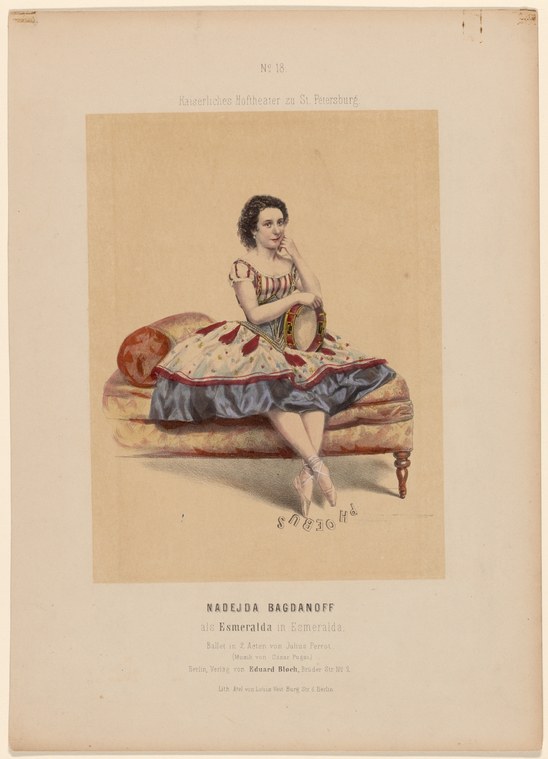
Nadejda Bagdanoff als Esmeralda in Esmeralda.: Ballet in 2 Acten von Julius Perrot (Musik von Cäsar Pugni)
Unknown artist
- Collection:
- Prints depicting dance
- Source:
- New York Public Library
- Rights:
- Public domain — free to use, share and adapt.
- Recorded as:
- Public Domain
This print documents how a specific, now-obscure dancer was presented to and remembered by her audience, and it shows the aesthetic values of Romantic ballet: grace, elongation, beauty, and a kind of dreaming introspection. For historians of dance and theater, it is evidence of the circulation of ballet celebrity and the ways images were used to sell performances and keep dancers in the public mind.
What you are looking at
A young woman in theatrical costume sits on a cushioned bench or daybed, her body twisted in a graceful contrapposto pose. She wears a sheer white chemise with puffed sleeves and a richly patterned skirt of deep blue and red fabrics—the skirt lifted and arranged to display its construction and the curve of her leg. Her dark curled hair is styled in the Romantic era fashion. The background is a warm ochre tone that throws her figure forward. The setting suggests a theatrical moment rather than a naturalistic interior: this is a costume study or a scene from a production, presented as a formal portrait of the dancer in character. The artist has rendered the fabrics with careful attention to texture and drape, and the overall composition is intimate and posed—not a captured moment of dance but a presentation of the performer at rest in costume.
The dancing
The dancer's torso is lifted and angled away from the viewer while her head turns back toward the camera, creating a serpentine curve through the spine—a pose that displays both grace and physical control. Her weight appears supported by her left arm and the bench beneath her. Her legs are crossed or draped, the right leg extended to show the costume. The pose is balletic in its elongation and in the articulation of the limbs, but it is stillness rather than a captured moment of movement. Her expression is introspective, gazing downward or away, which adds to the sense of a formal costume portrait.
The dance depicted
This is a costume study for a dancer in the role of Esmeralda, the central character in the Romantic ballet *Esmeralda* (choreography by Jules Perrot, 1847, to music by Adolphe Adam and Cesare Pugni). The inscription at the foot identifies the subject as Nadejda Bagdanoff in this role. Bagdanoff was a Russian ballerina who danced in European theaters during the mid-nineteenth century. The work documents not the dance itself but the costume, the dancer's theatrical presence, and the persona of a specific performer in a famous Romantic role. The pose—elongated, graceful, introspective—is characteristic of how dancers were presented in theatrical portraiture of the period: as objects of beauty and carriers of the character rather than as bodies in motion.
How it was made
This appears to be a hand-colored lithograph or possibly a color engraving, a common medium for theatrical celebrity portraiture of the nineteenth century. The technique allowed for rapid reproduction and wide circulation; these prints were sold to audiences and collected as souvenirs of famous performances and performers. The color has been applied by hand to capture the specific hues of the stage costume—the deep blue and red of the skirt, the pale muslin of the chemise, the warm tone of the skin. The lithographic line is precise but soft, suited to the rendering of fabrics and the gentle modeling of the figure.
About this work
This is a costume portrait of the Russian ballerina Nadejda Bagdanoff in the role of Esmeralda from Perrot's famous Romantic ballet. It dates from the mid-nineteenth century and was produced as a theatrical print for public sale—the kind of image that made dancers recognizable to theater-goers and that documented the visual spectacle of a famous role. It sits at the intersection of portraiture, theatrical documentation, and the culture of dancer celebrity that flourished in the Romantic era. The work shows how the ballet was consumed and remembered by audiences: not as choreography but as the image of a beautiful, graceful performer in an exotic or emotionally fraught role.
How to look at it
Look at how the artist has chosen to present the dancer: not mid-leap or mid-turn, but seated and introspective, the focus on the costume and the body's graceful elongation rather than on technical virtuosity. The twisted torso and turned head create a spiral line typical of Romantic choreography, suggesting an emotional or spiritual quality—a kind of reverie. The careful rendering of the fabrics, especially the blue and red skirt, tells us how important costume was to the visual impact of Romantic ballet. This is a work about looking at beauty and at the dancer as an object of aesthetic contemplation.
The artist
The artist is not identified in the catalogue record. The style and technique suggest a professional theatrical print maker working in the mid-nineteenth-century European theater industry, likely in Vienna (suggested by the German text at the head of the sheet) or another major opera center. Such prints were usually produced by firms that specialized in theater portraiture, often in collaboration with lithographic workshops.
The period
The Romantic ballet era (roughly 1830–1870) centered on the idealized female dancer and the fantastical or exotic scenarios in which she appeared. *Esmeralda*, first choreographed by Jules Perrot for the Italian dancer Carlotta Grisi in 1844 and set to music by Cesare Pugni, became one of the decade's most frequently performed ballets across Europe. The role of Esmeralda—a gypsy girl caught between virtue and temptation—was a star vehicle, and many dancers took it on. The cult of the ballerina during this period meant that dancers were celebrity performers whose images were as much a part of their fame as their dancing; prints like this one were essential to that circulation.
Where it lives
The work is held in the New York Public Library's collection of prints depicting dance. It is labeled as a print from the Kieselbach collection, and the archival reference visible at the head of the page suggests it was catalogued as part of a theatrical collection. It is the kind of ephemeral, commercial print that was produced in the hundreds and distributed to theaters and through print sellers.
Dance in this work
Questions about this work
Who was Nadejda Bagdanoff?
She was a Russian ballerina active in European theaters during the mid-nineteenth century. Little is widely documented about her career, but this print shows she was known enough to have her likeness circulated in a famous role. She would have trained in the Russian ballet tradition but performed for European audiences, a common path for dancers of the era.
Is this image of her dancing?
No—it is a costume portrait. She is posed seated, not moving. The work documents the visual costume and presence of the character of Esmeralda rather than capturing a moment of choreographed movement. Theatrical prints like this one were made to be sold as souvenirs and to keep the image of a famous dancer in the public mind.
What is the ballet Esmeralda?
It is a Romantic-era ballet first choreographed by Jules Perrot in 1844, with music by Cesare Pugni and Adolphe Adam. Based loosely on Victor Hugo's *The Hunchback of Notre-Dame*, it tells the story of the gypsy dancer Esmeralda and was a major star vehicle for ballerinas throughout the nineteenth century. It remains in the repertory of some classical ballet companies.
Why is the pose so twisted and graceful?
The artist is displaying the dancer's training and the aesthetic values of Romantic ballet: elongation, fluidity, and a kind of spiritual or emotional quality. The spiral line through the body—created by the twisted torso and turned head—became a signature of Romantic choreography and was a way of showing both beauty and emotional interiority.
More dance artwork





