49 works in this view — arrow keys or swipe to move between them.
Dance in Art
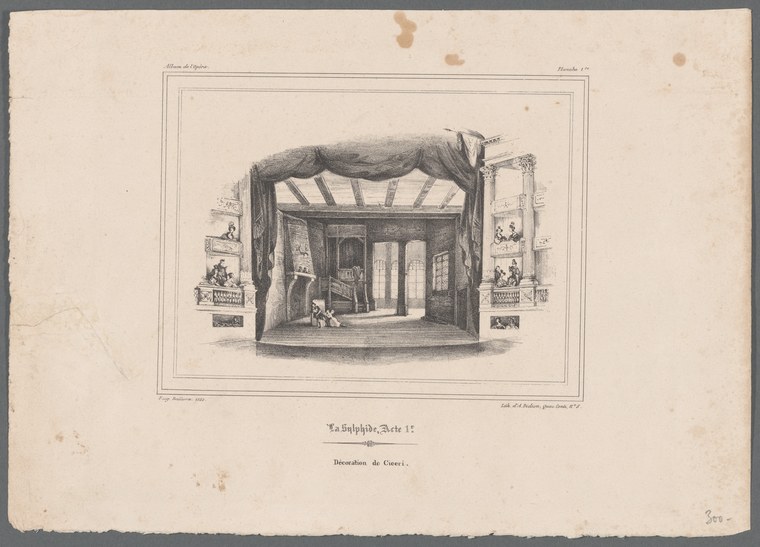
La sylphide, Acte 1r: décoration de Ciceri
Unknown artist
- Collection:
- Prints depicting dance
- Source:
- New York Public Library
- Rights:
- Public domain — free to use, share and adapt.
- Recorded as:
- Public Domain
This design is a primary document of how Romantic ballet staged the encounter between the human and the supernatural. Ciceri's architectural precision shows that the sylph's realm was rendered not through abstract or fantastical scenery but through an idealized, almost austere domestic space—a choice that shaped how ballet audiences understood otherworldliness for decades. For dance historians and designers, the image reveals the material and spatial conditions under which the ballet's most famous choreography was first performed.
What you are looking at
A stage design for Act 1 of *La Sylphide* shows an interior architectural space rendered in perspective, with a deep proscenium frame. The stage itself is a shallow domestic room with tall doors or windows at the center back, defined by classical columns and elegant moldings. A heavy draped swag hangs above the stage opening. The stage floor is bare and level. To either side of the main stage, smaller vignettes show additional scenes or character positions—suggesting this is a design study for multiple tableaux or positions within the act. The whole is executed in careful pencil with fine cross-hatching to create shadow and depth, typical of architectural stage design documentation.
The dancing
Small human figures are sketched within the main stage space and in the side vignettes, though they are quite reduced in scale. The central figures appear to be in standing or walking positions rather than in extended dance attitudes. The proportions and placement suggest documentary interest in how dancers would inhabit and move through the architectural space rather than in capturing a specific choreographic moment. The figures lack the dramatic extension or balletic articulation that would indicate a moment of technical virtuosity.
The dance depicted
*La Sylphide* premiered in Paris in 1832 and became the foundational work of Romantic ballet, establishing the supernatural sylph as a central figure in dance narrative. This design by Pierre-Luc-Christian Ciceri, the Opera's principal scenographer, shows Act 1's domestic Scottish setting—the room where the mortal hero James first encounters the mysterious sylph. The image documents the spatial and architectural framework for the action rather than a moment of dance itself, reflecting the 19th-century practice of creating distinct scenic environments for each act that were central to the romantic ballet's storytelling. The careful architectural rendering shows how the stage design itself became a character in the narrative.
How it was made
This is an engraving or lithograph, likely produced for publication as a souvenir or documentary record of the stage design. The image shows fine architectural line work with careful pencil shading to suggest volume and recession. The technique is consistent with printed stage design documentation of the 1830s, circulated to theatres, audiences, and archives to record the visual spectacle of major productions. Such prints were essential to the dissemination of ballet's visual language in an era before photography.
About this work
*La Sylphide* Act 1 Stage Design by Pierre-Luc-Christian Ciceri documents the architectural setting for one of ballet's most historically significant works. Ciceri was the pre-eminent scenographer of the Paris Opéra during the Romantic era, and his designs for *La Sylphide* became iconic—the elegant domestic interior established a visual language for supernatural encounters that influenced ballet design for generations. This design sheet records not a moment of dance but the stage environment itself as a narrative space, reflecting the 19th-century understanding of scenography as integral to theatrical meaning. The work sits at the intersection of architectural drawing, theatrical documentation, and the visual culture of Romantic ballet.
How to look at it
Observe the mathematical precision of the perspective—the vanishing point draws the eye deep into the stage space, suggesting both intimacy and mystery. Note how the architectural elements (columns, doors, the heavy swag) frame the stage as a formal interior while remaining almost bare of ornament or cluttered objects. The reduction of human figures allows the space itself to dominate, inviting the viewer to imagine how a dancer's movement would articulate the room. The side vignettes suggest Ciceri's process: studying how the design would work from different angles or for different moments in the action.
The artist
Pierre-Luc-Christian Ciceri (1782–1868) was the dominant stage designer at the Paris Opéra from the 1810s onward. He was trained in architecture and developed a distinctive style combining neoclassical precision with romantic atmosphere, achieved through careful perspective and lighting effects. He designed sets for the premieres of most of the great Romantic ballets—*La Sylphide*, *La Tarentule*, *Giselle*—and his work established the visual aesthetic of the era. His designs were widely circulated through engravings, making him influential far beyond Paris.
The period
Romantic ballet emerged in the 1830s as a reaction against the rigid formalism of classical ballet, embracing narrative, emotion, and the supernatural. *La Sylphide* (1832) crystallized this shift, introducing the ethereal ballerina in white tulle as an iconic image. The period saw intense investment in theatrical machinery, lighting, and scenography as tools for creating illusion and atmosphere. Simultaneously, the economics of opera-ballet required that successful designs be documented and disseminated through engravings so that provincial theatres and amateur dancers could stage or study the work. Ciceri's prints were central to this apparatus.
Where it lives
This print is held in the New York Public Library's collection of prints depicting dance. It appears to be a published engraving documenting the original 1832 production design, likely produced shortly after the premiere as a souvenir or archival record for the Opéra's collections and for circulation to other theatres.
Dance in this work
Questions about this work
Did dancers actually perform in this room, or is it a fantasy design?
The design is realistic in its architectural language—a plausible Scottish domestic interior of the period—but rendered with theatrical idealization. Ciceri created a space that felt both recognizable and elevated, avoiding both crude realism and pure abstraction. Dancers did perform in physical constructions based on this design, so it represents a real stage environment, not a purely imaginary one.
Why is the actual choreography not shown—why just the empty stage?
Stage design documentation of this era typically separated the architecture from the performers. Ciceri's job was to provide the spatial framework; the choreographer and dancers would animate it. Publishing the design without figures also made it more reusable—other casts and companies could adapt it. The architectural drawing was the permanent record; the dancing was ephemeral.
How does this compare to modern ballet set design?
Ciceri's approach—architectural precision, clear perspective, minimal clutter—reflects 19th-century ideals of beauty and illusion. Modern design often prioritizes abstraction, symbolism, or technological spectacle. Yet Ciceri's principle remains influential: the set should clarify the emotional and spatial world of the ballet without overwhelming the dancers' bodies.
More dance artwork





