49 works in this view — arrow keys or swipe to move between them.
Dance in Art
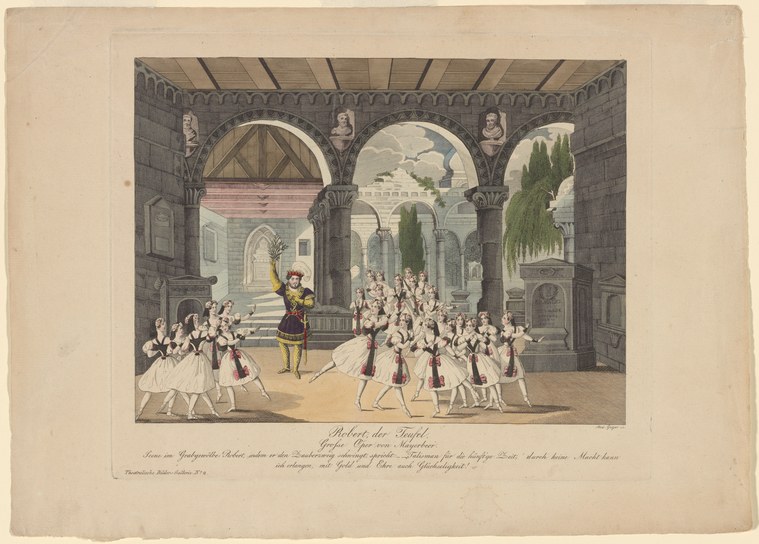
Robert der Teufel: grosse Oper von Meyerbeer
Unknown artist
- Collection:
- Prints depicting dance
- Source:
- New York Public Library
- Rights:
- Public domain — free to use, share and adapt.
- Recorded as:
- Public Domain
Robert the Devil was the gateway work of French Romantic opera and one of the most influential dance spectacles of the 19th century—its success triggered a wave of imitation and established the ballet divertissement in opera as a standard feature. This engraving is one of the few surviving visual documents of how the famous ghostly nun ballet actually looked, making it invaluable for understanding both the choreography and the theatrical aesthetic of the Romantic era.
What you are looking at
A grand theatrical interior with classical architecture frames a formal dance scene. Three large round arches supported by columns dominate the composition, their stone surfaces rendered in careful perspective. Through these arches we see a distant landscape with cypress trees and classical buildings, suggesting an Italian Renaissance setting. In the foreground, a soloist in red doublet and hose stands center-stage, one arm raised in a graceful gesture. Around this figure, arranged in a loose semi-circle, are approximately twenty dancers in white tulle skirts and fitted bodices, their bodies arranged in a corps de ballet formation. The women hold their arms in classical positions, some extended, some at the sides. The lighting is even and theatrical, with no strong shadows, typical of stage lighting design. The entire scene is rendered in hand-colored engraving with soft washes of color—grays for the architecture, flesh tones for the figures, pale blues for the sky.
The dancing
The dancers' bodies are posed in balletic positions characteristic of the Romantic era: turned-out legs, upright spines, arms held in classical port de bras. The female dancers wear pointe shoes (visible as pale extended feet) and appear to be en pointe or demi-pointe. The soloist in the center commands attention through his contrasting red costume and more dynamic pose—his raised arm and forward-inclined torso suggest agency and performance. The corps members are arranged symmetrically, creating a frame around the soloist, with their bodies oriented toward him. Skirts are mid-calf length, a convention of the period, and the women's posture is uniformly elongated and ethereal.
The dance depicted
This is almost certainly a scene from Giacomo Meyerbeer's opera *Robert le Diable* (Robert the Devil), first performed in 1831 in Paris. The image depicts a famous act featuring a spectral ballet of nuns—a theatrical showstopper that became a signature moment of early Romantic opera. The red-costumed male figure is likely Robert, the protagonist, surrounded by the ghostly dancing nuns. The style and composition are typical of Romantic ballet as it appeared in opera: corps members in identical formations, a soloist as the dramatic focus, and the ethereal, otherworldly quality conveyed through pale costumes and formal pose. This was one of the most celebrated dance scenes in early 19th-century theater.
How it was made
This is a hand-colored engraving or aquatint, a reproductive print technique that allowed theatrical scenes to reach a wide audience. The fine lines of the architectural detail and the careful modeling of the figures through line work indicate engraving; the soft color washes suggest hand coloring applied after printing. This technique was the standard way to document and circulate images of celebrated stage productions in the early 19th century, making them accessible to those who had not seen the performance and providing a record for those who had. The quality of the execution suggests this was made for a prosperous audience—likely prints of a famous production intended for collectors of theater imagery.
About this work
This is a theatrical scene engraving documenting a performance moment from Meyerbeer's *Robert le Diable*, one of the most influential operas of the 1830s. It captures the famous ballet of the nuns, a sequence that astonished audiences and became a defining image of Romantic-era dance spectacle. The print preserves not only the choreography and staging of a lost performance tradition—the work of dancers whose names are largely forgotten—but also the aesthetic values of the era: symmetry, ethereal grace, the corps de ballet as a collective visual form, and the subordination of female dancers' individuality to a harmonious ensemble effect. For dance historians, it is both a primary source for understanding how Romantic ballet actually appeared on stage and a window into how theatrical dance was circulated, celebrated, and remembered in print culture.
How to look at it
The composition is carefully staged to present the dance as a formal, symmetrical spectacle. Notice how the three great arches create a sense of receding architectural space, emphasizing the theater's grandeur and the dancers' smallness within it. The soloist's crimson costume breaks the monotony of white, commanding visual attention while the pale corps members create an ethereal, almost ghostly effect. The dancers' poses are held and formal rather than caught mid-movement—they are frozen in classical positions, which was the engraver's convention for showing balletic grace. The artist has chosen a moment of static, composed beauty rather than kinetic energy, which tells us something important about what Romantic-era audiences valued in dance: not virtuosity or speed, but refinement, symmetry, and an otherworldly quality.
The artist
The engraver is not identified in the catalogue record. However, prints of this scale and quality from major theatrical productions of the 1830s were typically produced by established print houses in Paris, such as those working for the Opéra. The maker was likely a professional theatrical documentarian working in the reproductive print tradition, creating images for the print market rather than a named artist working in the fine arts tradition.
The period
This image dates from the early Romantic movement in opera and ballet, roughly 1830–1850, when supernatural and medieval subjects, ethereal femininity, and spectacular staging transformed European theater. Meyerbeer's *Robert le Diable* (1831) was a turning point: it synthesized elements of Gothic drama, Italian opera, French grand opéra conventions, and cutting-edge choreography. The ballet of the nuns, created by choreographer Filippo Taglioni (father of the famous ballerina Maria Taglioni), astonished audiences and made dance an integral part of operatic narrative rather than a mere diversion. This was also the era when lithography and color engraving allowed theatrical imagery to be mass-produced and circulated as popular prints, creating a visual culture around performance. The Romantic aesthetic—a preference for lightness, verticality, pale fabrics, and androgynous grace—is evident in every figure here.
Where it lives
The print is held in the New York Public Library's collection of prints depicting dance. It is identified by title as relating to Meyerbeer's *Robert le Diable* but lacks a recorded artist, date of publication, or engraver's name. Such prints were typically produced in Paris in the years immediately following a celebrated premiere, likely within five years of 1831.
Dance in this work
Questions about this work
Who were the dancers in this scene?
The cast changed over time as the opera was performed across Europe. The choreography was created by Filippo Taglioni. The role of Robert was famously sung by Adolphe Nourrit. Female dancers in this scene would have been members of the corps de ballet of the Opéra in Paris or other major opera houses. Individual dancers' names were rarely recorded in prints of this era.
What is happening in this scene?
This depicts Act III of *Robert le Diable*, in which Robert is led by a mysterious woman to a supernatural graveyard where the ghosts of sinful nuns rise from their tombs to seduce him into damnation. The scene was famous for its spectacle: the nuns' ballet was both eerie and seductive, and the staging created an illusion of ghosts rising and dancing in an uncanny space.
Why was this opera so important to dance history?
*Robert le Diable* proved that ballet could be integrated into opera as a vehicle for storytelling and spectacle rather than mere entertainment. The success of the nun ballet inspired a flood of similar scenes in other operas, making the choreographed divertissement a standard feature of grand opéra throughout the 19th century.
How would dancers have learned these steps?
The choreography would have been taught by repetition and demonstration by the ballet master or his assistants. There was no standardized notation system in common use at this time, so the choreography survived only through the bodies of dancers who had learned it and passed it on. Prints like this one, while beautiful, are not precise enough to reconstruct the actual steps.
More dance artwork





