49 works in this view — arrow keys or swipe to move between them.
Dance in Art
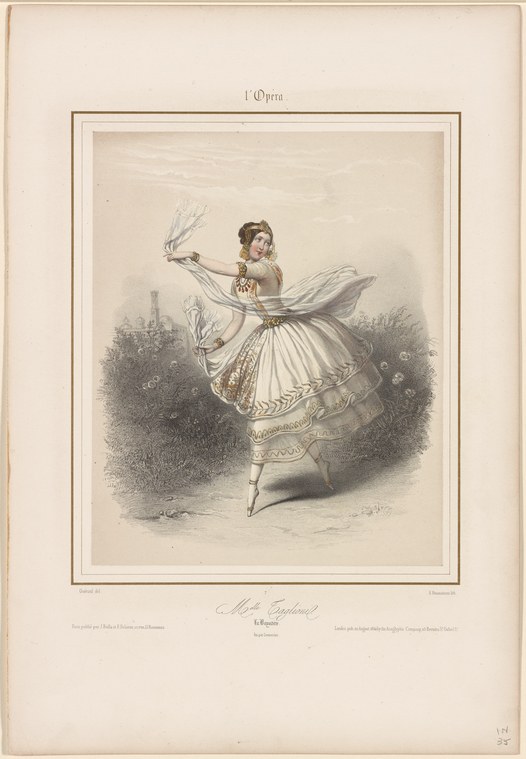
L'Opéra. Melle Taglioni. La bayadère
Unknown artist
- Collection:
- Prints depicting dance
- Source:
- New York Public Library
- Rights:
- Public domain — free to use, share and adapt.
- Recorded as:
- Public Domain
This print is material evidence of Romantic ballet as a popular, reproducible commodity and of a particular moment when theater stars began to be marketed and circulated as celebrity images. It also preserves a record of how the role and the dancer's body were visually codified—what pose, dress, and gesture would be instantly legible to an audience as *this* role in this ballet. For historians of dance notation, costume, and the emergence of dance as spectacle, these prints are primary documents.
What you are looking at
A solo female dancer in a pale muslin dress stands center stage against a lightly shaded background suggesting theatrical depth. Her pose is one of arrested motion: the body lifts vertically on pointe, left leg extended behind in a high arabesque, right arm curved overhead holding what appears to be a feathered fan or plume of flowers, left arm extended outward. The dress, rendered in careful detail, is a long tulle skirt with layered hem and fitted bodice ornamented with gold or metallic trim and what may be jeweled ornament at the waist. Her upward gaze and the lift of her torso convey both grace and a certain languid exoticism. The setting is minimal: a suggestion of landscape or architectural forms fades into shadow behind her, with no props or other figures to distract from the solitary, elegantly posed body.
The dancing
The dancer occupies the vertical center of the composition in a controlled, balletic pose. The weight is held on the supporting leg en pointe, with the extended leg raised high behind—a classical arabesque—demonstrating turnout and control. The upper body remains erect and lifted; the arm positions are open and extended, the overhead arm curved in a graceful port de bras. The head is tilted upward, maintaining the line. This is not a naturalistic gesture but a held moment of formal elegance, characteristic of trained classical technique.
The dance depicted
This is recognizably Romantic-era ballet, almost certainly a representation of a celebrated role. The catalogue title attributes this to Mlle Taglioni and "La bayadère," but the evidence requires care. Taglioni was famous for her roles in Romantic ballet, particularly *La Sylphide* (1832). The bayadère—a temple dancer—appears in several works of the period, notably in *La Bayadère*, the Petipa ballet premiered in St. Petersburg in 1877. However, the style and delicacy of the lithograph, the hand-colored technique, and the title *L'Opéra* (The Opera) suggest this may be from a series of operatic or theatrical celebrity prints. If this is Taglioni, it dates to her active years (1822–1847); if it represents another dancer in the role, the date of creation could vary significantly. The image shows what was prized in 1830s–1840s ballet: verticality, ethereal lightness, the pointe shoe as emblem of classical training, and a costume that blends Europe and an exotic fantasy Orient.
How it was made
This is a hand-colored lithograph, recognizable by the fine linear work and subtle tonal gradations characteristic of the medium. The artist has used stippling and light shading to suggest form and space without heavy modeling. The delicate color application—pale flesh tones, the cream and white of the dress, the subtle grays of the background, touches of gold and rose—is typical of theatrical prints produced in France during the 1830s–1850s for a middle-class market of theater-goers and art collectors. The precision of the linear work and the quality of hand-coloring suggest a professional Paris or London printshop of some standing, probably production in multiple impressions for serial or album distribution.
About this work
This is a theatrical celebrity print documenting a moment in Romantic ballet, one of hundreds such images that circulated in Europe during the early 19th century. The print celebrates a star dancer—named here as Mlle Taglioni—captured in a moment of the dance that was instantly recognizable to its audience: the pose, the dress, the setting all encode both the specific role and the broader aesthetic of Romantic ballet. These prints functioned as a form of mass media, recording and advertising the great dancers and roles of the day. The image is both a document of what Romantic ballet looked like and an artifact of how that ballet was consumed, circulated, and remembered by the public.
How to look at it
Look at the moment the artist has frozen: the dancer is mid-movement but held in a pose of perfect control and balance. She is not jumping or turning but extended vertically, the body arranged to display technical mastery and graceful line. The arabesque pose—one of the fundamental positions of classical ballet—is instantly recognizable. The printed detail in the costume and the precision of the linear work show that this is a professional production meant for people who knew ballet and wanted a legible, beautiful image of a celebrated moment. The hand-coloring adds value and presence that a black-and-white print would lack.
The artist
The artist is not recorded in the catalogue. However, the style, technique, and title format are consistent with French theatrical print production of the 1830s–1850s, a period when lithography and hand-colored prints were the dominant means of circulating images of performers. Such prints were often produced by commercial printshops or specialty publishers in Paris, working from sketches or memory, often by artists who were not themselves famous. The prints frequently bear the names of singers, dancers, or celebrated roles but not always the printmaker's name.
The period
The Romantic era in ballet (roughly 1830–1870) was marked by a fascination with the otherworldly, the exotic, and the feminine ideal. Marie Taglioni's 1832 debut in *La Sylphide* revolutionized the use of the pointe shoe and the aesthetics of weightlessness and verticality that define the image here. Lithography, perfected in the 1820s, made possible the rapid production of colored theatrical prints, and a commercial market emerged for images of celebrated performers—opera singers, actors, dancers. These prints were collected, exchanged, and preserved by the theater-going public. Dancers themselves became celebrities in a modern sense: their likenesses were reproduced and circulated, their roles were iconic. The image of the ballerina in an arabesque on pointe, in an ethereal tutu, became the visual shorthand for ballet itself.
Where it lives
The print is catalogued in the New York Public Library's collection of prints depicting dance, a significant and widely accessible holding of theatrical and dance imagery from the 19th and early 20th centuries. It is one of many such prints and bears the archival markings typical of library holdings.
Dance in this work
Questions about this work
Who was Mlle Taglioni?
Marie Taglioni (1804–1884) was a Swedish-born ballerina who became the most celebrated dancer of the Romantic era. She revolutionized ballet by perfecting technique en pointe and embodying the ethereal, weightless ideal that defined early 19th-century taste. Her role as the Sylph in *La Sylphide* (1832) became iconic, and her image was widely reproduced in prints like this one.
What is a bayadère?
A bayadère is a temple dancer, usually depicted in European Romantic ballet as an exotic, sensuous figure from India or Egypt. The role appealed to Romantic-era taste for the foreign and the erotic. Several ballets featured bayadère roles; the most famous is Petipa's full-length *La Bayadère* (1877), though earlier works also included the character.
Why do these prints matter?
These prints are rare documents of how 19th-century ballet looked and how it was understood by its audience. They record specific roles, costumes, and poses; they show us what dancers valued in their own technique; and they reveal the circulation of dance as a visual commodity before photography. They are primary documents for costume history, dance history, and the history of celebrity.
How was this print made?
This is a hand-colored lithograph. An image was drawn or transferred onto a lithographic stone, then printed in black or sepia. Each print was then colored by hand, usually by teams of specialists. This allowed for multiple copies but meant each print varied slightly. The technique was fast enough and cheap enough to support a mass market for theatrical prints.
More dance artwork





