49 works in this view — arrow keys or swipe to move between them.
Dance in Art
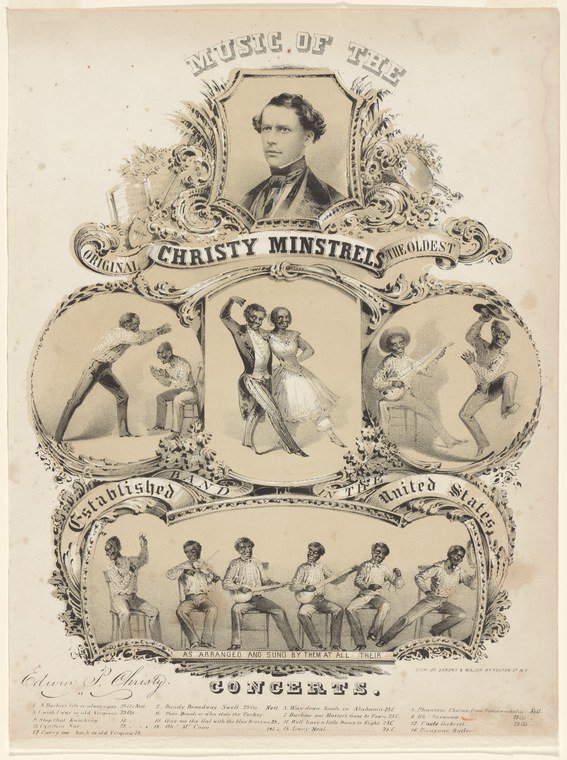
Music of the original Christy Minstrels
Unknown artist
- Collection:
- Prints depicting dance
- Source:
- New York Public Library
- Rights:
- Public domain — free to use, share and adapt.
- Recorded as:
- Public Domain
Minstrelsy shaped American popular dance and theatrical movement for generations, and this image is evidence of how that influence was marketed and sold. For historians of American performance, race, and entertainment, the image is vital: it shows the physical vocabulary of minstrelsy, the troupe structure, and the commercial apparatus that made blackface performance the most widespread theatrical form of its era. Understanding minstrelsy—its forms, its appeal, and its legacy—is essential to understanding American dance history.
What you are looking at
This is a decorative promotional print for the Original Christy Minstrels, a blackface minstrel troupe. The composition is organized as an ornate frame with a portrait of a white man (presumably E.P. Christy, the group's founder) at the top center, surrounded by elaborate scrollwork and flourishes. Below the portrait are three oval vignettes showing performers in blackface engaged in various entertainments: on the left, two figures in a comedic pose beside a stool; in the center, two figures in apparent physical comedy or dance interaction; on the right, two more figures in dynamic poses. The largest section at the bottom depicts six seated figures in blackface, arranged in a row, each holding instruments (banjos, tambourines, bones) typical of a minstrel band. The entire composition is framed by ornamental borders, scrolls, and decorative text panels. The style is that of a mid-19th-century wood-engraved or lithographed advertisement, printed in black ink on cream paper, showing signs of age.
The dancing
The figures throughout are rendered in exaggerated poses typical of minstrelsy performance. In the vignettes, bodies are contorted into acrobatic and comedic positions—limbs extended, spines arched, suggesting physical flexibility and practiced performance. The central oval shows what appears to be a dramatic lift or partner interaction. The seated musicians in the lower panel sit upright in formal arrangement, arms positioned to play their instruments, creating a line of performers awaiting their turn. All figures are depicted with the racist blackface makeup characteristic of the period. The poses emphasize spectacle and physical comedy over any coherent ballroom or concert-hall dance form.
The dance depicted
Minstrelsy was not a single dance form but a theatrical entertainment combining music, comedy, acrobatics, and vernacular movement drawn from African American culture (and performed by white men in blackface for white audiences). The image documents what would have been presented as 'Ethiopian' entertainment—a catch-all term for popular performance supposedly mimicking Black life. The vignettes suggest the variety act structure: individual performers executing physical feats, slapstick routines, and acrobatic tricks rather than choreographed group dances. The seated band at bottom represents the core musical ensemble. This was entertainment for popular audiences, touring widely and carrying enormous cultural weight; the prominence of this promotional image attests to the troupe's commercial success and the appetite for minstrelsy in mid-19th-century America.
How it was made
The print is a wood engraving or steel engraving, a mass-production technique using a finely engraved metal plate to create sharp, detailed impressions across many printings. The decorative borders, the consistent line weight, the ability to render fine detail in the facial features and clothing, and the regular dots used for shading are all characteristic of mid-19th-century engraving. This medium allowed rapid, affordable reproduction for theatrical advertising—thousands of these could be printed, distributed, and pasted as bills or broadsides. The elaborate ornamental frame and the theatrical typography (the text identifying this as a 'concert' and showing song titles in the lower margin) indicate this was a promotional tool designed to be visually arresting and to tour with or precede the troupe.
About this work
This is a mid-19th-century minstrelsy promotional broadside documenting the Original Christy Minstrels, one of the most successful blackface minstrel troupes in American history. The print captures the variety-show structure of minstrelsy—a combination of seated musical performance, acrobatic physical feats, and comedic routines—all executed by white men in blackface makeup. The engraving technique allowed mass production, and the elaborate ornamental frame testifies to the commercial ambition and popular appeal of the form. Minstrelsy was the dominant form of American theatrical entertainment in the mid-19th century, and this image is a primary document of how these performances were marketed and what audiences expected to see.
How to look at it
Begin with the overall design: notice how the ornate frame and decorative borders lend legitimacy and prestige to what was popular entertainment. Look at the progression from the founder's portrait at top to the variety vignettes to the settled band at bottom—this is the structure of a minstrelsy show. In the three central ovals, observe the exaggerated body positions and the emphasis on physical spectacle and comedy; these are not ballroom dances or concert performances but acrobatic feats and slapstick routines. The seated musicians at the bottom anchor the entertainment, their instruments visible and their formal positioning contrasting with the athletic chaos above. Notice too the racism embedded in every element—the caricatured blackface, the exaggeration of physicality—and recognize that this reflects the attitudes and appetites of mid-19th-century white audiences.
The artist
The artist is not recorded in the catalogue. The engraving is a commercial product, likely created by a theatrical printer or engraver working to the troupe's specifications. The print was almost certainly produced by a New York firm, as most minstrelsy broadsides were; major printers such as N. Mendal Shafer and others specialized in theatrical ephemera. The decorative frame and ornamental border suggest a skilled engraver working within mid-19th-century commercial printing conventions.
The period
Minstrelsy emerged in the 1830s and reached its peak in the 1840s–1860s. The Christy Minstrels were formed in the early 1840s and became one of the most famous and longest-running troupes, touring extensively in the United States and Europe. This print dates from the troupe's years of maximum popularity and commercial success. The rise of minstrelsy coincided with the growth of urban popular entertainment and mass printing technology; theatrical advertising became increasingly visual and elaborate. In the visual arts, the period saw the flourishing of theatrical prints and broadsides as a distinct commercial genre. The image reflects both the entertainment tastes of the era and the printing technologies that made mass theatrical promotion possible.
Where it lives
This engraving is held in the Prints collection at the New York Public Library. It is catalogued as theatrical ephemera—promotional material created for and distributed by a touring troupe. Such broadsides were typically printed in large quantities, pasted to walls and fences, and discarded; survival is often due to chance collecting or institutional preservation.
Dance in this work
Questions about this work
What is blackface minstrelsy?
Minstrelsy was a form of theatrical entertainment, dominant in mid-19th-century America, in which white performers wore blackface makeup and performed exaggerated versions of African American music, dance, and speech. The form was racist—it caricatured Black people for white audiences—yet was enormously popular and influential on American performance and music. The Christy Minstrels were among the most famous troupes of the era.
What dances are depicted in the vignettes?
The vignettes do not depict specific named dances but rather the physical vocabulary of minstrelsy performance: acrobatic feats, slapstick comedy routines, and flexibly contorted poses designed to astonish and amuse. Minstrelsy mixed music (the seated band), comedy, dance fragments, and acrobatics into a variety show format.
Why is this object in a dance collection?
Minstrelsy was the dominant form of American theatrical entertainment and movement in the mid-19th century, and it profoundly shaped the development of American popular dance and performance traditions. Understanding minstrelsy—its forms, vocabulary, and cultural impact—is essential to understanding American dance history, even though (and because) its legacy is bound up with racism and exploitation.
How were minstrelsy troupes structured?
A typical minstrelsy show featured a seated band (as seen at the bottom of this print) flanked by or interspersed with solo performers executing comedy routines, songs, dances, and acrobatic feats. The troupe was mobile and toured extensively; promotional prints like this one were distributed ahead of performances to attract audiences.
More dance artwork





