49 works in this view — arrow keys or swipe to move between them.
Dance in Art
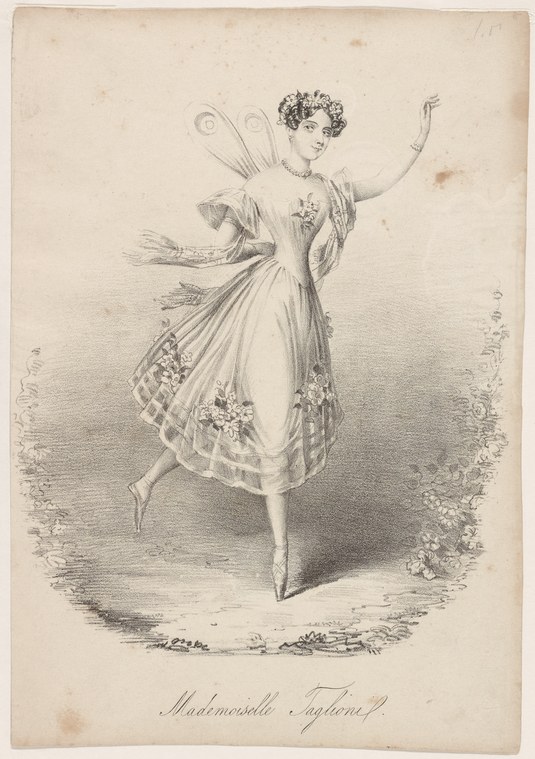
Mademoiselle Taglioni
Unknown artist
- Collection:
- Prints depicting dance
- Source:
- New York Public Library
- Rights:
- Public domain — free to use, share and adapt.
- Recorded as:
- Public Domain
Taglioni was the first ballerina to achieve international stardom and to establish the female dancer (rather than the male) as the primary focus of ballet. This engraving captures her in the specific pose and costume that made her iconic—the ethereal sylph—and documents the visual conventions of Romantic ballet at its height. For dancers and historians, the image is a primary source for understanding how the Romantic ideal was marketed, imagined, and embodied by the most celebrated performer of the age.
What you are looking at
A young woman in Romantic-era dress stands in a luminous, ethereal pose against a soft background scattered with flowers. She wears a white muslin dress with a fitted bodice decorated with sprigs of flowers, a full skirt with a checked or patterned hem band, and a gossamer shawl draped from her shoulders. Her dark curled hair is crowned with flowers. She stands on the ball of one foot in a lifted, weightless attitude, her free leg extended behind her, her body angled in profile toward the viewer's right. Her arms are raised in an open, expansive frame—one arm bent gracefully at the elbow, the other extended upward and outward. The composition is framed by a delicate oval border, and the overall effect is one of weightlessness and otherworldly grace. The engraving technique renders the figure with fine cross-hatching and stippling, creating soft modeling and an almost vaporous quality to the drapery.
The dancing
A single female dancer is captured mid-movement in a position of extreme lift and extension. Her supporting leg is nearly straight, rising en relevé on the ball of the foot, while her working leg extends behind her in a high arabesque or attitude devant. Her upper body is held in an open, frontal position with the shoulders squared, and her arms frame her face and body in a soft, lyrical manner rather than in the precise geometric positions of earlier neoclassical dance. The lifted torso, extended limbs, and ethereal bearing suggest a dancer of considerable technical skill and training.
The dance depicted
This is a portrait of Romantic ballet, almost certainly depicting Marie Taglioni, the era's preeminent ballerina and the dancer who defined the Romantic ideal. The inscription at the bottom reads 'Mademoiselle Taglioni', and the image captures the aesthetic that made her legendary: the illusion of weightlessness, the pointe work (though the engraving does not show the foot in detail), the emotional lift, and the union of technical virtuosity with spiritual delicacy. Taglioni pioneered the rise of the female dancer to prominence in the 1830s and 1840s, and this image encapsulates the male fantasy and aspiration of the era—the ballerina as ethereal, otherworldly being. The checked hem and floral decoration reflect the peasant-inspired or sylph-like costuming of Romantic ballets such as *La Sylphide* (1832), in which Taglioni famously danced.
How it was made
This is an engraving, likely from the 1830s or 1840s, produced through the intaglio method in which fine lines are incised into a copper plate. The artist employed cross-hatching and stippling (fine dots) to create tone and model the figure's form, especially in the drapery and background. Engraving was a common and economical method for circulating images of celebrated performers, and this work would have reached a broad middle-class audience as a souvenir or portrait to be framed and displayed in homes. The delicate line-work and soft tonal effects suggest the hand of a skilled technician, though the print is unsigned.
About this work
This is a portrait engraving of Marie Taglioni, the defining ballerina of the Romantic era, captured in a pose that epitomizes early 19th-century ballet aesthetics. The image shows a woman suspended in an attitude of weightless grace, her body lifted on pointe, her arms and extended leg creating an open, lyrical frame. The soft engraving technique and floral border reinforce the ethereal, otherworldly quality that audiences of the 1830s and 1840s found so compelling—the illusion of a creature not quite of this world. As a mass-produced engraving, it represents the celebrity culture of the Romantic stage and the way ballet was consumed and imagined by the public.
How to look at it
The viewer should attend to the moment of suspension the artist has frozen: the dancer at the apex of her lift, when the body appears to hover weightlessly rather than to be supported by muscular effort. Notice the extension of the working leg, the openness of the arms, and the upward lift through the torso—all of which create the optical illusion of an ascending, ethereal figure. The checked hem of the skirt and the floral crown are not incidental decoration but key markers of Romantic ballet's peasant-tinged, fantastical aesthetic. The soft, luminous background and the delicate cross-hatching create an effect of light and air that reinforces the sense of the dancer as a being of spirit rather than flesh.
The artist
The artist is unrecorded, as was common for reproductive engravings of the period. Such portraits were produced in workshops and studios across Europe and circulated widely as prints; they were often after drawings made from life or from stage observation. The quality of the line-work and the sensitive rendering of the figure suggest a competent practitioner, but the work is typical of the mid-19th-century theatrical portrait engraving industry rather than the work of a named artist seeking individual renown.
The period
This engraving dates from the height of Romantic ballet, roughly 1830–1850, when the female dancer emerged as the principal focus of the art form. The Romantic movement in arts and letters celebrated the ethereal, the emotional, and the fantastical; in ballet, this translated into the figure of the sylph or spirit—weightless, otherworldly, and ultimately tragic. Marie Taglioni's debut in *La Sylphide* (1832) crystallized this ideal and made her the most sought-after dancer in Europe. The engraving medium allowed this image to be reproduced and distributed to theaters, salons, and homes across the continent, making Taglioni a figure of international celebrity in a way no dancer had been before. The fashion for Taglioni-inspired costumes and poses extended even to everyday dress and decorative arts.
Where it lives
The work is held in the New York Public Library's collection of prints depicting dance. It is an unsigned reproductive engraving, typical of the theatrical portrait prints produced and circulated widely in the mid-19th century. Such prints were sold at theaters, in print shops, and through subscription, and they constitute a major primary source for understanding how dancers were seen and celebrated by their contemporaries.
Dance in this work
Questions about this work
Who was Marie Taglioni?
Marie Taglioni (1804–1884) was a Swedish-born Italian ballerina who became the most celebrated dancer of the Romantic era. She was the first female dancer to achieve truly international stardom and effectively moved the focus of ballet from the male dancer to the female. Her debut in *La Sylphide* in 1832 established the aesthetic of the Romantic ballet and made her synonymous with the ethereal, weightless ideal that audiences craved.
What is the dance position shown here?
The dancer appears to be in an attitude or arabesque—a pose in which one leg is extended behind the body while the dancer balances on the other leg, which is typically turned out and often on pointe. The exact position is hard to determine from the engraving because the supporting foot is not shown in detail, but the lifted, extended, open-armed frame is quintessentially Romantic ballet.
How was this image made and distributed?
This is a copper-plate engraving, a reproductive technique that allowed an image to be printed repeatedly and distributed to a mass audience. Such portraits of famous dancers were sold in theaters and print shops throughout Europe and America, serving as souvenirs and images of celebrity. They were affordable enough for middle-class homes and are now important primary sources for understanding how performers were presented and imagined.
What do the flowers and checked hem signify?
The floral crown and the checked or patterned hem of the skirt are elements of the costumes designed for Romantic ballets, particularly *La Sylphide*. They signal a 'natural' or 'peasant' aesthetic that was part of the Romantic movement's appeal to the imagined simplicity and spirituality of pre-industrial life. In Taglioni's case, these details became so iconic that they are instantly recognizable as markers of her most famous roles.
More dance artwork





