49 works in this view — arrow keys or swipe to move between them.
Dance in Art
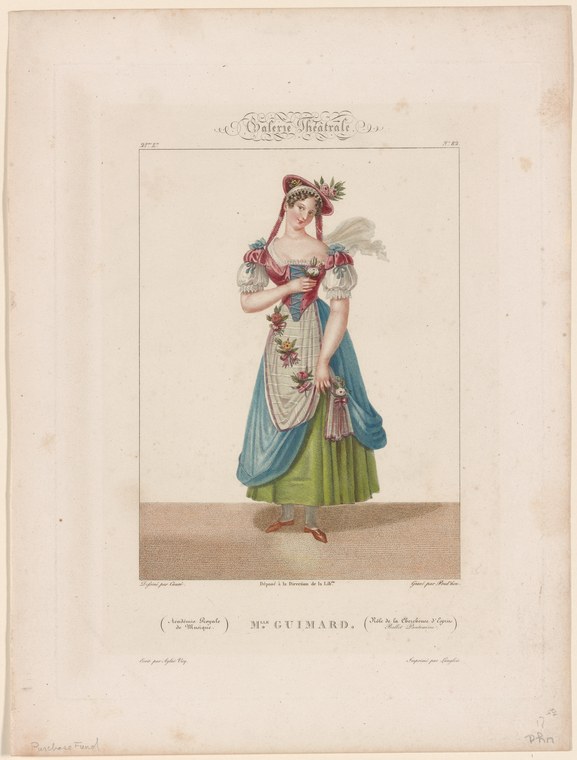
(Académie Royale de Musique). Mlle. Guimard. (Rôle de la Chercheuse d'esprit, ballet pantomime).
Unknown artist
- Collection:
- Prints depicting dance
- Source:
- New York Public Library
- Rights:
- Public domain — free to use, share and adapt.
- Recorded as:
- Public Domain
As a portrait of one of the Enlightenment era's most admired dancers, this print is direct evidence of how a canonical performer embodied a specific theatrical role and of the Neoclassical aesthetic that dominated French dance and dress in this period. It also illustrates the primary mode by which dance imagery circulated in the 18th century: not as action photography but as costume records that preserved institutional memory and fed the celebrity culture of the Opéra.
What you are looking at
A young woman stands alone against a neutral ground, dressed in early 19th-century theatrical costume. She wears a high-waisted white chemise-style underdress with a draped blue overskirt caught up at one side, exposing the underskirt and showing the silhouette favored in Regency fashion. Her shoulders are bare except for short puffed sleeves in a contrasting darker fabric (possibly plum or burgundy). She wears a wreath of flowers in her hair and holds sprays of flowers in each hand. Her posture is upright and composed, weight evenly distributed, with her arms held naturally but with decorative intention—one arm extended slightly forward, the other at her side, both displaying the flowers she carries. The figure is centered in the composition, isolated against the cream background, presented with the formality of a theatrical portrait or costume plate.
The dancing
A single standing figure with weight balanced on both feet and an upright, stationary carriage. The arms are not engaged in any dynamic movement but are positioned to display the flowers as attributes. The head is held high and slightly tilted, with a composed, serene expression. There is no indication of active stepping, turning, or the energetic port de bras associated with theatrical dance; instead, the figure presents as if for a costume documentation or beauty portrait. The overall frame suggests a moment of pause or presentation rather than kinetic dance action.
The dance depicted
This is almost certainly a costume plate or theatrical portrait documenting the role of the Chercheur d'esprit (Seeker of Wit) in a ballet-pantomime, rather than a depiction of dance action in motion. The woman portrayed—identified in the inscription as Mlle. Guimard, a celebrated dancer of the Académie Royale de Musique—is shown in costume but not captured mid-movement. The flowers, the high-waisted Neoclassical silhouette, and the formal standing pose suggest this was created to document the character and dress for theatrical records or print circulation, following the 18th- and early 19th-century convention of separating dancer portraiture from action choreography.
How it was made
This is a hand-colored engraving or aquatint, a reproductive print technique that allowed multiple copies to circulate widely. The delicate watercolor finish on the figure and the use of tinted paper create a soft, refined effect typical of high-quality theatrical costume plates. The technique—combining engraved line work with selective hand-coloring—was the standard for documenting dancers and roles in institutional theaters, serving both as record and as collectible art for theater enthusiasts. This method was far more economical and repeatable than original paintings, making it the primary vehicle for dance documentation in this period.
About this work
This is a hand-colored costume plate documenting Mlle. Guimard in the role of the Chercheur d'esprit from a ballet-pantomime at the Académie Royale de Musique (the Paris Opéra). Guimard was one of the most celebrated dancers of the late 18th century, known for both technical mastery and dramatic power in pantomime roles. The work belongs to the tradition of theatrical costume documentation that preserved the appearance and character of celebrated roles in the institutional memory of the opera house and in the collecting practices of theater patrons. Rather than capturing choreography in motion, it functions as an official record of character, costume, and persona—a form of dance documentation that was as important to the theater-going public as action images would become later.
How to look at it
Pay attention to the careful rendering of the costume detail—the draping of the overskirt, the transparency of the undergown, the delicate flowers in hair and hand—as documentary evidence of what this role looked like on stage. Note the stationary pose: this is not action captured mid-movement, but a moment of formal presentation. The flowers are not mere decoration but attributes of the character, suggesting her allegorical or sentimental nature. The print's status as a hand-colored engraving matters: it is a commercial art object, one of many copies, made to be owned, displayed, and discussed by theater enthusiasts.
The artist
The artist is not recorded. However, the style and format are consistent with the work of Jacques-Louis Voille, Jean-Baptiste Martin, or other engravers specializing in theatrical costume plates for the Académie Royale de Musique during the 1770s–1790s. Such prints were often collaborative, with the engraver working from a drawing or painting by a theater artist, and the colorist adding finish. They were typically published in series and sold as single sheets or collected in albums, making them commercial art objects as well as archival documents.
The period
This work belongs to the height of the Romantic era's interest in theatrical spectacle and the cult of the performer. The Neoclassical silhouette and the use of pantomime as a mode of storytelling reflect the influence of Noverre's Lettres sur la danse (1760) and the reform movement toward expressive action ballet. Mlle. Guimard was active when the ballet d'action was emerging as the dominant form, and pantomime roles like this one were central to that aesthetic. Simultaneously, the commercial print market for dancer imagery was booming: collecting prints of favorite performers was a fashionable pastime for the opera-going public, comparable to later photographs of theater stars.
Where it lives
This print is held in the New York Public Library's collection of prints depicting dance. The collection comprises primarily European theatrical costume plates, engraved portraits of dancers, and action scenes from ballet and pantomime spanning the 17th–19th centuries, making it one of the major institutional archives of pre-photographic dance imagery.
Dance in this work
Questions about this work
Was Mlle. Guimard a real dancer, and can we see her actual technique here?
Yes—Marie-Madeleine Guimard (1743–1816) was one of the most celebrated dancers of the late 18th century, known for technical brilliance and dramatic ability. However, this image is a costume portrait, not a choreographic document, so it tells us about her appearance and role more than about her movement vocabulary or technique. To understand how she actually danced, we would need action images, written descriptions, or notation.
What was a ballet-pantomime, and what is a Chercheur d'esprit?
A ballet-pantomime was a theatrical form blending dance and mime storytelling, pioneered by Jean-Georges Noverre and dominant in the late 18th century. The Chercheur d'esprit (Seeker of Wit) is an allegorical character—likely from a now-lost ballet—representing intellectual or witty pursuit, suggested here by the flowers (symbols of beauty and cultivation) and the elegant, refined costume. Such characters were common in the spectacular multi-act ballets of the period.
Why is this a hand-colored print rather than a painting?
Hand-colored engravings were the most efficient way to document and distribute images of celebrated performers in this period. A single engraved plate could be printed hundreds of times, and each print could be hand-tinted to add color and value. This made the images both affordable to collect and economical for the theater to produce, turning them into a mass commodity that fed the celebrity culture of the Opéra.
Is there choreographic information in this image?
Very little. The standing pose is formally composed rather than captured mid-movement, so we learn nothing about footwork, turns, or the flow of the dance itself. The image is primarily a record of character costume and theatrical persona—valuable for understanding how this role appeared, but not for reconstructing how it was danced.
More dance artwork





