49 works in this view — arrow keys or swipe to move between them.
Dance in Art
Costume de bacchante
Unknown artist
- Collection:
- Prints depicting dance
- Source:
- New York Public Library
- Rights:
- Public domain — free to use, share and adapt.
- Recorded as:
- Public Domain
The bacchante is a foundational figure in 19th-century ballet and operatic dance, appearing in major works throughout the century, yet rarely studied through the documentary costume prints that guided their creation. This image shows both what the role looked like and what kind of movement it implied—information no written description can convey. The expressive, freed upper body and the absence of pointe work or formal ballet frame reveal how the bacchante existed at the boundary between classical ballet and a more orgiastic, expressively gestural form of theatrical dance.
What you are looking at
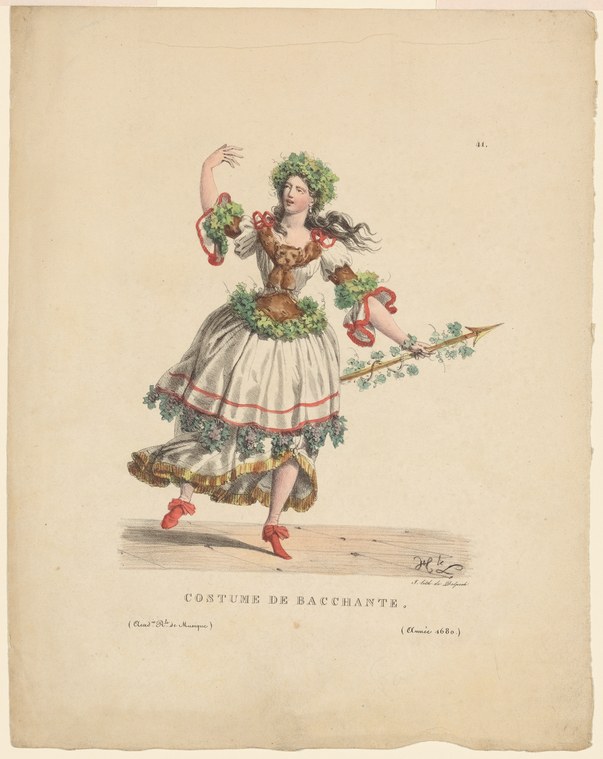
A single female dancer wearing the costume of a classical bacchante—a female follower of Bacchus—is captured mid-movement against a plain background. She wears a brown bodice laced or corseted at the front, with a pale grey skirt that falls to below the knee and is trimmed with a red band at the hem. Green ivy or vine garland adorns her head and is draped across her torso and arms, and she carries large bunches of red grapes in both hands, held aloft. Her hair flows loosely down her back. She wears red heeled shoes. Her body is twisted in a dynamic pose: her left arm is raised high with fingers spread in an expressive gesture, her right arm extends outward holding the grapes, and her weight appears to be on her right leg while her left leg steps forward, suggesting forward momentum or a turning movement. The composition is a three-quarter view that shows the full figure against an unadorned cream or white ground, typical of theatrical costume documentation of the 19th century.
The dancing
A single dancer stands in a twisted contrapposto stance with pronounced weight shift and rotation through the torso. Her left arm is raised above shoulder height with fingers spread in an open, expressively curved position; her right arm extends at roughly shoulder height, both gestures communicating theatrical joy and abandon. The body is turned and extended, with the right leg bearing weight and the left leg bent and stepping forward, creating a sense of forward propulsion or turning movement. The raised arms and open hand shapes suggest a vocabulary of expressive, gestural movement rather than the closed holds and linear frames of ballroom or the turned-out positions of classical ballet.
The dance depicted
This is a theatrical costume study for a bacchante, a figure central to Romantic-era ballet and operatic spectacle. The bacchante—drawn from classical mythology as a maenad or female devotee of the wine god Bacchus—became a stock character in European theatrical dance from the late 18th century onward, appearing in ballets, operas, and divertissements. The costume elements (ivy, grapes, the loosened hair and sensual drapery) and the expressive, ecstatic quality of the pose indicate a dancer performing ecstatic abandonment and Dionysian revelry rather than the controlled technique of classical ballet proper. The image documents not just the costume but the movement vocabulary of the role: expansive, free-limbed gestures and a torso-driven, expressive style quite distinct from the epaulement and épaulement of balletic propriety.
How it was made
This is a hand-colored engraving or lithograph printed in the 19th century, recognizable by the fine linear work in the background figures and the characteristic appearance of printed line combined with watercolor or gouache hand-coloring on paper. The page number 'ii' visible at the top right suggests this is part of a series or bound volume documenting theatrical costumes. The technique allows for accurate reproduction of costume detail and silhouette across multiple impressions, making this a form of theatrical reference material or evidence of what was worn on stage—a document with currency in the theater world and among those commissioning or studying dance costumes.
About this work
This hand-colored print documents the costume of a bacchante—a classical figure of ecstatic revelry—as performed in 19th-century European theater. The image captures not merely the dress but the movement vocabulary of the role: a torso-centered, expressive style distinct from formal classical ballet. As a costume study, it belongs to the archival tradition of theatrical documentation that served both the practical needs of costume makers and the broader cultural appetite for images of theatrical performance. The work testifies to the Romantic era's fascination with classical subject matter translated into contemporary stage spectacle, and the bacchante became an iconic figure through which dancers performed exoticism, ecstasy, and freedom from social constraint.
How to look at it
Notice the freedom of the pose: the raised arm with spread fingers, the twisted torso, the forward step. This is theatrical gesture rather than balletic technique. The artist has chosen to show the dancer in a moment of exuberant movement rather than a static pose, suggesting that what matters about this role is its emotional expressiveness and freedom from rigid form. The costume elements—ivy, grapes, loosened hair—are not merely decoration but signifiers of the character's mythological identity and her association with ecstatic pleasure and nature.
The artist
The artist is not recorded in the catalogue. The style and format suggest a mid-19th-century costume engraver or lithographer working for a major theater or publishing house, likely French or Italian. The page numbering and systematic presentation indicate this was part of a published or curated series documenting theatrical costume.
The period
The bacchante emerged as a stock theatrical figure during the Romantic era (1820s–1850s) when European ballet and opera turned to classical and exotic subjects as vehicles for emotional expression and spectacle. The loosened costume, flowing hair, and expressive gesture seen here embody Romantic ideals of unleashed nature and sensuality in contrast to the strict codes of classical ballet. Costume documentation through engravings and lithographs was a major form of theatrical publishing in the 19th century, serving both as souvenir and as reference material for touring companies and local theaters staging the same roles.
Where it lives
This print is held in the NYPL Prints collection under the category 'Prints depicting dance.' The page numbering suggests it was part of a bound or assembled volume of theatrical costume documentation, though the original publication source and date are not recorded in the catalogue.
Dance in this work
Questions about this work
What is a bacchante and why does she appear so often in 19th-century dance?
A bacchante is a female follower of Bacchus (Dionysus), the classical god of wine and ecstatic revelry. During the Romantic era, the bacchante became an iconic theatrical figure because she embodied everything Romantic artists valued: connection to nature, emotional excess, sensuality, and freedom from social constraint. Dancers performing the role could move in ways forbidden to 'respectable' women, using loosened hair, exposed arms, and ecstatic gestures to convey a kind of sanctioned wildness.
How is this different from classical ballet?
Classical ballet emphasizes turned-out positions, upright carriage, closed holds, and controlled épaulement (shaping of the arms and torso). The bacchante, by contrast, uses expressive arm gestures with spread fingers, a twisted and mobile torso, and looser, more naturalistic movement. This role sits at the boundary between classical ballet technique and a more orgiastic, expressively gestural form—it is ballet's way of performing ecstasy and abandon.
What does the costume tell us about how this dance was performed?
The soft drapery, absence of pointe shoes, loosened hair, and expressive arm gestures all signal that the bacchante was danced with a focus on emotional and gestural expression rather than technical virtuosity. The ivy and grapes are not just decoration—they anchor the character in a mythological world where such exuberant, uninhibited movement is not only permitted but required.
Why was this image made and who used it?
Theatrical costume engravings like this served multiple purposes: they were sold to the public as souvenirs of performances, they were used as reference material by costume makers and theaters staging the same roles, and they documented what major dancers actually wore on stage. For a role like the bacchante that appeared in many different productions, such prints ensured consistency in costume and helped establish a visual template for the character.
More dance artwork





