49 works in this view — arrow keys or swipe to move between them.
Dance in Art
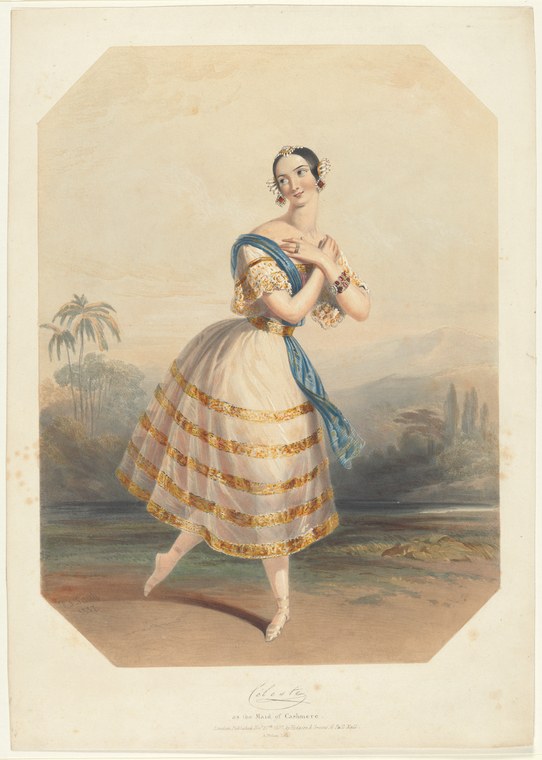
Celeste [fac. sig.] as the Maid of Cashmere
Unknown artist
- Collection:
- Prints depicting dance
- Source:
- New York Public Library
- Rights:
- Public domain — free to use, share and adapt.
- Recorded as:
- Public Domain
The print preserves the likeness and costume of a known Romantic-era dancer in a named role, providing rare visual documentation of actual performance practice and the aesthetic values of mid-nineteenth-century ballet theater. For historians, it captures the orientalist conventions of the period and the celebrity status of individual dancers; for dancers, it demonstrates the technical vocabulary and compositional ideals of classical ballet at a specific historical moment.
What you are looking at
A young woman in theatrical costume stands alone in a stylized landscape, posed en attitude with her weight on her left leg. She wears a white ballet skirt with broad horizontal bands of gold or bronze trim, topped by a fitted bodice and a draped blue shawl or scarf. Her dark hair is arranged with what appears to be a jeweled ornament. The setting suggests an orientalist fantasy—a palm tree and distant mountains rendered in soft watercolor washes create a vaguely Eastern atmosphere. The composition is frontal and staged, the figure presented for inspection against a plain background. The whole work is enclosed in an octagonal frame, which was a common format for theatrical prints and fashion plates of the mid-nineteenth century.
The dancing
The dancer balances on her right leg with the left foot raised and bent, the upper body held upright and composed. Her arms are raised at shoulder height in a soft, rounded position, with the right arm slightly forward. The posture suggests the classical ballet vocabulary of the period—controlled, vertical, aestheticized—rather than any ethnic or folk movement. There is only one figure, isolated and presented as a solitary performer rather than part of an ensemble or partnership.
The dance depicted
This is a theatrical ballet performance, specifically a character dance or 'specialty' number from the Romantic era of ballet. The title 'Celeste as the Maid of Cashmere' indicates this was a named star performer in a specific role, likely in a theatrical production. The costume and setting suggest an orientalist scenario, common in early nineteenth-century ballet where European dances were set in exotic locales. The attitude pose and classical line are consistent with Romantic ballet technique of the 1840s–1850s, though the printed format and inscriptional style suggest the work may have been created slightly later as a commemorative image of a famous performance.
How it was made
This appears to be a hand-colored lithograph or chromolithograph—the soft washes of color, the delicate gradations in the sky and landscape, and the crisp line-work of the figure all suggest the lithographic process. The octagonal framing and the formal inscriptional cartouche at bottom are typical of theatrical prints issued in the mid-nineteenth century, often as souvenirs of celebrated performances or as images of prominent dancers for sale to audiences. The coloring technique allowed for theatrical glamor while remaining economical enough for distribution.
About this work
This is a theatrical print documenting a specific performance in Romantic-era ballet, capturing a celebrated dancer named Celeste in a character role. The work sits at the intersection of dance practice and popular visual culture—it is neither a costume design nor a stage photograph, but rather a commemorative image made for an audience of theater-goers and ballet enthusiasts. The print preserves a moment of nineteenth-century ballet performance as it was marketed and remembered by spectators, showing both the technical vocabulary of classical ballet and the theatrical conventions of orientalist fantasy that dominated the Romantic stage. It belongs in a dance archive because it documents a specific role, a named performer, and the visual language of a historic dance form.
How to look at it
Observe the moment chosen: the dancer is frozen in a pose of apparent effortlessness, balanced on one leg in a classical attitude. This is not mid-leap or mid-turn, but rather a moment of stillness and display—the kind of pose a dancer might hold at the climax of a solo or at the moment of her entrance. The composition mimics the framing of a fashion plate or portrait, placing the viewer in the position of an admiring spectator. The orientalist setting and the luxurious costume details (the gold trim, the jeweled hair ornament, the draped shawl) announce this as a theatrical character dance rather than a strict classical variation, yet the body's lines remain strictly balletic.
The artist
The artist is not recorded in the catalogue. However, the style and format are consistent with the work of commercial theatrical lithographers of the 1840s–1860s, a period when such prints were mass-produced in major European theater centers including London, Paris, and Vienna. Individual dancers' likenesses were often engraved by multiple hands, and prints were frequently published without prominent artist attribution, making attribution difficult without additional research.
The period
This work dates to the Romantic period of ballet, when the art form had shifted from the virtuosic classical tradition toward a new aesthetic centered on ethereal femininity, supernatural themes, and exoticism. Ballets set in distant lands—Persia, India, Turkey, Spain—were enormously popular, offering European audiences fantasies of the Oriental Other while providing choreographers with justification for costumes and movement vocabularies that departed from strict classical discipline. The 1840s and 1850s were the era of dancers like Maria Taglioni and Jules Perrot; Celeste was a significant performer in this constellation, though less documented than some contemporaries. Lithographic prints of celebrated dancers became a major form of theatrical merchandise and fan culture.
Where it lives
The work is held in the New York Public Library's collection of theatrical prints and engravings relating to dance. It is catalogued as a print depicting a named performer, but lacks detailed provenance information. Such prints were typically sold as theatrical souvenirs or collected as memorabilia by dance enthusiasts, and often circulated through commercial print sellers rather than formal institutions.
Dance in this work
Questions about this work
Who was Celeste the dancer?
Celeste (Celine Celeste) was a prominent Romantic-era ballet dancer active in the 1840s–1850s, known for character roles and specialty numbers. She performed frequently in London and Paris and was celebrated for her gracefulness and technical skill. This print commemorates her in one of her signature roles, but detailed biographical information about her career is limited.
What does 'Maid of Cashmere' mean as a ballet role?
Cashmere (Kashmir) was one of many exotic locales invoked in Romantic ballet to justify theatrical spectacle and character dancing. The 'maid' or maiden of such places was typically a graceful female character, allowing the lead dancer to perform in both classical vocabulary and folk-inspired movement. These orientalist fantasies reflected European fascination with the East and had little relation to actual movement traditions.
How were theatrical prints like this one made and used?
Mid-nineteenth-century theatrical prints were made using lithography—a technique that allowed color printing and fine detail. They were sold as souvenirs at the theater, in print shops, and through theatrical agents. Dancers, wealthy patrons, and enthusiasts collected them; they functioned much like theater lobby cards or celebrity photograph postcards do today.
Is this image of an actual performance or an idealized portrait?
Most likely both. The print is a commemorative image made after (or during the run of) a celebrated performance, capturing the costume and role accurately enough to be recognized and remembered, but posed and rendered in a formal, idealized manner typical of theatrical print culture. It documents the role and the dancer's fame rather than capturing a moment from live performance.
More dance artwork





