49 works in this view — arrow keys or swipe to move between them.
Dance in Art
The fairie's home
Unknown artist
- Collection:
- Prints depicting dance
- Source:
- New York Public Library
- Rights:
- Public domain — free to use, share and adapt.
- Recorded as:
- Public Domain
For dancers and historians, this image is a primary document of how Romantic ballet looked and was understood by its audience. The printed circulation of such fantasies—images that could be displayed in homes—shaped public expectation of what ballet was supposed to represent: beauty, otherworldliness, and feminine idealization. Understanding this aesthetic context is essential to reading the choreography, costume, and subject matter of 19th-century ballet.
What you are looking at
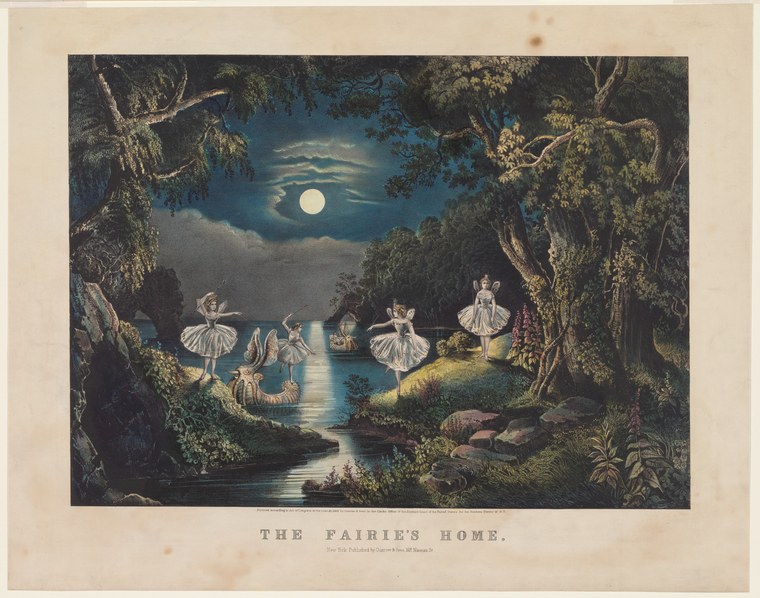
A moonlit forest clearing frames a fantastical gathering of dancers in diaphanous white tutus arranged across a rocky stream. The composition is framed by tall trees with gnarled trunks and hanging foliage that arch overhead, the full moon visible through a gap in the canopy above. The dancers, rendered in pale tones, occupy the middle ground and foreground: some stand on moss-covered banks, others pose mid-gesture in the shallow water, and at least two occupy elevated rocky outcrops. The lighting is ethereal—moonlight strikes the water and the pale fabrics, creating strong contrasts with the dark surrounding forest. The vegetation is lush and fantastical, with exotic plants and vines suggesting an enchanted or otherworldly location. The overall mood is dreamlike and romantic, typical of mid-19th-century aesthetic fantasy.
The dancing
The dancers are posed rather than captured in vigorous movement. Most stand with arms raised or extended, in attitudes suggestive of classical ballet—lifted spines, pointed feet, and graceful arm positions. One figure in the center middle distance appears to be en relevé or on pointe. Several dancers adopt formal poses facing toward the water, as though presenting themselves or engaging in a ceremonial arrangement. The tutus, rendered with careful attention to their stiffness and volume, suggest the crinolined ballet skirts of the mid-19th century. The bodies are elongated and elegant, with a feminine idealization characteristic of Romantic ballet aesthetics; no male dancers are visible.
The dance depicted
This is most likely a representation of Romantic ballet—specifically the idealized vision of sylphs or supernatural fairy beings that became the dominant aesthetic in European theatrical ballet from the 1830s onward. Works like Giselle and La Sylphide established the iconography of otherworldly female dancers in white tutus, ethereal and unattainable. The title 'The Fairie's Home' signals an engagement with folklore and fairy mythology that was central to Romantic ballet's thematic world. The moonlit forest and the posed, statuesque quality of the dancers align with how such supernatural encounters were staged and represented. The image documents not a moment of vigorous dancing but rather a tableau of these mythological beings in their own realm.
How it was made
This is a hand-colored lithograph or engraving, determined from the visible tonal gradations, the careful handling of light and shadow, and the style of the composition. The technique allows for the atmospheric effects visible here—the soft gradation of moonlit tones, the contrast between the figures and the dark forest—that would have made hand-coloring essential to achieving the ethereal quality. The print has a decorative border and appears to be a finished commercial print rather than a sketch. The medium was well suited to popular circulation in the mid-19th century, and such fantasies sold as wall prints for parlors and art collections.
About this work
This is a hand-colored lithograph or engraving depicting a scene from Romantic ballet—a gathering of sylphs or fairy beings in their enchanted forest home. The image captures the aesthetic and iconography that defined theatrical ballet in the mid-19th century: the idealization of the female body, the supernatural and otherworldly subject matter, the moonlit Gothic-Romantic setting, and the white tutu as the costume of the unattainable ethereal female. Rather than depicting a specific known ballet, it represents the genre's visual vocabulary and its cultural fascination with the fairy and the magical. The work belongs in a dance gallery because it documents how ballet presented itself to the public imagination—not as athletic or technically impressive, but as an encounter with the beautiful and the impossible.
How to look at it
The composition asks you to imagine a moment of complete stillness—not a moment in dance, but a vision or apparition. Observe how the artist has arranged the figures asymmetrically across the landscape, each posed in a different classical attitude, as though presenting an encyclopedia of ballet positions and gestures. The lighting is the real subject: moonlight becomes the technology by which the supernatural is made visible. Notice how the raised arms and elongated lines of the bodies emphasize vertical lift and ethereal weightlessness—the visual equivalent of the idea of dancing without effort or apparent physical strain.
The period
This work dates to the Romantic era in European art and dance, approximately 1830–1860. Romantic ballet emerged as a dominant theatrical form in the 1830s with works like La Sylphide (1832) and Giselle (1841), both of which featured sylphs and other supernatural female characters as their central fantastical subjects. The aesthetic emphasized beauty, otherworldliness, and femininity, often set in moonlit landscapes or enchanted forests. Simultaneously, Romantic painting and printmaking were exploring similar themes—medieval revival, nature mysticism, and the supernatural. The printmaking industry of the period made such images widely accessible, and hand-colored lithographs like this one were popular luxury items that allowed the middle class to own theatrical imagery.
Where it lives
Held in the New York Public Library's 'Prints depicting dance' collection, this work is catalogued as a print but without accession number, date, or artist name recorded. Its classification within a dance-specific collection confirms its identity as ballet-related theatrical imagery.
Dance in this work
Questions about this work
What ballet does this depict?
It is not a scene from a specific known ballet, but rather a generic fantasy image representing the Romantic ballet aesthetic and the theme of sylphs or fairy beings. The title 'The Fairie's Home' indicates the subject matter—the supernatural realm of magical creatures—but does not reference a particular choreography or performance.
Why are all the dancers in white tutus?
By the mid-19th century, the white tutu and the ethereal female dancer had become the visual signature of Romantic ballet. White fabric and moonlight made the supernatural visible and beautiful. Male dancers were rarely depicted in such fairy-realm fantasies, and when they appeared, they were secondary to the women.
Is this a record of an actual performance?
Not of a specific performance. This is a theatrical fantasy print—a visual representation of the Romantic ballet aesthetic and its mythological world, designed for sale and domestic display. It documents what ballet represented in the public imagination rather than what occurred on any particular stage.
More dance artwork





