49 works in this view — arrow keys or swipe to move between them.
Dance in Art
L'incomparable Ravel
Unknown artist
- Collection:
- Prints depicting dance
- Source:
- New York Public Library
- Rights:
- Public domain — free to use, share and adapt.
- Recorded as:
- Public Domain
Tightrope dancers were among the most celebrated and highest-paid performers of the eighteenth century, yet this tradition is largely absent from dance history written around ballet. This print is material evidence that extended body line, musicality, and theatrical presentation existed outside the academy, and that audiences valued the combination of technical risk, grace, and entertainment. For historians of circus, acrobatics, and popular theatre, it documents an aesthetic that shaped European performance culture.
What you are looking at
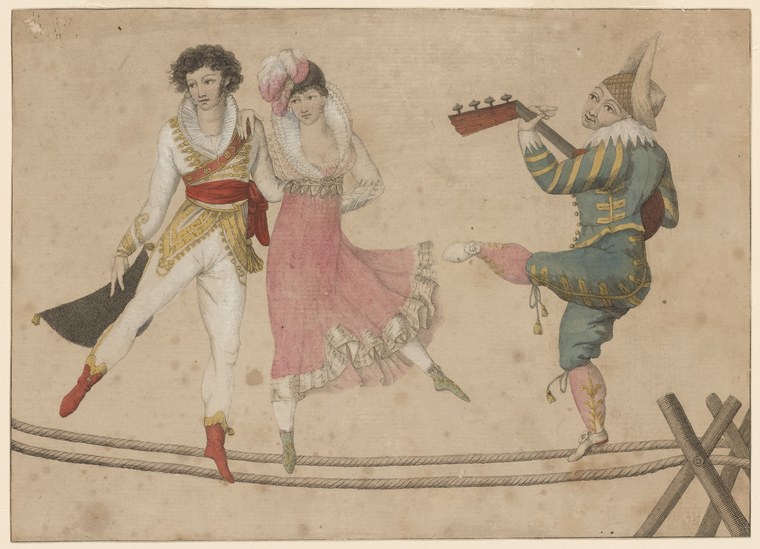
A male figure in theatrical costume stands on a tightrope at right, playing a wind instrument (possibly a pipe or flute) while gesturing toward two dancers on the rope ahead of him. The lead dancer, a man in white tights, gold-trimmed tunic, and a dark cape, extends his left leg in a sustained arabesque or attitude position, his body oriented downstage with considerable grace and control. Behind him stands a female dancer in pink skirts with a white bodice and elaborate headdress, her posture upright and formal. The rope itself is rendered clearly, supported by a wooden X-frame at left. The composition captures a moment of performance—acrobatic display combined with dance—against a warm, aged paper ground. The costumes suggest eighteenth-century theatrical dress, rich in ornament and theatrical exaggeration.
The dancing
The lead male dancer carries his weight on his right foot while extending his left leg in a high, sustained line—an arabesque or attitude that requires significant strength and balance on the unstable surface of the rope. His upper body is held vertically and slightly back, his arms in an open, presentational frame. The female figure stands behind and slightly upstage, her posture erect and her arms at her sides or loosely held, suggesting a waiting or supportive role. The male musician at right leans forward dynamically, his instrument raised, creating a diagonal thrust across the composition. All three figures demonstrate the trained body control necessary for both dance and acrobatic performance.
The dance depicted
This depicts the tightrope dance or *danse de corde*, a performance hybrid of dance and acrobatics that was a staple of European popular theatre, circus, and court entertainment in the eighteenth century. The work is titled *L'incomparable Ravel*, suggesting it portrays a member of the celebrated Ravel family of acrobats and tightrope dancers, or is advertising the incomparable skill of a performer in that tradition. The discipline required here is not theatrical ballet proper but rather the technical fusion of equilibrium work, extended body line, and theatrical presentation that made rope dancers famous attractions. The presence of the musician suggests this was danced to live performance, integrating sound and movement in a way distinct from spoken theatre.
How it was made
This is a hand-colored engraving or etching, evident from the linear work visible in the background, the precision of the figure drawing, and the selective use of watercolor or gouache to suggest costume detail and flesh tone. The technique allowed for mass production of popular theatrical imagery—prints like this were sold as souvenirs, advertisements, or illustrations of famous performers and acts. The coloring, while selective and not comprehensive, emphasizes the theatrical costume and the warm skin tones of the performers, drawing the eye to human bodies and their actions. The paper is aged and slightly foxed, consistent with an eighteenth-century date.
About this work
This print documents the tightrope dance, a major theatrical attraction of the eighteenth century that combined acrobatic balance with extended, presentational body lines drawn from theatrical dance. The *Ravel* named in the title connects it to a dynasty of famous rope dancers; the image captures the moment of performance—a male dancer in sustained arabesque, a female companion, a musician providing accompaniment—that made such acts famous across Europe and the Americas. It is a record of a performance tradition now largely extinct, showing how the distinction between dance and acrobatics was fluid and how theatrical innovation often emerged from popular rather than court-sponsored performance.
How to look at it
Attend to the male dancer's extended leg and the controlled inclination of his torso—this is not a leap or a turn but a sustained position held against the pull of gravity and the instability of the rope. The line from his hip through his extended foot shows an understanding of the extended arabesque or attitude that would become central to ballet vocabulary, yet executed here under conditions of genuine physical risk. The theatrical costume and the presence of the musician frame this as entertainment, not academic exercise. The engraver has chosen to freeze the moment of greatest extension and grace, not a transition or a landing.
The artist
The artist is not recorded, but the work is consistent with the output of commercial print shops that supplied popular theatre imagery in the eighteenth century. Such prints were typically produced in runs, sometimes hand-colored in workshops, and sold at theatres, fairs, and print stalls. The quality of the line work and the sophistication of the composition suggest a practised hand, but the anonymity was normal for commercial theatrical ephemera of this period.
The period
The eighteenth century saw a bifurcation of dance into court ballet (increasingly codified and academic) and popular theatre dance (acrobatic, risk-based, and closely tied to music and spectacle). Tightrope dancers, along with pantomime performers, harlequins, and rope-dancers, drew massive audiences and commanded high fees. Major cities had permanent or semi-permanent rope-dancing theatres; the Ravels were among the most celebrated dynasties, performing across Europe from the 1750s onward. This print likely dates to the late eighteenth century, when the Ravel family was at the height of their fame. Simultaneously, the academic ballet tradition was being codified by writers like Noverre and the vocabulary of *en dehors* rotation and line was becoming standard.
Where it lives
This work is held in the New York Public Library's collection of prints depicting dance. It is catalogued as an eighteenth-century engraving or etching but lacks specific attribution, date, or medium information in the current record.
Dance in this work
Questions about this work
Who were the Ravels?
The Ravel family were acrobats and tightrope dancers famous across Europe in the eighteenth and nineteenth centuries. They performed in major cities, commanded high fees, and were celebrated for their technical skill and theatrical presentation. Multiple members of the family were known as the 'incomparable' or 'celebrated' Ravel, making the title of this print likely but not certain attribution.
Is this ballet?
No. Tightrope dance is a distinct tradition, combining acrobatics with extended body positions and theatrical presentation. While it shares vocabulary with ballet (the extended leg line, the controlled carriage), it was a popular rather than academic form, performed in theatres, fairs, and circuses, not in court or academy. The two traditions coexisted and influenced each other.
What is that person playing?
The figure at right appears to be playing a wind instrument, likely a pipe, recorder, or small flute. Musicians accompanied rope-dancers during performance, providing rhythm and mood. This integration of live music with acrobatic movement was standard in tightrope theatre and distinguishes it from silent acrobatics.
How did people learn to do this?
Tightrope dancing was taught within families and in professional training companies. It required years of practice, beginning often in childhood, combining training in acrobatics, balance, dance technique, and theatrical presence. It was a specialized and highly valued skill that made performers wealthy and famous.
More dance artwork





