49 works in this view — arrow keys or swipe to move between them.
Dance in Art
Tamara Karsavina as Salome
Unknown artist
- Collection:
- Prints depicting dance
- Source:
- New York Public Library
- Rights:
- Public domain — free to use, share and adapt.
- Recorded as:
- Public Domain
Karsavina was one of the central figures in the Ballets Russes revolution; to see her immortalized in a major role from a contemporary hand allows us to understand how her body and presence were understood and valued in her own era. The work documents the early 20th-century classical ballet aesthetic before pointe work, the tutu, and literal storytelling became dominant—a moment when ballet could be modern, dramatic, and architecturally pure all at once.
What you are looking at
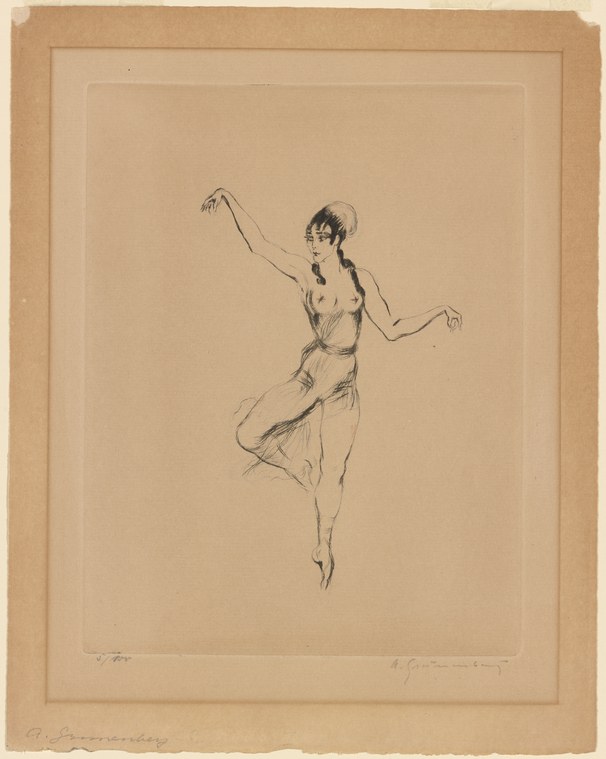
A single female dancer is captured mid-movement against a plain background, rendered in ink line drawing with light wash. She is shown in a moment of dynamic extension, her body lifted and arched in an attitude of ethereal grace. Her left arm reaches upward in a refined gesture while her right arm extends to balance the composition. Her right leg is raised behind her in a controlled extension, while her left leg appears to support her weight. She wears what appears to be a classical ballet costume—a fitted bodice and short skirt typical of early 20th-century dance—with her dark hair styled in the fashion of the period, swept back from her face. The minimal background and spare line work direct all attention to the geometry of her body and the implied momentum of the movement.
The dancing
The dancer's frame shows the upright carriage of classical ballet, with the torso elongated and the supporting leg straight. Her raised leg achieves significant height and extension behind her, suggesting strong control and turnout. The arm positions—one lifted to approximately shoulder height with a refined port de bras, the other extended for balance—show the balletic vocabulary of épaulement. The overall impression is of a moment suspended in elegant motion rather than a static pose, with the slight suggestion of forward movement through the composition. The drawing style captures the musculature and structural clarity of the dancer's body without unnecessary detail.
The dance depicted
This is almost certainly a study of Tamara Karsavina, the legendary Russian prima ballerina of the Ballets Russes, in her role as Salome. Karsavina danced this role in Florent Schmitt's *La Tragédie de Salomé* (1910), one of her most celebrated interpretations in the Western repertoire. The movement captured here is characteristic of the Fokine-era neoclassical ballet vocabulary that defined early 20th-century Ballets Russes aesthetics—legible, elongated, and emotionally charged. The pose itself suggests a moment of yearning or emotional intensity rather than pure technical display, consistent with the dramatic arc of the Salome narrative.
How it was made
This is an ink line drawing, likely a sketch or study, with minimal tonal wash to suggest form and the play of light across the body. The technique is economical: the artist has used selective hatching and light shading to articulate musculature and the fall of drapery, while reserving pure line for the contours of limbs and the silhouette. This is characteristic of the working drawings and press studies that circulated during the Ballets Russes era, created either by the artist from life observation or from photographic reference. The paper support shows age-appropriate discoloration. The presence of what appears to be a signature in the lower left suggests this was a finished study intended for circulation or publication, likely part of the extensive visual documentation that followed major Ballets Russes productions.
About this work
This is a drawing of the Russian prima ballerina Tamara Karsavina at the height of her fame, captured in a moment from her role as Salome. The work represents the early 20th-century intersection of theatrical modernism and classical ballet technique, documenting both the dancer and the aesthetic innovation of the Ballets Russes. The drawing exemplifies how ballet was studied and disseminated through visual media in this period—not as photographs meant to capture photographic likeness, but as interpretive sketches that emphasize the dancer's line, the balletic vocabulary, and the emotional content of a famous role. The spare draftsmanship and refined technique suggest the drawing was made by a skilled observer of dance, whether a professional artist working from performance or rehearsal, or from the photographic studies that were widely circulated at the time.
How to look at it
Look first at the geometry of the body and the clarity of the balletic line—the way the supporting leg is straight and engaged, the lifted leg extended behind and rotated outward, the torso held in alignment. Notice how the artist has used line to suggest both the physical structure of the dancer and the interior tautness of the movement; this is not a slack or casual pose, but one in which every part of the body is engaged. The arm positions frame a moment of emotional intensity—not purely technical display. The minimal background forces the viewer to read the dancer's body as the sole subject, emphasizing the vocabulary of classical ballet and the individuality of Karsavina's interpretation.
The artist
The artist is not recorded. The drawing's technical confidence and the attention to balletic anatomy suggest either a professional artist trained to work from dancers (such as the many choreographers, designers, and artists in the Diaghilev circle), or a skilled observer of the Ballets Russes working from the archival photographs that documented the company. The economy of line and the clarity of the pose are consistent with the working drawings and studies that filled the notebooks of early 20th-century dance professionals.
The period
This drawing was likely made between 1910 and the 1920s, during or shortly after the premiere and run of *La Tragédie de Salomé*. This was the height of the Ballets Russes era, when Russian Imperial ballet training and European modernism were in active dialogue. The company toured extensively across Europe and to North America, and the visual documentation of its dancers—through drawings, photographs, and prints—was a major part of how ballet was understood and disseminated to the public. Karsavina was celebrated as much for her dramatic intelligence and interpretive range as for her technical mastery, and her Salome was considered one of her finest roles, showcasing the new choreographic language that Michel Fokine had developed in reaction against the rigid conventions of the Imperial theaters.
Where it lives
The work is held in the New York Public Library's collection of prints depicting dance. The catalogue record is minimal, typical of many archival dance drawings; the holding suggests this was part of the extensive visual documentation of the Ballets Russes and its dancers that was collected during and after the company's active years.
Dance in this work
Questions about this work
Who was Tamara Karsavina?
Karsavina (1885–1978) was a Russian prima ballerina trained at the Imperial Ballet School in St. Petersburg and principal dancer of the Ballets Russes under Sergei Diaghilev. She was celebrated for her dramatic intelligence, technical refinement, and interpretive range; she created roles in works by Fokine, Nijinsky, and other choreographers of the avant-garde, and was one of the most influential dancers of the early 20th century.
What is the Salome role about?
In Florent Schmitt's *La Tragédie de Salomé* (1910), choreographed by Michel Fokine, Salome is the biblical figure whose dance in *La Danse de Salomé* precipitates the fall of John the Baptist. Fokine's version emphasized dramatic narrative and psychological depth, using the new language of modern classical ballet rather than the pantomime conventions of 19th-century narrative ballet.
How can I tell this is a study or sketch?
The technique is economical and selective—line work defines the silhouette and major contours, while light wash and hatching suggest form and drapery. There is no background or setting, and the focus is entirely on the dancer's body and pose. This approach was typical of working drawings made by artists studying dancers from life or from photographs, as opposed to finished exhibition pieces.
What is the Ballets Russes?
The Ballets Russes (1909–1929) was a revolutionary Russian ballet company founded by impresario Sergei Diaghilev. It brought Russian Imperial ballet training to Western Europe and collaborated with avant-garde artists, composers, and choreographers to create modern ballet; it fundamentally changed the aesthetics and social position of ballet in the West.
More dance artwork





