49 works in this view — arrow keys or swipe to move between them.
Dance in Art
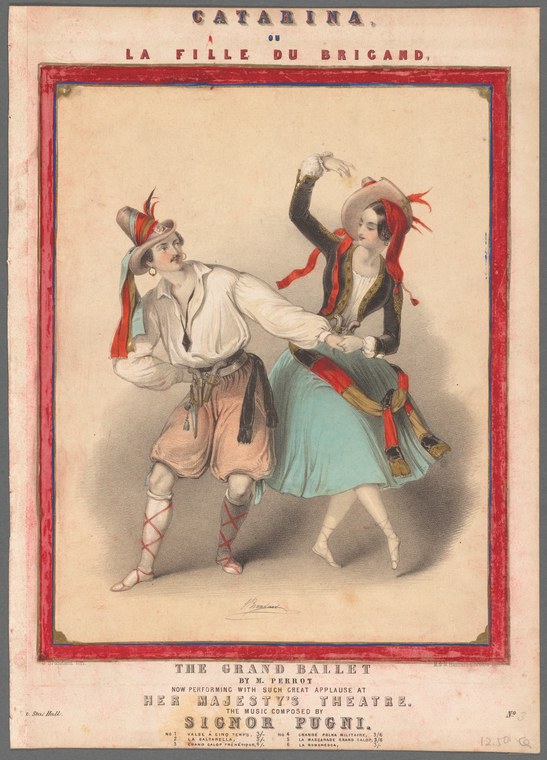
Catarina, ou la fille du brigand, the grand ballet by M. Perrot ... the music composed by Signor [Cesare] Pugni
Unknown artist
- Collection:
- Prints depicting dance
- Source:
- New York Public Library
- Rights:
- Public domain — free to use, share and adapt.
- Recorded as:
- Public Domain
Perrot's ballets are known primarily through notation and literary description, making contemporary theatrical prints like this one irreplaceable evidence of how Romantic narrative ballet was actually staged and what it looked like in motion. The image shows the dancer's body in an extreme, emotionally readable attitude that reveals how ballet of this period used exaggeration and asymmetry to convey character and dramatic meaning, rather than pursuing formal symmetry. This is material evidence of how dance was created, performed, and remembered before cinema.
What you are looking at
A theatrical scene from a Romantic-era ballet, showing two dancers in a dramatic moment of encounter or confrontation. The male dancer on the left, wearing a white shirt, tan breeches with red cross-garters, and a red-plumed hat, leans back in an exaggerated posture of surprise or alarm. The female dancer on the right, dressed in a pale blue skirt with red ribbons in her long dark hair, reaches toward him with one arm extended in a gesture of appeal or seduction. Both figures are caught mid-movement against a plain backdrop, their bodies angled toward each other in a composition that suggests narrative tension—possibly a moment of recognition, accusation, or romantic drama. The hand-colored engraving captures the theatrical heightening typical of early 19th-century ballet: elongated limbs, exaggerated expressions, and costume detail rendered with precision to convey character and mood.
The dancing
The male dancer's weight is thrown backward, his torso reclined at an acute angle, his left leg extended and right leg supporting, creating a posture of recoil or vulnerability that reads as masculine shock. The female dancer maintains a more upright but forward-leaning frame, her right arm raised and extended toward him while her left arm hangs, creating an asymmetrical silhouette that suggests pleading or accusation. Both figures are on the balls of their feet in the turned-out stance of academic ballet, and the composition suggests a moment frozen between approaching and retreating—neither figure in a stable position.
The dance depicted
This image documents a moment from *Catarina, ou la fille du brigand* (*Catarina, or the Brigand's Daughter*), a grand ballet choreographed by Jules Perrot with music by Cesare Pugni, likely from the 1840s. The scene depicts a dramatic encounter between two principal characters—possibly Catarina and a male character from the brigand narrative. The exaggerated backward lean of the male figure and the forward-reaching gesture of the female suggest a pantomimic exchange rather than pure classical choreography, which was characteristic of narrative ballets of this period. The costumes indicate character roles rather than corps de ballet uniformity, and the interaction is clearly staged for dramatic effect rather than as part of symmetric ensemble work.
How it was made
This is a hand-colored engraving, a commercial theatrical print produced for circulation among theater-goers and dance enthusiasts. The fine line-work of the engraving creates precise detail in the costumes, cross-garters, and facial expressions, while the hand coloring (visible in the skin tones, blue skirt, and red accents) was applied subsequently, making each print unique. Engravings of this type were the principal means of documenting and promoting theatrical dance to a literate public before photography; they circulated as souvenirs, playbills, and reference material. The technical capacity to render both fine anatomical detail and costume pattern made engraving the preferred medium for theatrical documentation of this era.
About this work
This is a theatrical souvenir engraving documenting a moment from a Romantic-era grand ballet by the celebrated choreographer Jules Perrot. The print captures a dramatic narrative encounter between two principal dancers, rendered in the pantomimic and emotionally heightened style characteristic of early 19th-century ballet-d'action. As a commercial engraving with hand coloring, it is both a historical record of choreography and costume, and evidence of how ballet was circulated, consumed, and remembered by the theater-going public of the 1840s.
The work belongs in a gallery of dance because it documents not just the movement vocabulary of Romantic ballet, but the theatrical apparatus around it—the celebrity of named choreographers and dancers, the narrative impulse driving ballet composition, and the commercial and visual economy of dance promotion. Perrot was one of the most influential choreographers of his era, and this image preserves a moment from a work that would otherwise be known only through textual records.
How to look at it
Attend to the asymmetry and exaggeration of the pose: neither dancer is in a position of balance or rest, and both bodies read as narrative rather than decorative. The extreme backward tilt of the male figure would be physically unstable in reality but is hyperbolized here to convey emotional shock or vulnerability. Note the precision of the costume detail—the specific pattern of the cross-garters, the ribbons in the hair, the military-style jacket—which identifies character and likely derives from the actual stage costume. The hand coloring adds specificity about fabrics and hue that the engraving line alone could not convey, and the plain background throws all attention onto the bodies and their interaction.
The artist
The artist is unknown. This is a commercial theatrical print of the type produced in Paris and London in the 1840s by publishing houses that specialized in theatrical documentation. Such prints were often unsigned or bore only a publisher's mark, as they were produced for mass circulation rather than individual artistic recognition. The engraving technique and style are consistent with Parisian theatrical publishing of this era.
The period
By the 1840s, ballet had undergone a decisive shift toward Romanticism and narrative complexity. Jules Perrot (1803–1878) was one of the dominant choreographers of this period, known for his dramatic ballets and his innovation in mime and pantomime. *Catarina* exemplifies the "ballet d'action"—a form that united classical technique with pantomimic storytelling and exotic or dramatic subject matter. Contemporaneously, lithography and hand-colored engraving were the principal media for circulating images of theatrical performance; photography of dancers was not practical until the 1870s. This print thus sits at the intersection of Romantic ballet aesthetics and the commercial culture of theatrical souvenirs and playbills that made dance visible to a wider public.
Where it lives
This is a theatrical print housed in the New York Public Library's collection of prints depicting dance, held as part of its extensive documentation of performance history. The print represents the type of commercial souvenir produced for distribution to theater audiences and for sale as standalone theatrical imagery in the 19th century.
Dance in this work
Questions about this work
Who choreographed this ballet?
Jules Perrot, one of the most celebrated choreographers of the Romantic era. He was known for his dramatic ballets and his innovations in pantomime and character work. Perrot created *Catarina, ou la fille du brigand* with music by Cesare Pugni, an Italian composer who frequently collaborated with major choreographers of the period.
How do we know this depicts Romantic ballet and not some other form?
The turn-out, the lifted port de bras, and the pointed-toe stance all indicate academic ballet training. The exaggerated emotional attitude and the narrative clothing identify it as ballet-d'action—story ballet—rather than pure classical technique. The 1840s date and the theatrical costume confirm its place in the Romantic period of dance.
Why is this image important if the ballet no longer exists?
The ballet survives primarily in written records and notational systems that capture steps but not the full theatrical life of the work. This image preserves evidence of how the choreography was physically realized on stage, how costume and character functioned, and what audiences actually saw. It is a form of historical documentation that cannot be recovered from notation alone.
How were theatrical prints like this made and circulated?
The image was first engraved—a plate was incised with fine lines that would hold ink—and then hand-colored with watercolor or gouache, making each print unique. These were sold at the theater, included in playbills, distributed to fans, and purchased as souvenirs. They were the primary means of circulating images of theatrical performance before photography.
More dance artwork





