49 works in this view — arrow keys or swipe to move between them.
Dance in Art
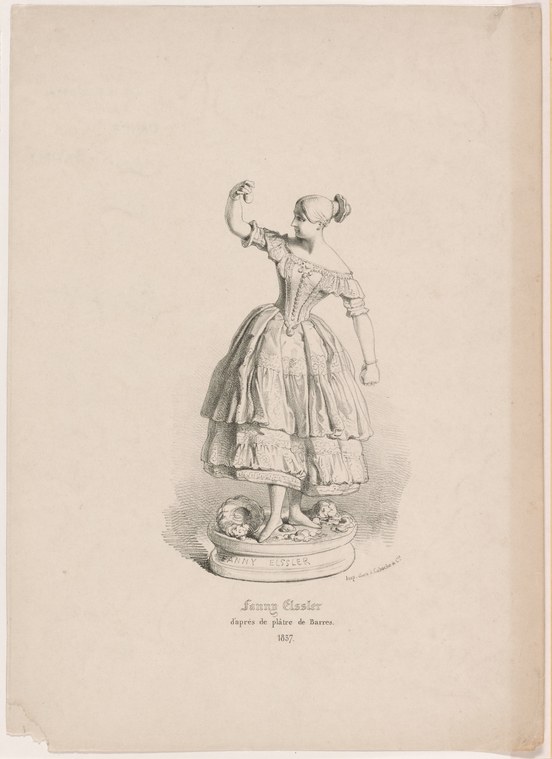
Fanny Elssler [inscribed on pedestal]
Unknown artist
- Collection:
- Prints depicting dance
- Source:
- New York Public Library
- Rights:
- Public domain — free to use, share and adapt.
- Recorded as:
- Public Domain
Fanny Elssler was a dominant figure in world ballet from the 1830s onward; she originated major roles in the earliest Romantic ballets and was one of the first European ballet dancers to achieve sustained fame in the Americas. This image, derived from a sculpture by a named artist, documents how the Romantic ballet world constructed and circulated the image of its stars, and preserves the visual record of her costume, deportment, and public persona at the height of her career.
What you are looking at
A single female figure stands alone against a plain background, her body turned three-quarters to the viewer in an attitude of restrained theatricality. She wears a romantic-era theatrical costume: a white or pale off-shoulder dress with short puffed sleeves, fitted bodice, and a full skirt with multiple layered tiers that fall to mid-calf. Her hair is arranged in ringlets pulled back from her face. Her left arm is raised gracefully at about shoulder height, the hand curved as if holding or gesturing toward an invisible object; her right arm hangs at her side. Her posture is upright and poised, her gaze directed upward and away. She stands on a shallow pedestal or platform inscribed with text. The rendering is a finely detailed engraving using fine parallel lines to create tone and volume; the figure appears luminous against the pale paper, her features delicately modeled.
The dancing
A single dancer in a classical standing position with the body turned in contrapposto, weight slightly shifted. The raised left arm is extended but not at full height, the hand softly curved in a position characteristic of early nineteenth-century stage deportment—neither a port de bras nor a reaching gesture, but a refined, contained elevation. The right arm hangs naturally. The posture suggests a moment of pause or repose rather than active movement, with the head lifted and gaze averted in a manner typical of Romantic-era theatrical convention. The figure is proportioned as an adult woman, alone, without male partner or ensemble.
The dance depicted
This is a portrait of a Romantic ballet dancer, most likely a celebrated ballerina of the 1830s–1840s. The inscription on the pedestal identifies the subject as Fanny Elssler, one of the great stars of the era. The costume—particularly the short tutu, off-shoulder bodice, and delicate pointe-capable slipper visible at the hem—is consistent with the theatrical ballet of the Romantic period. The pose is not a moment from a specific choreographed movement, but rather a formal portrait stance that presents the dancer as an artist and celebrity. Elssler was celebrated for both her technical virtuosity and her dramatic intensity; this image captures her as a public figure rather than a character in performance.
How it was made
This is a finely engraved print, executed in the tradition of steel or copper engraving typical of mid-nineteenth-century reproductive graphics. The image demonstrates the high technical standard of theatrical portraiture of the period: every detail of costume, fabric texture, and facial feature is rendered through careful parallel line work (hatching and cross-hatching) that creates subtle gradations of tone. The technique allowed for multiple impressions and wide circulation; this print likely served as both a souvenir and a promotional image, distributed to the public through print sellers and theatrical publications. The inscription 'd'après la plâtre de Barrè' (after a plaster model by Barrè) indicates this is a secondary work reproducing a three-dimensional sculpture.
About this work
This is a reproductive engraving of a portrait sculpture of Fanny Elssler, one of the most celebrated ballerinas of the Romantic era. The work presents the dancer as a fashionable celebrity and serious theatrical artist, dressed in the costume of her performances, her pose refined and contemplative rather than active. As a print, it circulated widely among the theatergoing public and served as both fan ephemera and a record of one of ballet's most important historical figures.
The image belongs in a dance art history context because it documents not only the costume and bearing of a major Romantic ballerina, but also the way nineteenth-century ballet culture presented its stars to the public. Elssler's fame was international and immense; images like this one shaped how audiences understood and remembered her. The print preserves a moment when ballet had achieved the status of high theatrical art and its greatest performers were celebrated as celebrities across Europe and America.
How to look at it
The viewer should note the extreme refinement and control of the pose: this is not a captured moment of movement, but a formal presentation of the dancer as an intellectual and aesthetic object. The gaze lifted and averted, the softly curved arm, the upright spine—all communicate restraint, cultivation, and inner life. The costume is accurate and detailed, allowing a viewer of the period to recognize Elssler's characteristic stage dress. The engraving technique creates an almost sculptural quality: the figure seems to exist in three dimensions despite being rendered in line alone. Look at the face: the engraver has given Elssler a thoughtful, composed expression rather than a smile or theatrical exuberance, emphasizing her status as a serious artist.
The artist
The engraving is credited as derivative: 'd'après la plâtre de Barrè' (after a plaster model by Barrè). The engraver's name is not recorded in the available inscription. This was a common practice in nineteenth-century reproductive printmaking: a sculptor would create a portrait in the round (the plaster), and an engraver would translate it into a widely circulated print. Such works were commercial projects, produced for the theatrical and fine-art markets. The unnamed engraver was likely a skilled reproductive artist working in Paris or another major European print center during the 1830s–1840s.
The period
This engraving dates to the height of the Romantic ballet era, when ballet had become one of the central theatrical and cultural forms of European entertainment. Fanny Elssler's career (1818–1884) spanned this period; she was a peer and rival of Marie Taglioni, and her dancing combined technical brilliance with dramatic intensity and sensuality in ways that made her a polarizing but immensely popular figure. The 1830s–1840s saw the proliferation of theatrical portraiture as a mass market; lithographs and engravings of dancers, singers, and actors were sold to audiences as souvenirs and collectibles. This print belongs to that commercial and cultural moment when a ballet dancer could be as celebrated and as widely circulated in image as any other public figure.
Where it lives
The work is held in the New York Public Library's prints collection, catalogued under 'Prints depicting dance.' The inscription dates it to 1837. It is a secondary reproductive work, created after a plaster sculpture, and would have been produced in multiple impressions for public sale.
Dance in this work
Questions about this work
Who was Fanny Elssler?
Fanny Elssler (1818–1884) was an Austrian ballet dancer and one of the most celebrated performers of the Romantic era. She was known for her dramatic presence, technical excellence, and her willingness to perform in a wider range of roles than her contemporaries. She achieved international fame and was one of the first major European ballet dancers to perform extensively in the United States, where she was received as a celebrity.
Is this an engraving or a lithograph?
This is an engraving, rendered in fine parallel lines rather than lithographic stone. The inscription indicates it was created 'after' (d'après) a plaster sculpture by an artist named Barrè, making it a secondary reproductive work. The technique and quality of line work are consistent with steel or copper engraving of the 1830s–1840s.
What does the costume tell us about Romantic ballet?
The short, full skirt (tutu), off-shoulder neckline, and delicate slipper are characteristic of 1830s–1840s theatrical ballet costume. The short length was radical and daring for its time, allowing audiences to see the dancer's footwork and leg extension. The pale, ethereal aesthetic—evident in the costume's style and the engraving's luminous rendering—was central to Romantic ballet's visual identity.
Why was this image made and distributed?
This print was created as a commercial product for the theatrical and fine-art markets. Prints of celebrated performers were sold as souvenirs to audiences and collected as records of important artists. In an era before photography became common, engravings and lithographs were the primary way a star's image circulated to a wide public, functioning much as publicity photographs do today.
More dance artwork





