49 works in this view — arrow keys or swipe to move between them.
Dance in Art
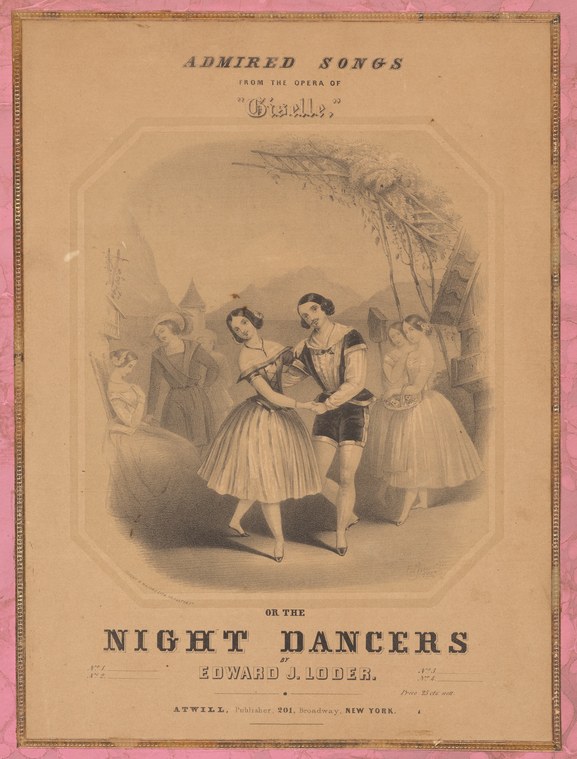
Admired songs from the opera of Giselle, or the night dancers by Edward J. Loder
Unknown artist
- Collection:
- Prints depicting dance
- Source:
- New York Public Library
- Rights:
- Public domain — free to use, share and adapt.
- Recorded as:
- Public Domain
This object sits at the intersection of dance, music publishing, and visual culture: it shows how a European ballet creation was immediately marketed to American audiences through affordable sheet music, and how lithography distributed Romantic ballet iconography to people who may never have seen the work on stage. The image is visual evidence of the Romantic ballet aesthetic in America circa 1841–1850, when the form was establishing its canonical vocabulary. For dancers, the poses offer a direct view of how Romantic ballet vocabulary was understood and represented in its own moment.
What you are looking at
This is a lithographic cover for a vocal score, showing a supernatural ballet scene set in a moonlit forest glade. Three female figures in white pointe shoes and classical ballet dress occupy the center—two in translucent skirts in graceful attitudes, one in darker dress (possibly male character or mortal), their bodies arranged in a triangular composition suggesting a dramatic moment. A fifth figure stands to the left in contemporary dress, perhaps an onlooker or the human protagonist, while in the background a misty architectural structure (a ruined chapel or castle) and leafless trees suggest a Gothic or supernatural setting. The entire scene is rendered in soft tones characteristic of Romantic-era lithography, with delicate shading creating an ethereal, nocturnal atmosphere. The composition emphasizes verticality and lightness—the dancers appear weightless, their poses suggesting movement suspended between earth and air.
The dancing
The two central female figures display the hallmarks of Classical ballet vocabulary: one stands in an attitude position with one leg raised behind, arms positioned in a soft frame; the other balances with arms extended in a graceful line. Both wear pointe shoes and the high-waisted, full-skirted white costume of Romantic ballet. The figure in darker dress stands more upright, possibly en relevé. The poses suggest moments of suspension and control rather than dynamic turning or traveling—the aesthetic typical of the Romantic era's emphasis on ethereal, otherworldly movement.
The dance depicted
This represents *Giselle* (or *Giselle, ou les Wilis*), the canonical Romantic ballet created by Adolphe Adam with choreography by Jules Perrot and Jean Coralli, first performed in Paris in 1841. The title references "the night dancers" (Wilis in the ballet are spirits of jilted brides), and the image likely depicts Act II in the graveyard, where the living hero encounters the ghost of his beloved Giselle and her corps of supernatural spirits. Edward J. Loder's score published here represents one of many contemporary vocal arrangements extracting popular melodies from the ballet for home performance—a common practice that brought operatic and ballet music into middle-class parlors. The image positions this as theatrical music for the stage-aware public rather than concert hall.
How it was made
This is a lithograph, identified by the characteristic soft tonal gradations and slightly fuzzy outlines typical of the medium. Lithography allowed rapid reproduction and wide circulation; this appears to be the cover or title page of a published vocal score, suggesting it was produced for commercial distribution rather than fine art collecting. The delicate handling of shadow and atmosphere—the misty background, the careful gradation of the dancers' skirts—demonstrates lithography's particular capacity for rendering the ethereal effects that Romantic ballet demanded. Publication by Atwill in New York indicates American circulation of this European cultural product.
About this work
This lithographic cover for a published vocal score illustrates the apotheosis of Romantic ballet spectacle: the supernatural encounter at the heart of *Giselle*. The image captures the essential aesthetic of the 1840s ballet—weightless female bodies in white, moonlit Gothic setting, the marriage of earthly and supernatural realms. As a vocal arrangement, it represents the era's appetite for theatrical music beyond the opera house, and the lithographic medium made that music accessible and affordable. For historians, it documents how ballet imagery circulated in mid-19th-century America, reaching audiences through sheet music covers as much as theater boxes. The work exemplifies the Romantic obsession with the female body as a vehicle for expressing the otherworldly and unattainable—a central preoccupation of the era's dance, music, and visual culture.
How to look at it
Attend to the moment the artist chose: not a moment of dynamic action (a turn, a jump) but one of suspension and stillness—the encounter between the mortal and the supernatural. This freeze-frame aesthetic was central to how Romantic ballet was visualized: not as movement but as sculptural pose. Notice how the lithographic technique renders the female body as almost weightless, the skirts dissolving into mist at the edges—a visual technique perfectly matched to the Romantic ideal. The Gothic architecture and moonlight are not incidental scenery but essential to the meaning: this is not court dance or village merrymaking, but a supernatural encounter that only the night and the forest make possible.
The artist
The engraver/lithographer is not recorded. Edward J. Loder (c. 1813–1865) was a British composer and conductor who emigrated to America and became active in New York musical life, conducting opera and writing for the stage and voice. He was part of the network of European musicians who brought Romantic operatic and ballet repertoire to America in the 1840s. The quality of the lithographic work suggests a competent theatrical illustrator of the period, likely working in New York's commercial music publishing industry.
The period
The 1840s saw Romantic ballet at its height in Europe: *Giselle* premiered in Paris in 1841 and was rapidly exported to London, America, and other major cities. The aesthetic—weightless, ethereal, female-centered, set in supernatural or exotic landscapes—dominated the stage and visual culture. Simultaneously, lithography had become the dominant medium for theatrical publicity and music publishing, allowing images of opera and ballet stars to circulate widely and cheaply. In America, the 1840s marked the beginning of sustained engagement with European Romantic ballet; this score represents that moment of cultural transfer. The sheet music market was vast and competitive; publishers used increasingly sophisticated lithographic covers to attract buyers and advertise performances.
Where it lives
The work is held in the New York Public Library's Prints collection, one of the largest archives of American theatrical imagery. It appears in the Library's collection as a music cover—a category of visual culture that was ubiquitous in its time but is now often overlooked by art historians focused on 'high' media like oil painting or engraving. This object is representative of tens of thousands of similar pieces documenting 19th-century theatrical culture.
Dance in this work
Questions about this work
What is Giselle and why did this ballet become so famous?
*Giselle* premiered in Paris in 1841 and became the defining work of Romantic ballet. It tells the story of a peasant girl betrayed by a nobleman, who dies of heartbreak and returns as a spirit (a Wili) to haunt him. The ballet synthesizes the period's obsessions: female suffering, supernatural themes, exotic or historical settings, and the ethereal movement of the female body. It remains in the international repertoire and is considered a cornerstone of classical ballet.
What are the Wilis?
The Wilis are the spirits of girls who died before their wedding day. In the ballet, they haunt the forest at night, forcing living men to dance until they collapse. The concept draws on Slavic folklore and the Romantic era's fascination with supernaturalism and female revenge. In Act II, Giselle joins the Wilis to protect her lover from their vengeance.
Why would someone buy this sheet music if they weren't a professional musician?
Amateur musicians and singers in 19th-century middle-class households were a huge market. Published vocal scores extracted popular melodies from operas and ballets, with piano accompaniment and a sung vocal line, making operatic and theatrical repertoire accessible at home. This allowed people to participate in or relive theatrical experiences they had seen, or to imagine experiencing them. The beautiful lithographic covers made these objects collectible and desirable.
When was this published?
The catalogue record gives the date as unknown, but the style of the lithography, the aesthetic of the ballet representation, and Atwill's active period in New York suggest publication in the 1840s or early 1850s, likely not long after *Giselle*'s 1841 premiere. American productions of *Giselle* are documented from 1842 onward.
More dance artwork





