49 works in this view — arrow keys or swipe to move between them.
Dance in Art
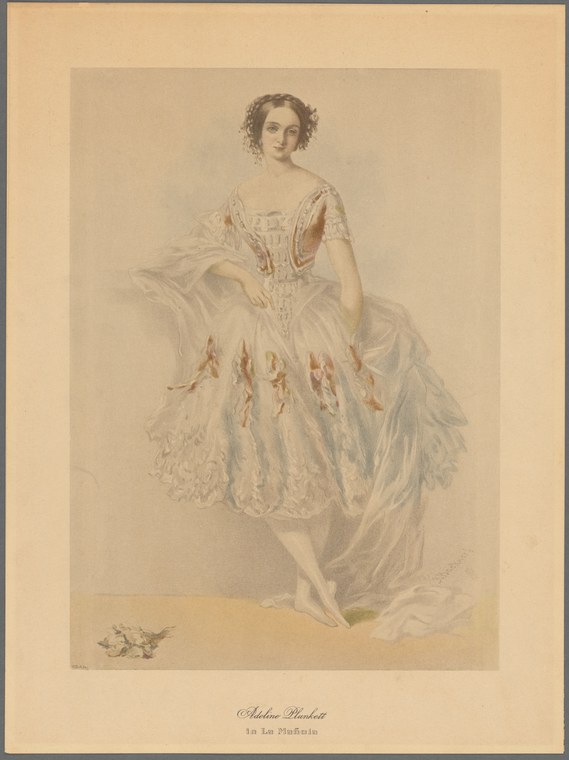
Adeline Plunkett in La Mañola
Unknown artist
- Collection:
- Prints depicting dance
- Source:
- New York Public Library
- Rights:
- Public domain — free to use, share and adapt.
- Recorded as:
- Public Domain
The image documents both a specific performer and a now-obscure theatrical dance form that was central to Romantic-era entertainment; it shows how 19th-century theater advertising functioned, and how dance—particularly character dance and exotic-themed pieces—was consumed as popular culture. The technical clarity with which the artist has rendered the costume and the weight of the dancer's body provides precise evidence of how these dances were actually performed and what the physical demands on the performer were.
What you are looking at
A young woman in an elaborate ball gown stands in a three-quarter pose against a plain ground, her weight poised as if mid-movement. She wears a corseted bodice with short sleeves and ornate embroidery or appliqué, from which cascades a voluminous skirt of gathered white silk or tulle, decorated with floral or figurative motifs in warm tones—gold, rust, and cream. The skirt sweeps dramatically to the ground and appears to be caught mid-swirl, creating multiple layers of gathered fabric that suggest she has just turned or is about to. Her dark curled hair is arranged simply, and her expression is direct and composed. A small posy or garland lies on the ground at the lower left of the composition. The drawing employs soft shading and careful modeling of the drapery to create volume and movement, with the figure rendered in what appears to be a combination of pencil and tinted wash.
The dancing
A single female figure stands with her weight shifted onto one leg in a pose suggesting rotational movement, her torso slightly angled and her skirts billowing outward as if responding to a turn. Her arms hang naturally at her sides; no partner is visible, and the pose suggests either a moment in a solo dance or the characteristic stance of a performer posed for portraiture. The silhouette emphasizes the exaggerated proportions of mid-19th-century female dress—a tiny corseted waist contrasting sharply with enormous skirt volume—which would have constrained and shaped the movement possible in any dance of the period.
The dance depicted
The title *La Mañola* refers to a Spanish or Spanish-influenced character or dance style popular in 19th-century European theater and ballet. The Mañola was typically a figure from Spanish street culture, and Romantic-era ballet frequently incorporated such 'national' or exotic character dances as divertissements or lighter moments. The costume—the ornate embroidered bodice and massive gathered skirt—is consistent with theatrical costume of the 1840s–1860s, and the figure's composed, presentational pose suggests this is a performer in a specific role rather than a social dancer. The dress and pose support a Romantic-era theatrical context, likely a ballet divertissement or character piece.
How it was made
This appears to be a colored lithograph or hand-colored lithographic print, a medium that dominated theatrical portraiture and costume documentation in the mid-19th century. The soft modeling, the way drapery is rendered with delicate shading, and the tinted washes of color applied over a drawn or printed base are characteristic of hand-colored lithography. This technique allowed fine detail and a quality of immediacy; the work could be mass-produced and circulated cheaply among theater-goers, fans, and performers. The signature or inscription at lower left appears to read 'Adeline Plunkett' and a subtitle, identifying both the performer and the role.
About this work
This is a hand-colored lithographic portrait of the dancer Adeline Plunkett in the role of La Mañola, a Spanish character dance that was likely part of a Romantic-era ballet or theatrical entertainment. The image captures both the costume and the movement of the role—the characteristic turn or pivot that the gathered skirt is designed to amplify and display. Such prints were staples of mid-19th-century popular culture, circulated as souvenirs of performances, costume references for other dancers, and images of celebrity performers. Plunkett is posed not as a social dancer in a ballroom, but as a stage performer in a fixed, legible moment—the kind of image used to advertise and memorialize a popular role.
How to look at it
Observe the moment the artist chose: the dancer is not static, but caught in what appears to be a turn, with the enormous skirt swirling outward from her tiny waist. The composition presents her full-length and frontally, making both her body and her costume legible to a viewer unfamiliar with the dance. The careful attention to the weight and volume of the fabric, and the way it responds to her movement, shows an understanding of how costume and movement work together. The soft, finished quality of the lithograph—the tinted washes and careful modeling—suggests this was a valued memento, not a quick sketch; it was meant to capture and preserve a specific performance.
The artist
The artist is not recorded. The work bears what may be a signature or inscription at lower center; the formal conventions and printing technique are consistent with mid-19th-century theatrical portraiture produced by commercial lithographic houses, particularly those serving London and continental European theater markets. Such prints were often unsigned or credited only to the lithographer or publisher, with the performer's name taking precedence.
The period
This work dates to the height of the Romantic ballet era, roughly 1840–1870, when European and American theaters were fascinated with exotic, national, and character dances as divertissements within longer ballet works. The Mañola—a figure drawn from Spanish popular culture—fits within this appetite for 'authenticity' and local color, though filtered through the conventions of academic ballet and ornate theatrical costume. At the same time, colored lithographic prints of dancers and their roles were a booming commercial market, more accessible and more widely circulated than oil paintings. The image sits at the intersection of high theatrical culture and popular print culture.
Where it lives
Held in the New York Public Library's Prints collection, identified as one of a series of hand-colored lithographic theatrical portraits. The work is catalogued as a dance-related print but carries minimal identifying information beyond the performer's name and the role title.
Dance in this work
Questions about this work
What was a Mañola and why did ballrooms and theaters want to dance it?
The Mañola was a Spanish or Spanish-influenced character, associated with folk tradition and street culture. Romantic-era ballet and theater were captivated by ideas of 'national' authenticity and exoticism; character dances like the Mañola were incorporated as divertissements—short, entertaining interludes—within longer ballets or plays. They offered contrast to classical ballet technique and gave dancers and audiences a sense of seeing 'real' culture on stage, though always filtered through a theater's conventions and aesthetics.
Why was Adeline Plunkett's portrait made as a lithograph rather than a painting?
Lithography was fast, cheap, and reproducible; a single image could be printed in hundreds of hand-colored copies and sold to theater-goers as souvenirs. Oil portraits were for wealthy patrons and major artists; these lithographs were popular entertainment, similar to modern theatrical playbills and cast photographs. The technique meant Plunkett's image could circulate widely and quickly, turning a successful performance into a celebrity artifact.
How do you dance in a skirt that large?
With great care and training. The enormous gathered skirt, essential to the visual spectacle of Romantic-era ballet and character dance, created significant drag and required a dancer to develop strength and control to move through the weight of the fabric. The turn or pivoting movement visible in this portrait—where the skirt swirls outward—was precisely the kind of moment designed to showcase both the costume and the dancer's ability to manage it. The movement and the garment were inseparable.
More dance artwork





