49 works in this view — arrow keys or swipe to move between them.
Dance in Art
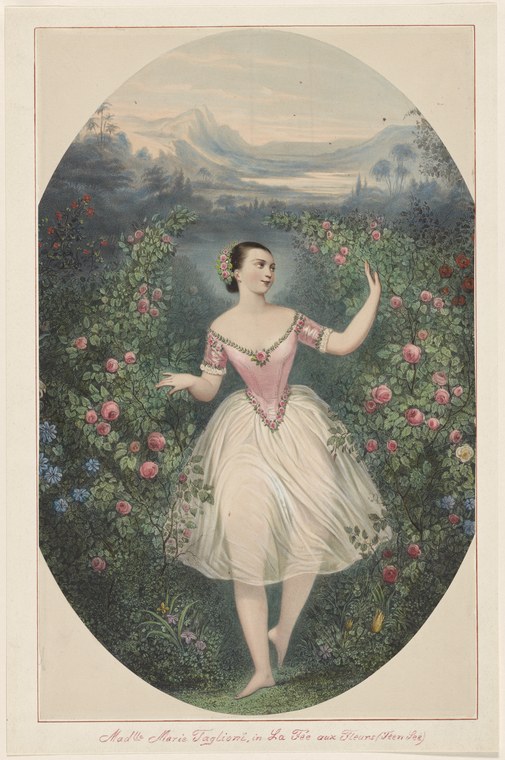
Madelle Marie Taglioni, La fée aux fleurs
Unknown artist
- Collection:
- Prints depicting dance
- Source:
- New York Public Library
- Rights:
- Public domain — free to use, share and adapt.
- Recorded as:
- Public Domain
Taglioni was the most celebrated dancer of the nineteenth century and the defining figure of Romantic ballet; this image preserves the visual vocabulary of that moment—the costume, the pose, the ethereal setting—through which audiences understood what ballet had become. For historians of dance, theater, and visual culture, the print offers evidence of how Romantic ballet was marketed, consumed, and remembered: not through photographs (which did not exist for performance) but through hand-colored prints that shaped the public memory of iconic roles and dancers.
What you are looking at
A young woman in a romantic ballet costume stands alone in an idyllic garden landscape framed by an arched border. She wears a pale tulle skirt and a pink bodice with decorative beading, her dark hair arranged in ringlets typical of mid-nineteenth-century fashion. She is surrounded by abundant flowering roses—pink, red, and white blooms with green foliage filling the composition—and holds her right arm aloft in an elegant gesture of appeal or wonder. Beyond the garden, a distant mountainous landscape with a lake or valley is visible beneath a pale sky, rendered in soft atmospheric perspective. The entire scene is contained within an oval frame, a common compositional device in prints of the period. The pastoral abundance and the woman's solitary, graceful pose suggest a moment of reverie or enchantment.
The dancing
A single female dancer is depicted in a vertical stance with weight centered, her left arm extended downward in a relaxed position and right arm raised upward and slightly back in an open, expressive gesture. Her body is upright and elongated, with her torso oriented three-quarter to the viewer. The stance suggests the poised balance and arm carriage characteristic of early Romantic ballet technique. Her feet appear to be in a classical position, though the actual footwork is largely obscured by the tulle skirt.
The dance depicted
This is a Romantic ballet image, almost certainly depicting a scene from *La Fée aux Fleurs* (The Fairy of the Flowers), a character and moment associated with the era's taste for supernatural and pastoral themes. The title naming Marie Taglioni, the preeminent dancer of the 1830s-1840s, suggests this print documents or commemorates a role danced by her. The garden setting, ethereal costume, and the dancer's isolated, meditative posture are hallmarks of Romantic ballet aesthetic—the solitary ballerina as sylph or enchanted being in a natural world. The gesture conveys the lyrical, expressive arm vocabulary that distinguished Romantic technique from earlier Classical ballet.
How it was made
This is a hand-colored lithograph, evident from the soft tonal gradations in the background landscape and the delicate color application, particularly in the flowers and sky. The process allowed for nuanced atmospheric effects—the hazy mountains and diffused light—while the oval frame was a standard feature of mid-nineteenth-century theatrical and dance imagery. Lithographic prints were the primary medium for disseminating images of celebrated dancers to a broad middle-class audience; this work would have been produced in multiple hand-colored impressions and sold as theatrical memorabilia or collected in albums of performance imagery.
About this work
This is a commemorative print of Marie Taglioni, the defining dancer of the Romantic era, in the role of the Fairy of the Flowers. It captures a pivotal moment in ballet history when the art form became associated with the ethereal, otherworldly, and feminine ideal—a shift embodied in Taglioni's technique and stardom. The image is not primarily a record of actual movement or a specific performance, but rather an idealized vision of the Romantic ballerina in her element: solitary, graceful, and immersed in a dreamlike natural landscape. It stands as both portrait and allegory of a defining aesthetic and a singular artist's influence on the art form.
How to look at it
Observe the solitude and stillness of the figure: this is not a moment of vigorous movement, but one of contemplation or enchantment—the aesthetic moment the Romantic era prized. Notice the arm gesture, which conveys emotion through a graceful, open line rather than narrative action; this expressive use of the upper body was a hallmark of Taglioni's influence on the technique. The garden setting is not merely scenery but integral to the meaning: the dancer is imagined as a spirit of nature, neither fully human nor object, a key trope of Romantic ballet ideology. The softness of the lithographic medium itself—the tender gradations of color and tone—reinforces the ethereal quality the image aims to convey.
The period
This print dates to the height of Marie Taglioni's international fame, the 1830s–1840s, when Romantic ballet was the dominant theatrical form in Europe. The Romantic movement in art and literature—with its emphasis on emotion, nature, the supernatural, and the idealized feminine—had thoroughly transformed ballet. Taglioni's technical innovations, particularly her use of the pointe shoe and ethereal upper-body carriage, made her the embodiment of the Romantic ballerina. Lithographic prints of celebrated dancers, often in their most famous roles, were a major form of theatrical publicity and fan culture; such prints were collected, displayed, and exchanged much as playbills or photographs of performers would be in later eras.
Where it lives
This print is held in the New York Public Library's collection of prints depicting dance, a major institutional repository of theatrical and dance imagery from the eighteenth through twentieth centuries. Such prints were typically issued by commercial publishers in Europe and the United States and would have been affordable enough for middle-class consumers to purchase and collect.
Dance in this work
Questions about this work
Was Marie Taglioni a real dancer?
Yes. Marie Taglioni (1804–1884) was a Swedish-Italian ballerina and the most celebrated dancer of the nineteenth century. She revolutionized ballet technique and aesthetics, popularizing the use of pointe shoes and creating an image of the ballerina as ethereal, weightless, and otherworldly. She performed throughout Europe and created or starred in numerous ballets, many of which defined Romantic ballet.
What is La Fée aux Fleurs?
The Fairy of the Flowers is a character role in Romantic ballet, emphasizing the supernatural and pastoral themes central to the era's aesthetics. Such fairy or sylph roles were standard in ballets of the 1830s–1840s and showcased the technical and expressive qualities audiences associated with the greatest dancers of the period.
Why is this a lithograph rather than a painting?
Lithography was the most practical and cost-effective technology for reproducing and distributing images of celebrated performers in the nineteenth century. A single lithographic stone could produce dozens or hundreds of hand-colored prints, making it possible to supply the demand from theaters, fans, and collectors across multiple cities and countries. Oil paintings of dancers existed, but prints were how most people encountered and remembered performance.
Is this a record of an actual performance?
Not necessarily. Such prints often conflate portraiture with idealization: they preserve the costume, the role, and the aesthetic the dancer was known for, but the specific pose and composition are typically the artist's invention, designed to convey grace and emotion rather to document literal stage movement. They function more like character sketches or allegories than photographs.
More dance artwork





