49 works in this view — arrow keys or swipe to move between them.
Dance in Art
The wreath quadrilles
Unknown artist
- Collection:
- Prints depicting dance
- Source:
- New York Public Library
- Rights:
- Public domain — free to use, share and adapt.
- Recorded as:
- Public Domain
This object illuminates how ballroom dance was imagined and sold in mid-19th-century America, and how commercial publishing shaped the visual culture of dance. The gap between what quadrilles actually were—geometrically precise group choreography—and how they were marketed—as individual romantic transcendence—reveals the period's anxieties about taste, gender, and gentility.
What you are looking at
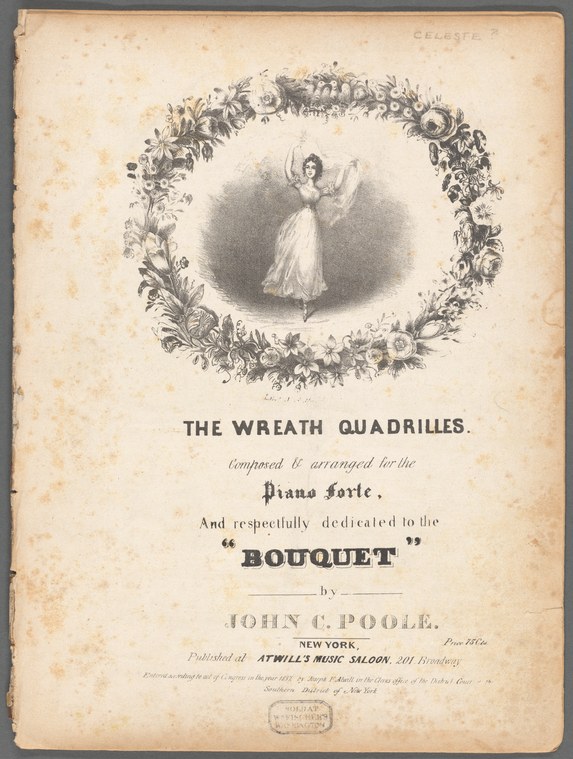
A romantic allegorical figure dominates the composition, suspended within an ornate wreath of flowers and foliage rendered in fine detail. The woman wears a classical draped white gown that seems to float around her, her arms raised in a graceful, lyrical gesture. She appears to be in motion—not walking but moving through space with an ethereal quality. The wreath framing her is densely populated with botanical forms: roses, morning glories, carnations, and scrolling vines create a luxuriant bower. The figure is rendered in soft gray tones against the lighter background, emphasizing her insubstantial, dreamlike quality. This is a title page for sheet music, with substantial text below identifying it as "The Wreath Quadrilles" composed and arranged for piano forte, dedicated to the "Bouquet," by John C. Poole, published in New York at Atwill's Music Saloon. The overall effect is that of a sentimental, mid-19th-century decorative scheme married to practical commercial purpose.
The dancing
A single female figure occupies the center, her body depicted in a three-quarter view with her left arm raised to shoulder height, the right arm positioned lower with a graceful curve. Her posture suggests upward motion or elevation rather than grounded stepping. The draped gown falls loosely, allowing freedom of movement. Her head is tilted slightly, her gaze directed upward or away from the viewer, contributing to a mood of reverie or aspiration rather than direct address. The figure is not partnered, and the emphasis is on her individual grace and the line of her body rather than on any specific technical footwork.
The dance depicted
This is dance imagery serving a commercial purpose: sheet music decoration rather than documentary record. The quadrille was the dominant ballroom form of the mid-19th century in both American and European society, typically performed by four couples in square formation. The image does not depict the quadrille in action—no couples, no formation, no visible partnership. Instead, the single floating figure embodies the ideal of ballroom dancing as romantic, graceful, and elevated above everyday movement. The woman's pose and costume reference the aspirational Romantic ballet aesthetic that dominated theatrical dance in the 1840s-1850s, even though quadrilles were social dances performed in everyday dress (though fashionable dress). The inscription identifies this as a piano arrangement, suggesting domestic or modest public performance rather than theatrical staging.
How it was made
This is a lithographic print, the standard technique for sheet music covers of the period. Lithography allowed for relatively economical mass production with fine tonal gradation and decorative detail. The soft modeling of the figure's face and the delicate rendering of the floral wreath are characteristic of mid-19th-century lithographic practice. The technique permitted both the commercial distribution of music and an art-quality presentation suitable to middle-class parlor use. The combination of image and letterpress text was typical: the lithograph was printed first, then text was added by conventional printing.
About this work
This is the cover of sheet music for a quadrille—a social dance in four movements, four couples, square formation—published in New York in the mid-19th century. Rather than depicting the actual dance, the print presents an idealized female dancer as an allegory of grace and elevation. The quadrille was the dominant ballroom dance form of its era, performed at public balls and private homes throughout America and Europe. This particular arrangement for solo piano suggests either a professional pianist accompanying public or semi-public dancing, or domestic music-making in which the dance itself was imagined rather than performed.
The work sits at the intersection of commercial music publishing, parlor culture, and the aesthetics of Romantic ballet. It demonstrates how ballroom dance was marketed and understood in its own time: not as technical accomplishment or social ritual, but as an expression of refined feeling and feminine grace. The wreath framing and allegorical presentation elevate a popular social form into the realm of sentimental art.
How to look at it
Attend first to the contrast between what the title promises—a quadrille, a geometric social dance—and what the image delivers: a solitary, floating figure. Notice the absence of the dancing body itself: no visible footwork, no clear weight transfer, no sense of contact with the ground. The raised arms and tilted head suggest emotional or spiritual elevation rather than the physical control required for actual quadrille dancing. The wreath functions as both a romantic frame and a boundary that isolates the figure from any social context. The technique of lithography—its soft tones and gentle gradations—reinforces the dreamlike quality, as if the image were capturing an ideal rather than a practice.
The artist
The composer and arranger John C. Poole is recorded on the cover but little else is known of him. The lithographic work itself is unsigned, which was standard practice for commercial sheet music covers of the period. The publisher, Atwill's Music Saloon, was a prominent New York music retailer and publisher active in the 1840s-1860s. Poole's arrangement suggests he was a working musician producing material for the domestic and public dance market.
The period
The 1840s-1850s were the height of the quadrille's popularity in America. It had arrived from France in the 1820s and dominated ballroom dancing through the Civil War era. This was also the period of Romantic ballet's greatest international reach: the aesthetics of weightlessness, ethereal femininity, and emotional expression visible in the Poole cover reflect how ballroom dancing was understood in conversation with theatrical dance. Lithographic sheet music covers were a major vector for distributing dance imagery and marketing musical taste to the middle class. The sentimentality and decorative excess of the wreath motif are characteristic of mid-century American commercial aesthetics.
Where it lives
This sheet music cover is held in the Library of Congress as part of its prints collection documenting American dance and music publishing. The New York publication date and printer's information (Atwill's Music Saloon, 201 Broadway) place it within the commercial publishing industry of mid-19th-century Manhattan.
Dance in this work
Questions about this work
What is a quadrille and how was it danced?
A quadrille is a ballroom dance performed by four couples arranged in a square. It consists of five numbered movements or "figures," each with specific choreography that the couples execute in unison. Unlike the waltz, which is a couple dance, the quadrille emphasizes formation, symmetry, and coordination across multiple couples. It requires a caller or musician to lead the dancers through the sequence.
Why does this image show a single dancer when quadrilles required four couples?
Commercial sheet music covers often used allegorical or romantic imagery rather than literal depictions of dance. The publisher wanted to appeal to middle-class consumers by associating the music with grace, refinement, and gentility. A single ethereal figure was more commercially appealing and aesthetically fashionable than an accurate but complex image of four couples in formation.
What does the wreath symbolize?
The floral wreath was a standard decorative motif in mid-19th-century commercial art, signifying luxury, refinement, and romantic sentiment. In the context of dance music, it frames the dancer as an object of aesthetic appreciation rather than a technical performer. The title "Bouquet" reinforces this floral symbolism—the music is presented as a gift or decoration rather than as notation for practical use.
Who would have used this music?
Pianists accompanying ballroom dancing—either at public or semi-public venues like hotels and assembly rooms, or in the homes of wealthy families. The arrangement for solo piano suggests a single musician providing accompaniment rather than a full orchestra. The publication by a commercial music house indicates it was produced for sale to amateur musicians and professional accompanists alike.
More dance artwork





