49 works in this view — arrow keys or swipe to move between them.
Dance in Art
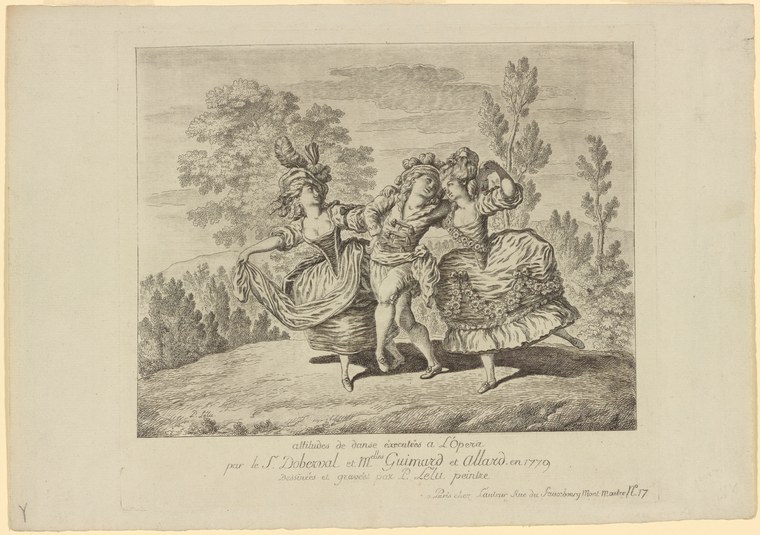
Attitudes de danse exécutées à l'Opéra par le Sr. Doberval et Melles Guimard et Alard en 1779
Unknown artist
- Collection:
- Prints depicting dance
- Source:
- New York Public Library
- Rights:
- Public domain — free to use, share and adapt.
- Recorded as:
- Public Domain
This is contemporaneous visual documentation of how three celebrated eighteenth-century dancers actually positioned their bodies in performance—not a later historical reconstruction, but an engraved record made while these artists were still performing. For historians of ballet technique, the image shows the turn-out, carriage, arm positions, and spatial relationships that defined the haute école at a specific moment before Romantic ballet emerged. For historians of Parisian theatrical life, it names the performers and confirms their visibility as high-status artists worthy of print circulation.
What you are looking at
This engraving depicts three dancers in motion against a pastoral landscape. At center, a male dancer in breeches and coat gestures expressively with both arms raised, his body angled dynamically. To his left, a female dancer in a full-skirted gown with elaborate drapery and feathered headdress moves with extended arm, her posture suggesting the lifted, ethereal quality of eighteenth-century stage performance. A second female dancer in similar costume appears at right, also in animated pose. The background shows a wooded hillside with scattered trees rendered in fine parallel lines typical of engraving technique. The foreground is a open stage floor. All three figures are caught mid-movement, their poses suggesting a choreographed ensemble or perhaps a teaching moment—the male figure's gestures could indicate he is leading or demonstrating steps. The lighting is created entirely through the density and direction of the engraved lines, giving the scene a theatrical quality characteristic of print documentation of stage performance.
The dancing
The male dancer stands with weight on one leg, his torso upright and both arms raised to shoulder height or above in an open, expressive gesture—the arms show varied flexion rather than rigid line, suggesting naturalistic movement within formality. The two female dancers assume positions of balletic grace: one with arm extended, the other in a similar elevated pose. All three appear to be on the stage floor, in a moment of sustained mid-phrase rather than frozen landing. The bodies show the characteristic turned-out leg placement and upright carriage of late-eighteenth-century theatrical dance. The relationship between the figures is suggestive of interaction or ensemble choreography rather than isolated solo performance.
The dance depicted
This depicts theatrical dance from the Paris Opéra in 1779, specifically performances by Jean-Georges Doberval and the dancers Guimard and Alard. The poses and costuming are consistent with the pantomimic and balletic vocabulary of serious opera-ballet at this period. Doberval was a celebrated male dancer of the era, known for dramatic roles and for choreographic innovation; the female dancers, particularly Guimard, were prominent soloists. The image likely documents a moment of choreographed ensemble interaction from an opera-ballet or divertissement. The theatrical setting, the formal costume, the turned-out positions, and the elevated arm placement all point to haute école ballet as performed in the French court and opera house tradition. The apparent teaching or demonstrative pose of the male figure might suggest this is a record of rehearsal or a pedagogical moment, though it could equally be a staged dramatic scene.
How it was made
This is an engraving, identified from the characteristic fine parallel lines (hatching and cross-hatching) used to model form and create tonal gradation. The technique allowed for precise reproduction and wide circulation—engravings were the primary medium for documenting theatrical performance in this period, particularly important before photography. The fineness of the line work and the careful modeling of fabric and pose suggest skilled execution by a professional engraver, likely created after a drawing or painting. The inscription in French at the bottom confirms this as a document of contemporary performance and provides naming and dating, making it a primary historical record of eighteenth-century dance praxis and costume.
About this work
This engraving records a moment from the Paris Opéra in 1779, showing three of the era's leading dancers in animated theatrical pose. The work is a primary document of late-eighteenth-century French ballet, capturing the vocabulary of movement, the formal costuming, and the physical ideals of the serious opera-ballet tradition. It sits at a moment of transition: Doberval was among the choreographers working toward reform of ballet, away from purely ornamental display toward greater naturalism and narrative coherence. The work belongs in a dance archive because it provides visual evidence of how the bodies moved, how they were dressed, how the dance was staged, and which performers commanded enough status to merit documentation in print.
How to look at it
Attend first to the moment the engraver chose: this is mid-phrase, with all three bodies in active extension or gesture, not a resting position. Notice the male dancer's expressive arm movement—this is not balletic line but theatrical pantomime, suggesting interaction or demonstration. The female dancers' lifted carriage and turned-out legs mark the haute école convention, but the slightly varied arm positions (rather than rigid line) suggest a scene of dramatic action rather than pure abstraction. The pastoral background is subordinate; the focus is the bodies and their relationship to each other on the stage floor.
The artist
The engraver is not recorded in the catalogue. The inscription credits the performers and indicates the work was made in 1779 or shortly after. The quality of execution and the formal documentation suggest a professional theatrical print workshop, likely Parisian, operating in the tradition of documenting the Opéra's leading performers for a cultivated audience. Such prints were commissioned to commemorate notable performances and to circulate images of celebrated dancers to a paying audience who could not attend the theater.
The period
The 1770s saw intense activity around the reform of French ballet, driven by choreographers including Jean-Georges Doberval and others who questioned the conventions of purely decorative dance in opera. Marie-Madeleine Guimard was one of the most celebrated dancers of the era, known for both technical brilliance and dramatic ability. The Opéra at this moment was the apex of theatrical dance in Europe, and Parisian print culture made these performances visible to a wider educated public through engravings. The formality of the costume and setting, despite the more naturalistic gesturing beginning to appear, reflects the hybrid moment between the extravagantly ornamental Baroque-influenced opera-ballet and the emerging Romantic ballet of the early nineteenth century.
Where it lives
This engraving is held in the New York Public Library as part of a collection of prints depicting dance. The inscription in French at the bottom dates the work to 1779 and identifies the three dancers and the venue (the Opéra). Such prints were produced and circulated as theatrical souvenirs and documentation, aimed at a literate, theatregoing public in Paris and beyond.
Dance in this work
Questions about this work
Who were these dancers?
Jean-Georges Doberval was a prominent French male dancer, choreographer, and reformer of ballet at the Opéra in the late eighteenth century. Mademoiselle Guimard and Mademoiselle Alard were celebrated female dancers of the same period. Guimard in particular was famous for her technique, dramatic ability, and star status at the Opéra. All three commanded enough prestige to be documented in print.
What dance are they doing?
The inscription refers to 'attitudes de danse' (dance attitudes or poses), which does not name a specific dance form. However, the formal costuming, setting, and body positions all point to serious opera-ballet or a divertissement within an opera. The vocabulary—turned-out legs, lifted carriage, raised arms—is that of the French haute école ballet tradition. This was likely a choreographed ensemble moment or teaching scene rather than a specific named dance.
How was this made?
This is an engraving, a relief printing process that uses fine lines to create image and tone. The engraver worked from a drawing or painting, laboriously cutting lines into a metal plate. Engravings allowed for precise detail and wide reproduction, making them the primary medium for circulating images of theatrical performance before photography. The skill required to achieve this level of detail meant such works were expensive and aimed at a cultured audience.
What was the Opéra like in 1779?
The Paris Opéra in the 1770s was the center of French theatrical dance and a leader in European ballet. It was a moment of transition: older conventions of purely ornamental, geometric dance were beginning to give way to reformist choreographers (including Doberval) who wanted greater naturalism and narrative. The dancers were highly trained in the turned-out, lifted technique of the haute école and were celebrated as individual stars with significant social status.
More dance artwork





