49 works in this view — arrow keys or swipe to move between them.
Dance in Art
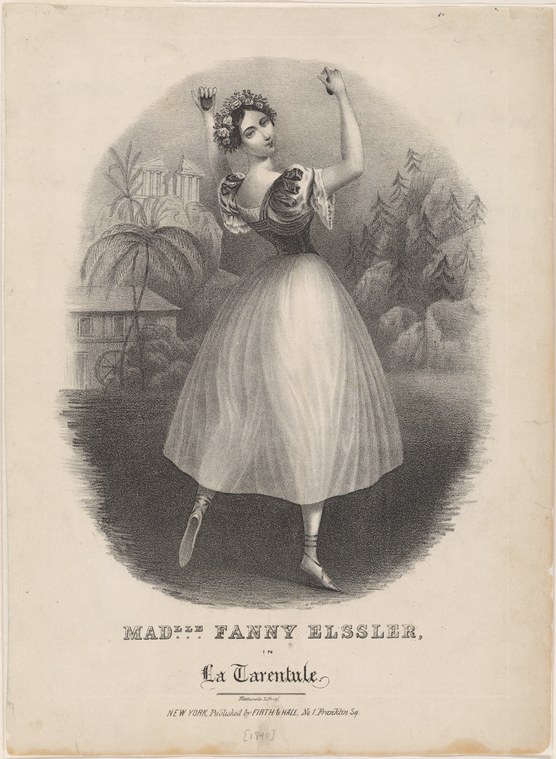
Madlle. Fanny Elssler in La tarentule
Unknown artist
- Collection:
- Prints depicting dance
- Source:
- New York Public Library
- Rights:
- Public domain — free to use, share and adapt.
- Recorded as:
- Public Domain
Fanny Elssler was one of the most influential dancers of the nineteenth century, and *La Tarantule* was one of the ballets that defined Romantic dance's departure from pure classicism toward psychological intensity and narrative drama. This image preserves the moment and the role for which she was most celebrated and most imitated, showing how Romantic dancers used their bodies to express states of mind rather than merely demonstrate technique.
What you are looking at
A young woman in Romantic-era theatrical costume stands in a graceful pose against a softly shaded background. She wears a white tulle skirt of mid-calf length, fitted dark bodice or corsage with what appears to be ornamental decoration, and her dark hair is crowned with flowers. Her arms are raised in an open, expressive frame—the right arm extended upward, the left arm raised to shoulder height—and her gaze is lifted, suggesting ecstatic or frenzied emotion. She stands en demi-pointe or on her toes, weight forward. To her left stands a potted plant; to her right, trees and what may be architectural elements recede into shadow. The engraving technique creates a luminous quality in the white skirt, which dominates the composition, while the body and setting are rendered in fine grayscale tones. The oval vignette format and the atmospheric background are typical of theatrical prints from the 1830s–1840s.
The dancing
A single female figure in a vertical, lifted frame. Both arms are raised with an open, uncontained quality—not the controlled épaulement of classical ballet but something more urgent and expressive. The legs appear to support her weight with elongation through the body, the torso upright and the head thrown back or tilted upward. The pose suggests a moment of abandon or possession rather than technical display, with the energy radiating outward through the limbs rather than contained within a centered frame.
The dance depicted
This is a portrait of Fanny Elssler, the legendary Romantic-era dancer, in the role of the Tarantula from *La Tarantule* (also known as *La Tarantelle*), a ballet that premiered in Paris in 1839 and became one of the defining vehicles of the Romantic ballet. The tarantula theme—a woman seized by a spider's bite and driven into frenzied dancing—allowed dancers to perform with an intensity and emotional expressiveness that departed from classical restraint. Elssler was famous for this role and for her ability to convey the psychological and physical states demanded by such Romantic narratives. The raised arms and lifted posture here capture the moment of possession or ecstatic movement central to the ballet's drama.
How it was made
This is a lithograph or engraving (the catalogue does not specify; the technique appears to be engraving or possibly lithographic toning based on the fine line work and grayscale rendering). The print shows the refined reproductive techniques available to theatrical publishers of the 1830s–1840s, allowing for rapid dissemination of images of celebrated dancers to a broad public. The oval vignette format and the atmospheric shading are hallmarks of theatrical celebrity portraiture of the period. Such prints were produced in large editions and circulated as both souvenirs and publicity, making them crucial to the cult of the Romantic dancer.
About this work
This is a theatrical portrait engraving of the Romantic ballerina Fanny Elssler in one of her most celebrated roles: a woman overcome by tarantula possession in the ballet *La Tarantule*. The image captures a moment of emotional and physical intensity—arms aloft, body lifted, expression turned skyward—that was central to Romantic ballet's embrace of feeling and psychological drama. Elssler's ability to convey both technical mastery and emotional authenticity made her one of the era's most influential dancers, and this print preserves a moment from one of her signature vehicles.
The work sits at the intersection of theater history, dance history, and visual culture. It is at once a record of a specific dancer's fame, evidence of how Romantic ballet choreographed emotion and abandon, and an artifact of how celebrity and performance were mediated through print in the pre-photographic era. For scholars of nineteenth-century dance, it is crucial documentary evidence; for viewers, it offers insight into what audiences saw and what mattered to them about performance.
How to look at it
Notice the asymmetry and openness of the arm frame—neither constrained nor formally composed, but radiating outward as if the body cannot contain its own energy. Observe how the artist has chosen a moment of vertical extension and emotional expressiveness rather than a closed, balanced pose. The gazing upward and the lifted posture together suggest a body in the grip of an external force (the venom, in the narrative) rather than a body in full self-control. This was a radical choice for ballet portraiture and signals the shift from neoclassical to Romantic values.
The artist
The print is attributed only to "Printpub" (likely a publisher's mark) and appears in the New York Public Library collection. It was likely produced by one of the major Parisian theatrical print publishers of the 1830s–1840s, such as Martinet or Lemercier, who specialized in celebrity portraits of stage performers. These publishers employed skilled engravers and lithographers to produce high-quality portraits from drawings or paintings supplied by theater artists or court painters. The work is unsigned in the traditional sense, which was common for reproductive prints of the period.
The period
This print dates to the height of the Romantic ballet era (c. 1830–1850), when ballet underwent a radical transformation in subject matter, technique, and affect. Romantic choreographers such as Filippo Taglioni drew on Romantic literary themes—the supernatural, the exotic, the passions—and demanded new technical vocabularies from dancers, including pointe work (which Elssler pioneered) and the ability to convey interiority and madness. *La Tarantule* premiered in 1839, a moment when such narratives of possession and bodily surrender were at the height of their popularity in European theater. The print itself reflects the era's hunger for images of celebrated performers and the new technologies that made mass reproduction possible.
Where it lives
The print is held in the New York Public Library's collection of prints depicting dance. It was produced as a theatrical celebrity portrait and was likely circulated as a print for sale to the public, making it one of the primary media through which audiences encountered and remembered their favorite dancers in the pre-photographic era.
Dance in this work
Questions about this work
Who was Fanny Elssler?
Fanny Elssler (1810–1884) was an Austrian-Italian dancer who became one of the most celebrated performers of the Romantic era. Known for her technical brilliance (she was a pioneer of pointe work), her dramatic intensity, and her ability to convey emotion through movement, she was the rival and foil to Marie Taglioni in the ballet world of the 1830s and 1840s. She performed across Europe and the Americas and was a central figure in the development of Romantic ballet.
What is *La Tarantule* and why was it important?
*La Tarantule* (1839) was a Romantic ballet based on the folk belief that a tarantula's bite caused a frenzied, uncontrollable form of dance. The ballet gave Elssler a vehicle to show her range as a dramatic performer and her mastery of virtuosic technique, and it became one of her most famous roles. It exemplified Romantic ballet's embrace of exotic, supernatural, and emotionally intense subject matter.
How does this image differ from earlier ballet portraits?
Earlier eighteenth-century ballet portraits typically showed dancers in balanced, controlled poses that displayed their technical mastery and refinement. This portrait, by contrast, captures a moment of emotional abandon and physical intensity. The raised arms, the lifted gaze, the sense of uncontrol or possession mark a shift toward Romantic values of feeling and authenticity over pure technical display.
Why are prints like this valuable historical documents?
Before photography, theatrical prints like this one were the primary visual record of how dancers actually looked in performance, what costumes they wore, and how audiences saw them. They circulated widely and shaped public memory of famous dancers and their roles. They are also evidence of how dance was marketed, celebrated, and experienced as popular entertainment.
More dance artwork





