49 works in this view — arrow keys or swipe to move between them.
Dance in Art
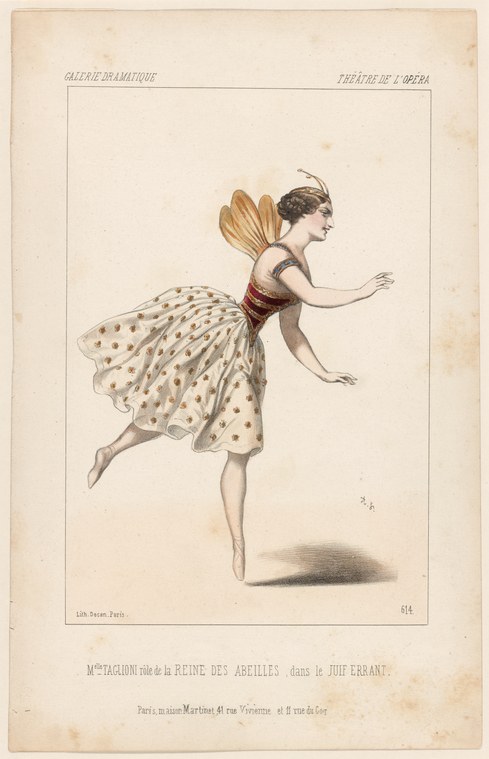
Melle Taglioni: rôle de la Reine des Abeilles, dans Le Juif errant
Unknown artist
- Collection:
- Prints depicting dance
- Source:
- New York Public Library
- Rights:
- Public domain — free to use, share and adapt.
- Recorded as:
- Public Domain
This print is direct evidence of how Romantic ballet translated fantasy into visual form: the costume, the pose, the wings, and the suspended weightlessness together create a language for expressing otherworldliness through the moving body. For dance historians, it documents both a specific work and the popular visual economy around major ballet productions—these prints were commodities, souvenirs, and advertisements rolled into one. For choreographers and dancers, it shows how theatrical fantasy was grounded in classical balletic technique, using the ballarina's trained line and elevation to make the impossible believable.
What you are looking at
A young woman in theatrical costume executes a dynamic leap or suspension, caught mid-movement against a plain background. She wears a fitted bodice with a deep red or burgundy band across the chest, and a voluminous skirt decorated with a pattern of small dark dots or spots—suggesting a bee-themed costume. Large translucent wings project from her back, shaped like those of an insect and colored in warm tones. Her dark hair is styled up and adorned with what appears to be antennae or decorative headpiece. Her body is extended in a graceful, weightless pose, one arm raised and open, the other extended, with her legs in a balletic position. She appears almost to float or hover, with her shadow falling on the ground below. The composition is theatrical and fantastical, emphasizing the illusion of flight or aerial suspension.
The dancing
The dancer's body is elongated in an airborne position, suggesting either a leap frozen at its apex or a sustained aerial effect. Her posture exhibits classical balletic line—extended limbs, pointed engagement, open carriage through the torso. The arm positions are naturalistic rather than codified, with one arm raised at approximately shoulder height and the other extended to the side, creating an open, unguarded quality. Her weight appears suspended or distributed across an imagined vertical axis, and her legs are positioned in what suggests either an extended arabesque or a preparatory leap position. The overall frame is singular and frontal, with the figure occupying the center of the composition.
The dance depicted
This is a costume study for *Le Juif errant* (The Wandering Jew), a major ballet-pantomime first staged in Paris in 1836, and shows the "Queen of the Bees" (*Reine des Abeilles*) role. The catalogue attributes it to Melle Taglioni, the most celebrated ballerina of the Romantic era, though this is likely a costume design or promotional print rather than a portrait of a specific performance. The fantasy character, the emphasis on weightless elevation, and the classical balletic line all reflect the Romantic ballet aesthetic of the 1830s–1840s, where ethereal, otherworldly roles were central to the repertoire. The insect-themed costume and aerial quality suggest the kind of imaginative scenic fantasy that Romantic ballet audiences craved.
How it was made
This is a hand-colored engraving or lithograph, a reproductive print from the period's theatrical documentation trade. The delicate linear work establishes form and detail, while selective hand-coloring—particularly in the wings, skirt pattern, and bodice—adds theatrical luminosity. The technique allowed for rapid, economical circulation among audiences, dancers, and patrons; such prints were sold in theaters and shops, functioning as both souvenirs and advertisements. The fine detail and pale tinting preserve the lightness and fantasy of the original design, suggesting this was made for wide distribution rather than as a unique artwork. The presence of publication marks (*Lith. Thalès 2bis* and the number 614) indicates it was part of a numbered series, likely a theatrical costume or character gallery.
About this work
This is a costume design or theatrical print documenting a fantastical character role from mid-nineteenth-century French Romantic ballet. It represents the visual and kinetic imagination of the Romantic period, when ballet embraced supernatural, fairy-tale, and exotic themes as a vehicle for demonstrating weightlessness, grace, and the illusion of flight. The Queen of the Bees was a minor but memorable role in a major work; this print circulated among theatergoers and dancers to commemorate it and market the spectacle. The image is valuable both as a record of choreographic fantasy and as evidence of how Romantic ballet costumes were designed, distributed, and consumed as popular visual culture.
The work belongs in a gallery of dance because it documents not just a character but an entire aesthetic moment: the triumph of illusion-making in theater, the cult of the ballerina's body, and the emergence of fairy-tale narrative as the dominant form of European theatrical dance. It is a primary source for understanding how dance was imagined, marketed, and consumed in the Romantic era.
How to look at it
Observe the moment the artist chose: not the beginning or end of a leap, but the weightless instant of suspension, where the body appears to defy gravity. Note how the wings are rendered as translucent and delicate, almost as an extension of the dancer's own grace rather than a heavy prop. The posture is classical—extended limbs, pointed feet, open arm positions—yet the overall effect is dreamlike, unanchored. The insect costume allows the artist to justify an impossible pose; the wings do the visual work of explaining how she floats. This is a key convention of Romantic ballet design: the costume creates permission for the body to behave in ways nature does not allow.
The artist
The artist is not recorded. The print bears production marks indicating it was published in Paris by the firm Thalès as part of a numbered series, suggesting it was a commercial theatrical print rather than a fine art print. Such prints were typically made by collaborative teams—a choreographer or costume designer would provide drawings, which were then translated into engravings or lithographs by skilled reproductive artists. The quality and finish suggest a professional theatrical publisher marketing images of major Parisian productions to a broad audience.
The period
This print dates to the height of French Romantic ballet, roughly 1836–1850. The aesthetic reflects the movement's obsession with weightlessness, transformation, and the supernatural: fairies, sylphs, nymphs, spirits, and enchanted creatures populated the stage. *Le Juif errant*, despite its religious subject matter, was conceived as a vehicle for spectacular scenic effects and fantastical interludes. The Queen of the Bees epitomizes this: she has no narrative function but exists to demonstrate spectacle and ethereal beauty. Taglioni's dominance of the stage during this period meant that roles she danced were instantly famous, and prints like this one were produced and sold as mementos. The theatrical print market was booming in 1830s–1840s Paris, a sign that ballet had become mass entertainment.
Where it lives
This is a hand-colored theatrical print from the *Prints depicting dance* collection at the New York Public Library. It is part of a numbered series (614) produced by the Paris-based publisher Lith. Thalès, a commercial firm specializing in theatrical costume prints. Such prints were sold in and around theaters during the 1830s–1840s as souvenirs and promotional images.
Dance in this work
Questions about this work
Was this actually danced by Marie Taglioni?
Almost certainly yes. Taglioni was the leading ballerina of *Le Juif errant* at its premiere in 1836 and performed in it for years. The attribution on the print ("Melle Taglioni: rôle de la Reine des Abeilles") suggests this is a record of her performance. However, this is a print *after* the fact, not a contemporary drawing from the stage, so it represents the memory or fame of the role rather than a direct artistic portrait.
How did a dancer actually perform this levitating?
Through a combination of technique, illusion, and possibly mechanical aid. The pose could be executed as a supported jump or leap (held momentarily at its peak by a male dancer, though none is shown here). The wings and the upward arm gestures direct the eye toward the visual fantasy of flight. Romantic ballet also used theatrical lighting, paint effects, and even hidden mechanical apparatus to enhance the illusion of weightlessness. This print shows the ideal image; the mechanics of the stage were its own secret.
What was *Le Juif errant*?
*The Wandering Jew* was a major five-act ballet-pantomime choreographed by Jean-Auguste Mérante and others, with music by Adolphe Adam, premiered in Paris in 1836. It was a spectacular production blending narrative (a retelling of the Wandering Jew legend) with fantastical interludes. The Queen of the Bees was one such interlude, a moment of pure fairy-tale spectacle with no connection to the plot—typical of Romantic ballet's strategy of framing exotic or supernatural episodes as dreams, visions, or enchantments.
Why print and circulate an image of a minor character?
Because Taglioni was a superstar and anything she did was marketable. More broadly, these prints served multiple purposes: they preserved memory of major productions, advertised the spectacle to potential theatergoers, functioned as souvenirs for attendees, and provided dancers with visual reference for roles and costumes. They were affordable and portable, making them ideal for a mass theatrical public in the age before photography.
More dance artwork





