49 works in this view — arrow keys or swipe to move between them.
Dance in Art
Piramo e Tisbe
Unknown artist
- Collection:
- Prints depicting dance
- Source:
- New York Public Library
- Rights:
- Public domain — free to use, share and adapt.
- Recorded as:
- Public Domain
This work is valuable evidence of how Renaissance and Baroque court dance was understood and represented in visual culture. It shows that engravers considered dance worthy of detailed, skilled documentation, and that the pose, gesture, and costume of dancing figures carried meaning legible to educated viewers. For historians of dance, it reveals the relationship between theatrical narrative and bodily movement in court performance.
What you are looking at
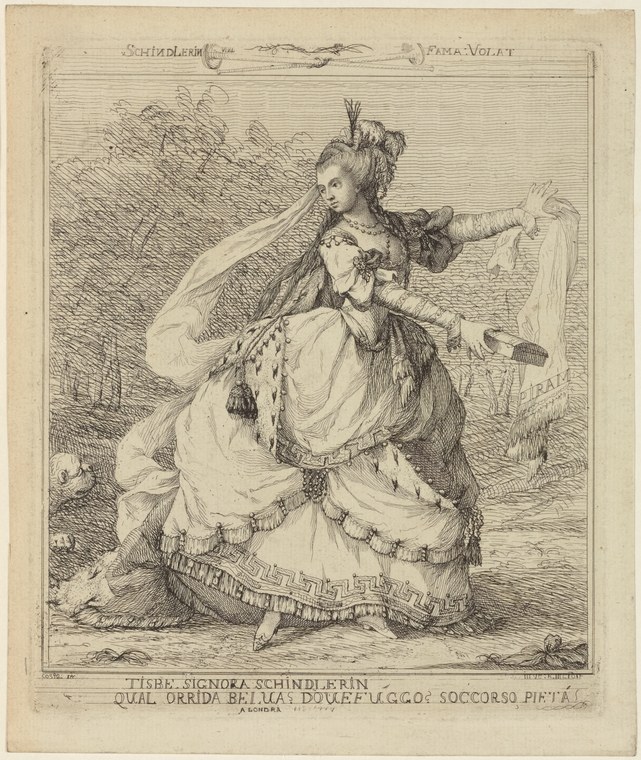
A young woman in elaborate court dress dominates the composition, captured mid-movement in what appears to be a theatrical or allegorical moment. She wears a heavily decorated gown with a fitted bodice, full skirt with layered hems trimmed with geometric patterns, and a flowing cape or mantle draped asymmetrically across her body. Her hair is elaborately dressed with feathers or ornamental plumes, and her pose suggests dynamic motion—one arm extended outward in a gesture of flourish or command, the other raised toward her companion. Behind and beside her stands a younger figure, possibly a child or attendant, dressed more simply. The setting is sketched with hatching that suggests an interior or garden space with architectural elements in the background. The engraving's fine lines and controlled crosshatching create a sense of movement and fabric texture, emphasizing the swirl of the costume and the theatrical nature of the moment.
The dancing
The primary figure is captured in an open, expansive pose with asymmetrical arm placement—one arm extended laterally and slightly upward, the other positioned differently, suggesting a moment of turning or rotating movement. Her weight appears shifted, with the body angled in contrapposto. The secondary figure is positioned lower and to the side, creating a compositional hierarchy. Both figures are upright and elegant in bearing, with no indication of close partner contact or ballroom hold. The pose reads as theatrical display rather than social dance partnership.
The dance depicted
This image illustrates a narrative moment from the Renaissance or early Baroque court, possibly depicting allegorical or mythological content (the title references Pyramus and Thisbe, the tragic lovers from Ovid's Metamorphoses). The figure's pose and costume suggest court dance of the 16th–17th century—the kind of stately, processional, or pantomimic movement that characterized court masques and ballet de cour. The elaborate costume and theatrical presentation indicate this is not vernacular social dance but rather a formal, spectacle-based performance in which a noble or professional performer demonstrates pose, gesture, and refined bodily deportment. The engraver has frozen a moment of courtly movement emphasizing elegance, status, and narrative expression.
How it was made
This is a finely executed engraving, identifiable by its characteristic linear hatching, crisp lines, and monochromatic tonal range. The artist has used parallel and crosshatched lines of varying density to create volume, fabric texture, and atmospheric depth. Engraving was the primary medium for reproducing and circulating images of court performance in the 16th and 17th centuries, making this work likely intended for a scholarly, noble, or artistic audience rather than a mass public. The precision of the technique suggests professional execution and implies this image held documentary or commemorative value—recording either an actual performance or an ideal of courtly movement.
About this work
This engraving depicts a figure from the story of Pyramus and Thisbe in the costume and pose of 16th- or 17th-century court dance or masque performance. The elaborate dress, theatrical gesture, and narrative framing place it within the tradition of aristocratic spectacle dancing that flourished in Renaissance and early Baroque Europe. The engraving preserves an ephemeral art form—court dance and masque—through a visual medium designed for circulation among educated elites. It documents not actual steps or technique but rather the aesthetic ideals of courtly movement: dignity, elaborate costume, asymmetrical elegance, and the fusion of dance with narrative performance.
How to look at it
Attend to the costume first: every element—the plumes, the fitted bodice, the geometric-trimmed hem, the flowing mantle—signals elite status and theatricality. Then follow the line of the body: the angle of the torso, the extension of the arms, and the tilt of the head together create a sense of graceful motion arrested mid-gesture. The artist has chosen not a symmetrical, static pose but a fleeting moment of turning or flourishing, suggesting movement even in stillness. This captures the essence of court dance as it was valued—not for virtuosity in footwork but for the elegant, expressive deployment of the entire costumed body.
The period
Court dance in the 16th and 17th centuries was a central practice in aristocratic life, combining movement, music, costume, and narrative in the form of ballets de cour and masques. These performances were tools of political display and artistic patronage, often commissioned by royal courts to celebrate dynastic events or to dramatize classical and allegorical themes. Engraved images of performers and dance moments circulated among courtiers and scholars, serving as mementos of performances and as ideal representations of courtly grace. The choice of Pyramus and Thisbe—a classical narrative of thwarted love—was typical of court spectacle, which favored mythological and tragic subjects as frameworks for displaying skill and emotional refinement.
Where it lives
The work is held in the NYPL Prints collection as part of a series depicting dance-related imagery. It is catalogued under the title 'Piramo e Tisbe' with the inscription visible at the bottom of the print.
Dance in this work
Questions about this work
Is this an actual historical dance or a theatrical pose?
It is both. The figure is posed in the manner of court dance or masque performance—a theatrical art form that combined stylized movement, gesture, and narrative. The pose itself may represent an actual step or flourish taught in dancing schools of the period, or it may be an idealized representation of courtly movement. The engraver was interested in capturing the aesthetic and narrative moment rather than technical accuracy.
What does the clothing tell us about the dance?
The elaborate costume—layered, draped, and heavily ornamented—reveals that this was not popular or vernacular dance but an elite, courtly practice. The voluminous skirt and flowing mantle required specific movement qualities: turning movements that display the fabric, controlled walking and gliding, and gestures of the arms that showcase the costume and project courtly deportment. The costume was not merely decoration but an integral element of the dance itself.
Why would anyone commission an engraving of this particular moment?
Court performances were major cultural events commissioned by royal patrons, and visual documentation through engravings extended the reach and memory of these spectacles. A scene depicting the Pyramus and Thisbe narrative would have appealed to educated collectors and courtiers familiar with classical literature. The image served as a souvenir, a work of art in its own right, and perhaps also as a record of a specific court performance.
More dance artwork





