49 works in this view — arrow keys or swipe to move between them.
Dance in Art
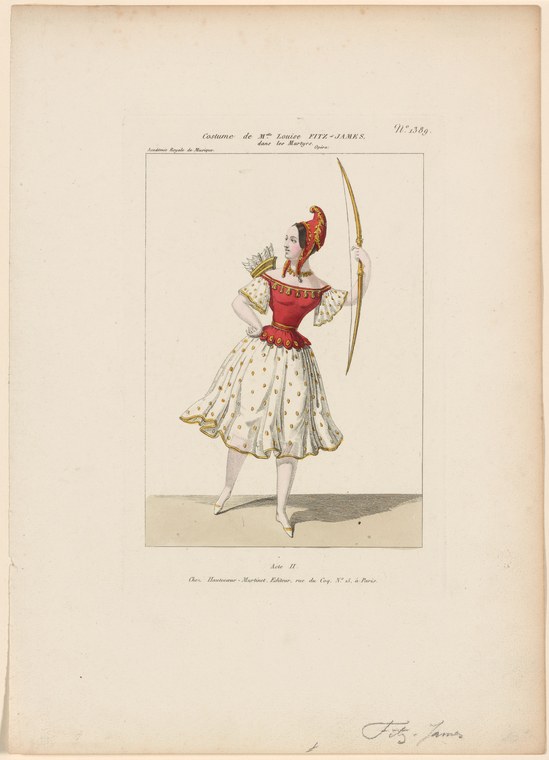
Costume de Melle. Louise Fitz-James dans Les martyrs, Opéra, acte II
Unknown artist
- Collection:
- Prints depicting dance
- Source:
- New York Public Library
- Rights:
- Public domain — free to use, share and adapt.
- Recorded as:
- Public Domain
Costume plates are among the most direct records we have of how theatrical dance looked in the 19th century before photography became standard. This plate documents not only the costume and props of a specific role, but the body position, carriage, and presentational style expected of a principal dancer in opera-ballet—information no written description could convey.
What you are looking at
A single female dancer stands in profile against a neutral background, posed as if mid-performance. She wears a striking red bodice or corseted top trimmed with white lace at the neckline and sleeves, paired with a voluminous cream-colored skirt decorated with small red or rust-colored dots scattered across the fabric. Her reddish-brown hair is styled up and adorned with a tiara or decorative headdress. Most distinctively, she holds an archer's bow in her raised right hand, with an arrow nocked and drawn, her left arm extended downward in a graceful line. She stands en pointe or nearly so on her left leg, her right leg slightly bent. The composition is a formal costume plate, a type of document-record common in opera and ballet production, showing precisely how a performer appeared in a specific role and moment.
The dancing
The dancer's weight appears to rest on one leg in a ballet-derived stance, with the supporting leg nearly straight and the free leg softly bent. Her frame is elongated and graceful, with the arrow-holding arm raised to eye level in what appears to be an archery stance adapted for theatrical presentation. The gesture is performed and controlled rather than naturalistic—her left arm hangs with classical line, her fingers extended, her torso held upright with the formal carriage expected of operatic dance. The pose is static and presentational, designed to be read and remembered rather than to capture a moment of motion.
The dance depicted
This is a costume plate from a 19th-century opera production, almost certainly documenting a principal female dancer's role. The archery pose and the title's reference to 'Les Martyrs' (The Martyrs) suggest a dramatic or semi-heroic role, possibly one involving a hunting or warrior scene common to Romantic-era opera. The dress and presentation follow theatrical ballet conventions of the period, though the emphasis on the archery prop and the static, presentational pose indicate this is opera-ballet rather than pure ballet—a role sung as well as danced. The identity of the performer (Melle. Louise Fitz-James) and the specific role in Donizetti's or Spontini's *Les Martyrs* would need to be confirmed through opera archives, but this is clearly a record of professional stage costume and a specific scene.
How it was made
This appears to be a hand-colored engraving or etching, a standard format for theatrical costume documentation in the 19th century. The precision of the line-work, the even application of color (particularly in the red bodice and dotted skirt), and the clean white paper ground are consistent with engraved copper or steel plates, then colored by hand or through stenciling. Such prints were produced in series, sold as souvenirs and records of current productions, and often collected by theater enthusiasts and dancers themselves. The technique allowed for multiple copies to be made from a single plate, making this a distributed, public record rather than a unique artwork—a form of theatrical documentation and publicity.
About this work
This is a costume plate documenting a named performer, Louise Fitz-James, in a specific role from a 19th-century opera production. It belongs to a large archival category of theatrical prints that served simultaneously as souvenirs, costume records, and publicity material. The work is valuable not for its artistic merit but for its documentary precision: it tells us exactly how a professional dancer appeared in a celebrated role at a particular moment in theater history, preserving details of dress, pose, and character that would otherwise be lost. For dance historians, such plates are primary sources for understanding how bodies were positioned, dressed, and presented on the opera stage before the age of photography.
How to look at it
Notice the precision with which the costume is rendered—every fold of the skirt, every pleat and trim is recorded, as if the print were a technical specification rather than an artistic interpretation. The pose is frozen and formal, designed to show the full costume clearly rather than to suggest motion; the archer's stance is theatrical convention rather than anatomical naturalism. The hand-coloring adds information the engraving alone could not convey: the specific shade of red in the bodice, the delicate dots on the skirt. For a dancer or costumer, this image would have served as a instruction sheet for recreating or remembering the role.
The period
This costume plate dates to the early-to-mid 19th century, an era when opera-ballet was the dominant form of theatrical dance in Europe. The composition and printing technique place it within a well-established tradition of theatrical documentation; such plates were produced by the dozens for every major new production and were sold at the theater or through print shops. The role itself—a young female dancer in classical dress performing archery—reflects the Romantic era's fascination with graceful, ethereal femininity often placed in dramatic or hunting scenarios. The print's format and distribution made performers and their roles visible to a public beyond those who could attend the theater, creating a form of celebrity documentation.
Where it lives
The work is held in the New York Public Library's collection of prints depicting dance, part of the institutional record of theatrical and performance history. It is one of many such costume plates in that collection, documenting European opera and ballet from the 18th and 19th centuries.
Dance in this work
Questions about this work
Who was Louise Fitz-James?
A professional dancer in 19th-century European opera, known for principal roles in major productions. Beyond what this plate tells us—her appearance in this specific role and costume—detailed biographical information would require consultation of theater archives or specialized dance history sources. Her prominence was sufficient to warrant a published costume plate, indicating she was a celebrated performer.
What is 'Les Martyrs' and why is a dancer shooting an arrow?
Les Martyrs (The Martyrs) is a grand opera, likely Spontini's 1840 revision of his earlier work. The archery pose suggests a scene involving hunting, warfare, or a historical/mythological female character. Romantic-era opera often included dance scenes involving weapons or martial imagery as part of dramatic spectacle.
How was this print made and distributed?
It is a hand-colored engraving, produced by engraving a design into a metal plate, then inking and printing it on paper. Hand-coloring was applied afterward, either by individual artisans or through stenciling. Such plates could produce many copies, making them affordable souvenirs and promotional materials. They were sold at theaters or through print dealers.
Why are costume plates important for dance history?
Before photography, costume plates were the primary visual record of how performers actually looked on stage. They preserve details of dress, decoration, body position, and the spatial relationship between body and costume that no written description or later recollection could convey with such precision. For historians studying 19th-century theatrical dance practice, they are irreplaceable primary sources.
More dance artwork





