49 works in this view — arrow keys or swipe to move between them.
Dance in Art
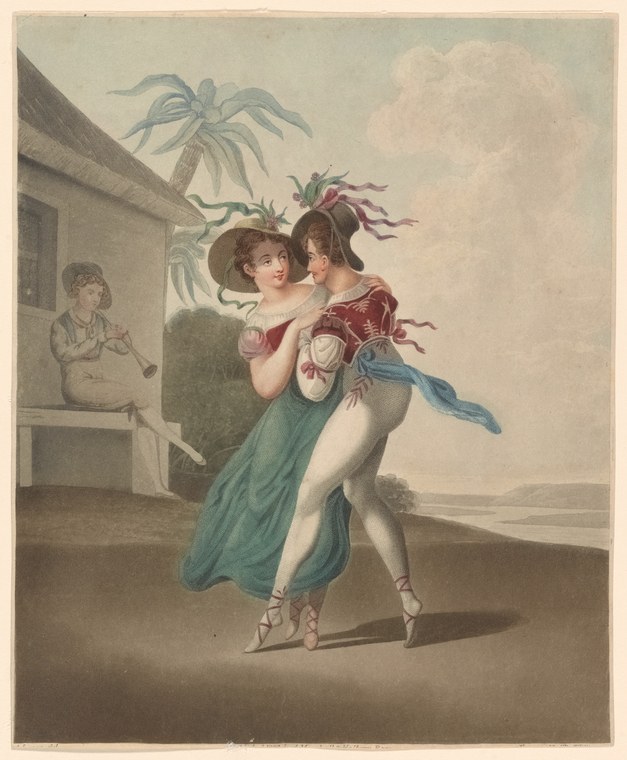
Dancers in theatrical folk costume
Unknown artist
- Collection:
- Prints depicting dance
- Source:
- New York Public Library
- Rights:
- Public domain — free to use, share and adapt.
- Recorded as:
- Public Domain
This image is documentary evidence of how Romantic ballet bodies moved and were presented to audiences in the early 19th century, before photography. The engraving captures not just costume but the actual balletic frame, carriage, and line that defined the period's aesthetic. For dancers and historians, it illustrates the continuity between Romantic ballet and contemporary classical technique, and the centrality of female soloists and their bodies to the era's theatrical imagination.
What you are looking at
A young woman in a burgundy silk dress dances alone in a sunlit, columned space that opens onto a distant landscape. Her pose is caught mid-movement: she balances on the ball of one slippered foot while the other leg extends behind her, her upper body tilted slightly forward in a posture that suggests lyrical momentum. Her arms curve expressively, one raised and softly angled. Her dark hair is dressed with ribbons that stream behind her head, amplifying the sense of motion. In the left background, a small figure—possibly a musician or observer—sits at a table near the colonnade. The setting suggests an idealized theatrical or pastoral space rather than a real interior: the architecture is classical but spare, the distant landscape hazy and undefined. The light is soft and warm, creating a dreamy atmosphere typical of Romantic-era theatrical imagery.
The dancing
A single female dancer carries the entire composition. She stands on one leg with considerable turnout, the supporting foot en relevé or fully pointed, creating an extended vertical line. Her free leg is lifted behind her in a position suggesting développé or an arabesque-like extension. Her torso is angled forward from the hips with a gentle curve through the spine—a characteristic Romantic balletic carriage. Both arms are raised and curved, with hands extended in a soft, articulate manner. The overall frame is one of weightless suspension, with the body's line suggesting upward lift despite the forward tilt.
The dance depicted
This appears to be Romantic ballet of the early-to-mid 19th century, likely French or Italian in origin. The single female figure, the emphasis on ethereal weightlessness and extension, the pointed slippers, and the idealized pastoral setting are hallmarks of the Romantic ballet aesthetic. The pose itself—a sustained balance on one leg with the other lifted—is central to classical ballet vocabulary. The costume and setting suggest a theatrical rather than social context, and the figure's isolated prominence indicates this is a prima ballerina in a solo variation rather than a group or partnered moment. The artist has captured a brief moment of suspended balance, emphasizing the dancer's elongation and the illusion of effortlessness that Romantic ballet cultivated.
How it was made
This is a hand-colored engraving or aquatint, a technique that allowed mass circulation of theatrical imagery in the 19th century. The warm tones, subtle gradations, and soft edges suggest aquatint or etching with hand color applied in layers, possibly with watercolor or gouache. The technique was ideally suited to dance imagery because it could render both the crisp definition of architecture and costume and the softer modeling of flesh and drapery. Such prints were popular souvenirs of performances and circulated widely among theater-goers and collectors, making them a primary record of how Romantic ballet looked to its contemporary audience.
About this work
This is a Romantic-era theatrical print documenting a female ballet dancer in a characteristic pose of the period. The work captures the essence of early 19th-century dance aesthetics: a solitary, weightless figure in an idealized setting, emphasizing the illusion of effortless elevation and extension that defined the era's most celebrated performances. The dancer's costume—the silk dress, ribboned hair, and pointed slippers—and her extreme turnout and lifted posture mark this as theatrical ballet rather than social or folk dance. The print was likely created to commemorate a specific performance or dancer and would have been sold to enthusiasts and collectors.
How to look at it
Notice first the precise articulation of the dancer's feet and legs: the turnout, the pointed slippers, and the lifted, extended position. The artist understood the physical language of ballet and rendered it accurately. Observe how the body's line flows upward through the supporting leg despite the forward angle of the torso—this is the paradox of Romantic balance, where the dancer appears light despite working against gravity. Look at the costume: the flat slippers (not pointe shoes as we know them), the simple silk dress, and the streaming ribbons are all historically accurate details of the 1830s–1850s. The setting and lighting are equally important: the classical colonnade and hazy landscape create an idealized, otherworldly frame that elevates the dancer into a realm beyond the everyday. This is not a naturalistic scene but a theatrical vision.
The period
This work dates to the height of European Romantic ballet, roughly 1830–1860. This was the era of Marie Taglioni, Carlotta Grisi, and the cult of the ballerina as an otherworldly, almost supernatural figure. Choreographers like Filippo Taglioni and Jean Coralli created works that emphasized pointe work, weightlessness, and the ballerina's isolation as the central spectacle. Prints and lithographs of famous dancers were produced in vast quantities and were as widely consumed as today's performance photography. The ethereal, pastoral aesthetic in this image—with its soft light and classical architecture—reflects the period's fascination with the supernatural and the ideal. This was also the era when ballet was definitively establishing itself as a primarily female-centered art form in European theaters.
Where it lives
This print is held in the New York Public Library's collection of prints depicting dance. It is part of the broader 19th-century documentation of theatrical dance through commercial printmaking, when such images were primary records of famous performances and dancers.
Dance in this work
Questions about this work
Is this a real dancer or an idealized figure?
Likely both. The print may commemorate a specific celebrated dancer and performance, but the artist has also idealized her body and positioned her in a dreamlike setting that emphasizes the Romantic ballet aesthetic rather than documentary realism. The accuracy of the dance position and costume suggests knowledge of actual practice, but the pastoral setting and soft light are theatrical conventions rather than descriptions of a real theater.
What are those slippers?
They are soft ballet slippers of the early 19th century—likely satin or leather, flat at the sole with minimal shaping. The pointe shoe as a rigid, reinforced shoe did not become standard until later in the 19th century. However, dancers at this period did begin to rise onto the ball of the foot (relevé) for certain movements, as this image shows, creating the illusion of weightlessness that defined Romantic ballet.
Why is she alone?
The isolation of the ballerina was central to Romantic ballet's appeal. While group scenes existed, the genre's most iconic moments featured a single female dancer highlighted, often in a supernatural or ethereal context. Her solitude emphasizes her as the object of spectacle and admiration, a convention that persists in classical ballet today.
More dance artwork





