49 works in this view — arrow keys or swipe to move between them.
Dance in Art
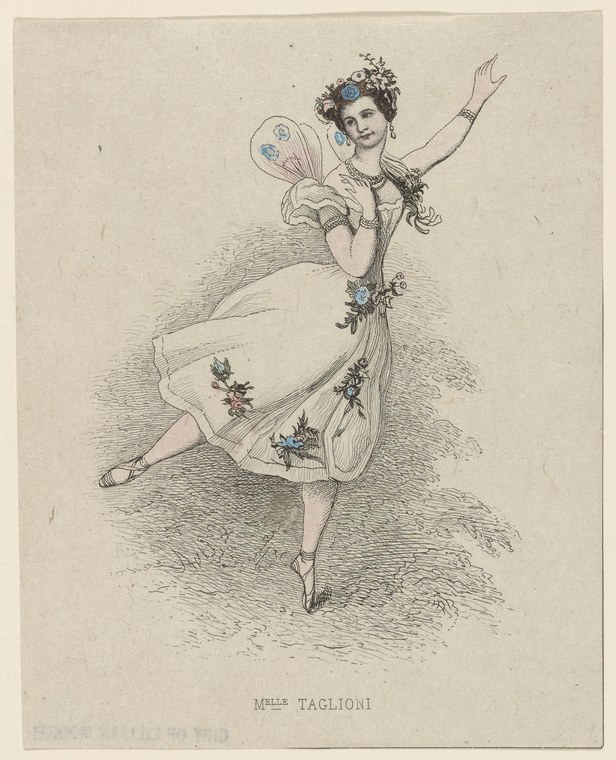
Melle. Taglioni
Unknown artist
- Collection:
- Prints depicting dance
- Source:
- New York Public Library
- Rights:
- Public domain — free to use, share and adapt.
- Recorded as:
- Public Domain
Taglioni is the founding figure of Romantic ballet and the first truly international dance superstar; her image in prints like this shaped how people around the world understood what ballet was and could express. This particular work is valuable because it captures the visual language of early-nineteenth-century female ballet: the costume, the accessories, the elevation, and the emotional tone that made Romantic ballet revolutionary. For students of dance history, it is both a primary document and an artwork—evidence of how the period represented itself to itself.
What you are looking at
A solo female dancer in mid-leap, captured in a moment of exuberant elevation against a plain background. She wears a white knee-length dress with a full skirt caught mid-swirl, puffed sleeves, and decorative floral garlands at the bodice and waist. Her hair is styled up with flowers woven through, and she wears what appears to be a jeweled ornament in her hair. Her right arm extends upward and outward in a graceful arc while her left arm holds a large translucent fan decorated with peacock feathers or similar ornamental details. Her body is weightless, her left leg raised high behind her in a nearly horizontal extension. The composition is a three-quarter view, intimate and focused on the dancer's form and the delicate rendering of her fabrics and accessories. The engraving technique creates fine hatching in the shadow beneath her that anchors the figure in space without a full stage setting.
The dancing
A single dancer in a sustained aerial position, her body fully extended in a pose of classical lightness. The raised leg and arched back suggest a vocabulary of elevation and extension typical of romantic-era pointe work, though the exact position is neither a formal ballet position nor an academic turnout. Her arm-port and the tilt of her head convey narrative expressiveness—she is not presenting technique for its own sake but embodying a character or emotional state. The fan held in the lower hand is an accessory that reads as both prop and part of the movement vocabulary, suggesting a choreography that incorporates such objects.
The dance depicted
This is almost certainly a portrait of the Romantic ballet dancer Marie Taglioni (1804–1884), one of the supreme figures of early nineteenth-century dance. The title "Melle. Taglioni" confirms this. The work likely dates from the 1830s–1840s, when Taglioni's fame was at its height and her image was circulated widely in prints. The pose, dress, and accessories align with the romantic idiom she epitomized: the ethereal quality, the emphasis on the illusion of weightlessness, the decorative femininity, and the use of props. Taglioni was famous for her technique en pointe and her ability to convey an almost supernatural lightness. This print preserves a moment from what was probably a specific celebrated role—the costume and pose suggest a character part rather than classical-academic ballet.
How it was made
This is an engraving (or possibly a fine lithograph), executed in black ink on paper. The technique is evident in the fine parallel lines used to build tone and shadow, particularly visible in the hatching beneath the dancer's lifted leg and in the delicate modeling of the fabric. The medium allowed for precise rendering of detail—the ornamental fan, the flowers in the hair, the gather of the skirt—and for wide circulation through printing. As a reproductive print, this work was one of many popular images of Taglioni made available to the public; such prints were collected by dance enthusiasts and hung in homes and public spaces. The quality of the line work and the attention to surface decoration suggest a skilled engraver, not a simple commercial reproduction.
About this work
This engraving preserves a document of one of the most influential dancers of the Romantic era. Marie Taglioni defined what the female ballet dancer could be and do in the early nineteenth century, and her image—as represented in such prints—became the visual standard of the period. The work captures not a moment from a specific ballet but rather an iconic type: the weightless, ethereal, romantic heroine. The engraving format speaks to how widely and eagerly Taglioni's image was consumed. She was a celebrity in the modern sense, and this print is evidence of a star system operating in early nineteenth-century dance.
For historians and dancers, this work marks a crucial transition in dance documentation. Before photography, prints and lithographs were the primary visual record of how dancers looked and moved. This engraving shows us not raw technique or choreography but rather the aesthetic ideal that surrounded Taglioni: feminine, graceful, decorated, and seemingly defying gravity. It is as much an artwork as a document—the engraver has composed and idealized the image, not merely recorded it.
How to look at it
Look first at the moment the engraver chose: not a step or a leap caught in the air, but a sustained hover—a pose of impossible lightness held in time. Notice how the right arm and head direct the viewer's gaze upward, and how the extended left leg and arched back enhance the sense of elevation. The engraver has used the fan to balance the composition and to create a secondary line that echoes the curve of the body. Observe the detail in the costume: the flowers, the decoration, the play of fabric—these are not incidental but central to the image's meaning. In Romantic ballet, costume and femininity were inseparable from the dance itself. Finally, note that this is not a record of a step or a movement vocabulary but rather an idealization: the body is too weightless, the pose too perfectly composed, to be a literal transcription of movement. This is art representing art, the visual culture of celebrity surrounding a historical dancer.
The artist
The artist is not recorded. The print carries the inscription "Melle. Taglioni" but no engraver's signature is visible in the reproduction provided. Given the quality of the line work and the period style, it was almost certainly made by a professional reproductive engraver working in the 1830s–1840s, likely in London or Paris, the two major centers of print culture devoted to theatre and dance. Many such prints were issued as loose sheets or in theatrical gift books and magazines. The absence of an attribution suggests either that the signature has been cropped or that the engraver's work was anonymous—a common practice for commercial theatrical prints of the era.
The period
Marie Taglioni rose to fame in the early 1830s with her appearance in *La Sylphide* (1832), a watershed moment in ballet history. The Romantic movement in the arts was at its height: literature, painting, and theatre were all exploring themes of the supernatural, the ethereal, and the emotionally transcendent. In dance, this meant a shift away from the technical display of the late eighteenth century toward an emphasis on grace, mystery, and narrative. Taglioni epitomized this aesthetic, and her celebrity was immense—she danced across Europe and as far as Russia and America, and her image was reproduced in prints, lithographs, and later photographs thousands of times over. This engraving belongs to a massive visual culture surrounding Taglioni; she was the equivalent of a modern film star, and these prints were the fan merchandise and publicity materials of the era.
Where it lives
The work is held in the New York Public Library's collection of prints depicting dance, one of the largest and most important such collections in North America. It is catalogued as a print (medium unspecified in the record, but identified here as an engraving). The absence of a date and artist attribution in the record is typical for commercial theatrical prints of this period, many of which were issued anonymously or with signatures that have been lost or obscured.
Dance in this work
Questions about this work
Who was Marie Taglioni?
Taglioni (1804–1884) was a Swedish-Italian dancer who became the most famous and influential ballet dancer of the Romantic era. She was the first dancer to achieve truly international stardom and was celebrated for her technical virtuosity and her ability to convey emotion and poetry. She premiered in *La Sylphide* in 1832, a ballet that defined Romantic ballet. Her image was circulated so widely in prints and photographs that she became the visual template for what a classical ballet dancer should look like.
Why is she floating like that?
Taglioni was famous for her technique en pointe (dancing on the tips of the toes) and her apparently effortless elevation. The Romantic ideal celebrated an illusion of weightlessness and ethereality, and Taglioni embodied this ideal better than any dancer of her time. This engraving exaggerates that quality for artistic effect—it is not a literal transcription of a moment in performance but an idealization of her famous weightlessness.
What is she wearing?
The costume is a Romantic ballet dress: a white knee-length skirt with a full, gathered shape; puffed sleeves; and elaborate decoration with flowers and jewels. This type of dress became standard for female ballet dancers in the nineteenth century and is still recognizable today. The fan she holds was a common accessory in theatrical costume of the era and is incorporated into the choreography and pose.
What ballet is this from?
The image does not depict a moment from a specific choreography but rather presents an iconic type—the romantic heroine in a characteristic pose. It may be based on a remembered image of Taglioni in one of her famous roles, or it may be a composite or idealized portrait. Without additional documentation, it is impossible to say exactly which ballet or moment this represents.
More dance artwork





