49 works in this view — arrow keys or swipe to move between them.
Dance in Art
French social dancing
Unknown artist
- Collection:
- Prints depicting dance
- Source:
- New York Public Library
- Rights:
- Public domain — free to use, share and adapt.
- Recorded as:
- Public Domain
This image is a primary visual record of how French social dance was performed and understood in its own time: the posture, the spacing, the dress, and especially the spectatorial arrangement all teach us about the dance and its social meaning. For historians of dance, fashion, and manners, it is evidence of how dance functioned as a code of civility and courtship. It also shows that social dance was not private or domestic, but rather a public performance witnessed and evaluated by the community.
What you are looking at
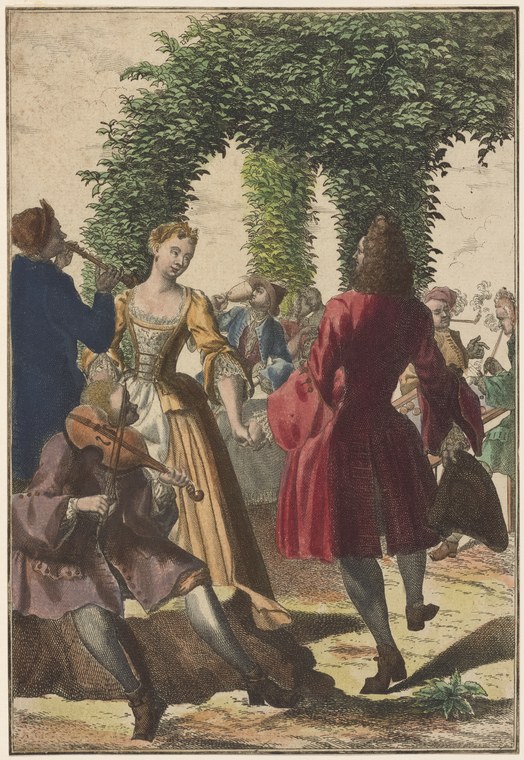
A fashionable outdoor gathering in an ivy-draped garden or pergola, likely from the 18th century, captures the moment a couple dances while onlookers observe. The woman wears a yellow-ochre dress with white lace cuffs and neckline, the man opposite her a burgundy coat. To the left, a woman in a dark purple-brown dress is seated, attending to the spectacle; to the right, a gentleman in deep red stands watching. In the background, a crowd of figures in period dress mills beneath the trailing ivy that frames the composition overhead. The light is soft and even, suggesting an afternoon gathering. The scene conveys the mingled formality and pleasure of social dance among the leisure classes—this is dance as courtship ritual and public entertainment, a moment of display within a larger social occasion.
The dancing
The central couple stands in a sprightly, engaged posture suggesting an active step or turn. The woman's body inclines slightly toward her partner; both figures are upright and formal, yet there is a suggestion of lightness and energy in their bearing. The dancers maintain visual contact and an open frame typical of 18th-century social dances. Spectators are ranged in depth and profile, some seated, some standing, all oriented toward the couple, which emphasizes the public and performative nature of the moment. The composition includes at least six clearly distinguishable figures, with others suggested in the background crowd.
The dance depicted
This is a French social dance of the 18th century, most likely a minuet or a country dance of the period—both staples of aristocratic and upper-middle-class gatherings. The title 'French social dancing' and the open-air garden setting with fashionable dress indicate the ceremonial, courtship-oriented dancing of the ancien régime or early post-revolutionary era. The upright posture, moderate distance between the dancers, and the spectatorial arrangement suggest a minuet (the most formal and codified), though the informality of the garden setting and the presence of onlookers might also indicate a contre-danse or English country dance adapted to French taste. The image shows dance as social ritual: it is witnessed, commented upon, and offers partners an opportunity for visible courtship and display before their peers.
How it was made
This is a colored engraving or hand-colored print, likely from the late 18th or early 19th century, executed with fine line work and then tinted with watercolor or similar pigments. The technique allowed for mass reproduction with individual finishing, making it an affordable luxury for the educated and affluent—a common format for illustrated books on manners, fashion, and social instruction. The precision of the line work and the delicate detail of costume, foliage, and spatial recession show skilled draftsmanship. The color has faded and shifted with age, particularly in the flesh tones and greens, which is typical of period aquatints and hand-colored prints. This was a work made for circulation and instruction: it teaches as much as it documents.
About this work
This colored engraving depicts a moment of aristocratic or upper-bourgeois social dancing in an 18th-century garden, capturing both the formal technique and the courtship function of dance in that world. The image belongs to a large body of printed material—manuals, conversation pieces, fashion plates—that documented and codified the elaborate social rituals of the pre-revolutionary and Napoleonic era. It is a document of how dance functioned as social display, courtship, and communal ritual among the European leisure classes, where every gesture was prescribed and every moment observed.
How to look at it
Watch the posture and spacing of the couple: note how the woman's body angles toward her partner and how both maintain an upright carriage. The artist has frozen a moment of motion—a turn or glide—rather than a static pose, which tells us this is a traveling dance, not a stationary figure. Look at the faces of the onlookers: their attention is rapt and evaluative, reminding us that social dance was always on display. The ivy overhead frames the scene as a private garden made public by the gathering; this was how the wealthy danced, in half-enclosed spaces where nature and artifice met.
The period
This work dates from the late 18th or early 19th century, a period when the minuet and contre-danse dominated European ballrooms and when dance instruction was a marker of social class. The style of dress—the high waistline, the cut of the coat, the decoration—places it in the 1780s–1810s range. This was an era of enormous interest in dance manuals, prints, and illustrated instruction; works by artists such as Gillray, Rowlandson, and others captured the dance, dress, and manners of the period for public consumption. The garden setting and the emphasis on spectacle reflect the Enlightenment and pre-Romantic taste for nature and informal sociability, even as the dance itself remains rigorously formal.
Where it lives
This work is held in the Prints collection of the New York Public Library and is catalogued as a work depicting social dance. No artist, date, or medium are recorded in the catalogue, but the image itself identifies it as a colored engraving from the late 18th or early 19th century.
Dance in this work
Questions about this work
What dance are they doing?
Most likely a minuet or contre-danse. The formal posture, the upright bodies, and the distance between the partners suggest a minuet, which was the most codified social dance of the period. The garden setting and the informality of the occasion suggest it could also be a country dance adapted to French taste. Both were performed at social gatherings among the nobility and wealthy bourgeoisie.
What does the spectating tell us?
Social dance was always a performance for an audience of peers. The onlookers are not incidental; they are part of the ritual. They watch, evaluate, and participate in the social meaning of the dance. A well-executed minuet or contre-danse demonstrated grace, breeding, and courtship intent.
When was this made?
The style of dress, the technique of hand-colored engraving, and the conventions of representation all suggest the late 18th or early 19th century—roughly 1780–1820. This was the heyday of illustrated prints on manners and social life.
Why is it in a garden?
Gardens were fashionable settings for social gatherings among the wealthy, especially in summer. They offered a compromise between nature and artifice—the controlled nature of a formal garden provided an elegant backdrop for display and courtship. This image may reflect actual practice or the Romantic taste for 'natural' sociability.
More dance artwork





