49 works in this view — arrow keys or swipe to move between them.
Dance in Art
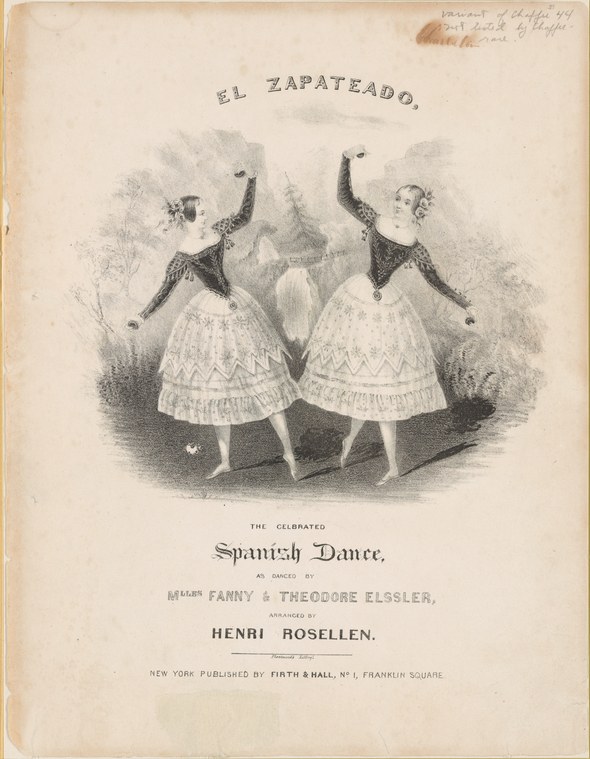
El zapateado, the celbrated [sic] Spanish dance, as danced by Mlles Fanny & Theodore Elssler
Unknown artist
- Collection:
- Prints depicting dance
- Source:
- New York Public Library
- Rights:
- Public domain — free to use, share and adapt.
- Recorded as:
- Public Domain
This work documents the professionalization and international circulation of Spanish dance in the 19th-century theatrical marketplace. It shows how regional dance traditions were adapted for the European and American stage, formalized through symmetrical choreography and performed by the era's most celebrated dancers—a pattern that shaped how Spanish and flamenco dance entered the global dance canon. The Elssler sisters were at the height of their fame during this period, and their association with this dance tells us something important about the cultural prestige and appeal of Spanish movement to 19th-century audiences.
What you are looking at
This is a lithographic print titled *El Zapateado*, depicting two female dancers in a moment of energetic, synchronized movement. Both wear identical costumes of black bolero jackets and voluminous white skirts with decorative zigzag hems and ruffled tiers. They stand side by side, facing forward, with their bodies angled slightly away from each other. Both have raised their right arms high overhead in mirror-image gestures, creating a dynamic vertical emphasis; their left arms are extended outward. Their heads are tilted back, faces bright with expression. The setting is minimal—soft shading creates a diffuse background with no architectural or spatial markers. The composition emphasizes the symmetry and unison of the two performers, a key feature of 19th-century theatrical dance presentation.
The dancing
Both dancers are shown in an identical pose mid-movement, their bodies upright but energized. The raised right arms and extended left arms create an open frame around the torso. Their posture suggests a moment of rhythmic footwork rather than a held balance—the tilt of the heads and the overall tension in the limbs convey motion and percussion. The precision of their mirroring suggests these are trained performers executing a choreographed number rather than improvisation. The skirts, full and tiered, would allow rapid footwork and ankle articulation characteristic of Spanish dance.
The dance depicted
This is *El Zapateado*, a celebrated Spanish dance featuring rapid, rhythmic footwork and distinctive shoe percussion. The title refers to *zapateado*—the characteristic tapping and striking of the soles and heels of the shoes against the floor, a core element of flamenco and Spanish theatrical dance. The image shows it being performed by Mlles Fanny and Théodore Elssler, celebrated European ballerinas of the 19th century who were known for their versatility across multiple styles. The unison positioning and mirror-image gestures reflect the theatrical convention of the period: even Spanish regional dances, when staged for European audiences, were often formalized into symmetrical ensemble presentations. The footwork itself is not clearly visible in this static image, but the pose and the context tell us this is primarily a dance of lower-body percussion and rapid leg work.
How it was made
This is a lithographic print, a technique that allowed for mass production and wide distribution of theatrical imagery. The artist has used crayon and stone to achieve soft tonal gradations in the background and fine linear detail in the costume; the signatures of a skilled lithographer are visible in the precise rendering of the fabric folds and the delicate shading of the faces. Lithography was the dominant medium for theatrical promotion and dance documentation in the 19th century, affordable enough for audiences and effective at capturing the visual spectacle of stage costume and pose. This print was published in New York by Firth & Hall on Franklin Square, indicating it was intended for the American market—an important detail for understanding how Spanish dance entered the English-speaking theatrical repertoire.
About this work
This is a 19th-century lithographic print documenting a theatrical performance of *El Zapateado*, a Spanish dance distinguished by rapid, percussive footwork. It shows two identical female figures in coordinated gesture, their costumes (black jacket, white tiered skirt) and synchronized pose emphasizing the formality and spectacle of staged Spanish dance as presented to European and American theatre audiences. The print records not the folk dance itself but its transformation into a professional theatrical number, performed by celebrated international ballet stars and distributed as promotional imagery. The work belongs in a gallery of dance imagery because it captures a crucial moment in dance history: the encounter between European balletic training and Spanish regional traditions, mediated through the commercial theatre and the lithographer's stone.
How to look at it
The viewer should attend to the precision and symmetry of the pose—this is a formalized, staged version of Spanish dance, not a documentary record of folk practice. Notice how the raised arms and tilted heads create a sense of energy and abandon while the identical positioning of both dancers signals choreographed precision. The artist has frozen a moment of rhythmic intensity without being able to show the footwork itself; instead, the costume (especially the detailed hem and ruffles of the skirt), the posture, and the title do the work of suggesting rapid lower-body percussion. The soft, atmospheric background keeps attention on the dancers themselves and their costumes, typical of theatrical portraiture of the era.
The artist
The artist is not recorded in the catalogue. The work is credited to Henri Rosellen, whose name appears at the base of the print—likely the composer of the musical accompaniment or the choreographer, rather than the lithographer. This reflects 19th-century print conventions, which often credited the overall theatrical work rather than the visual artist who executed the stone. The print was published by Firth & Hall, a major New York music and theatre publisher of the period.
The period
The 1830s-1840s were a period of intense fascination with Spanish and Oriental imagery in European and American theatre, part of a broader Romantic interest in exoticism and regional difference. The Romantic ballet was at its height, and leading dancers like the Elsslers were known for their technical range and their ability to perform not only classical ballet but also character dances, national dances, and theatrical pastiches. Spanish dance, particularly the cachucha and zapateado, became fashionable numbers in the theatrical repertoires of major ballet stars. This print sits at the intersection of Romantic-era celebrity culture, the consolidation of theatrical dance as a commercial entertainment, and the documentation of movement through mass-produced visual media.
Where it lives
The print is held by the New York Public Library in their collection of prints depicting dance. It was published in New York by Firth & Hall, a major publisher of music, theatrical works, and related imagery, indicating it was part of the commercial apparatus of theatrical promotion and public documentation of stage performance.
Dance in this work
Questions about this work
Who were the Elssler sisters and why were they important?
Fanny and Théodore Elssler were among the most celebrated dancers of the 1830s-1840s, celebrated for their technical virtuosity and for their willingness to perform in multiple styles—not only classical ballet but also character and national dances. They were international stars who toured extensively and brought Spanish and other regional dances into the mainstream European and American theatrical repertoire. Their association with this dance tells us that Spanish dance had become prestigious enough for top-tier ballet stars to perform.
What is zapateado and how is it different from flamenco?
Zapateado is the rhythmic footwork and shoe percussion that is central to both flamenco and Spanish theatrical dance. While modern flamenco is deeply rooted in Andalusian folk and Romani traditions, 19th-century theatrical zapateado was often a formalized, choreographed version designed for stage audiences. This print shows the theatrical version: symmetrical, precise, and performed in coordinated unison rather than the improvisational, syncopated style of folk flamenco.
Why is this print in a lithographic style?
Lithography was the dominant medium for theatrical promotion and dance documentation in the 19th century because it could be mass-produced affordably while still capturing fine detail and tonal subtlety. This print would have been sold to audiences attending the performance, distributed by the publisher, and displayed in shops and theatres—making it part of the commercial and visual culture of theatrical dance.
Why are the two dancers posed identically?
Symmetrical, mirrored poses were a standard theatrical convention of the era, emphasizing spectacle, precision, and the formality of the staged performance. This aesthetic choice reflects how regional and folk dances were adapted for European and American theatre: they were formalized, regularized, and presented as unified ensemble numbers rather than as improvisational or individualized performances.
More dance artwork





