49 works in this view — arrow keys or swipe to move between them.
Dance in Art
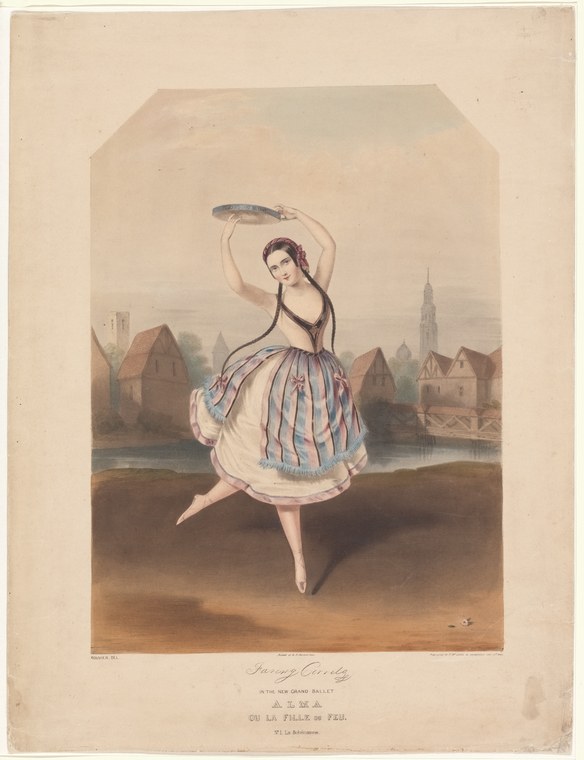
Fanny Cerrito [facsimile signature] in the new grand ballet Alma; ou La fille du feu, no. 1, La Bohémienne
Unknown artist
- Collection:
- Prints depicting dance
- Source:
- New York Public Library
- Rights:
- Public domain — free to use, share and adapt.
- Recorded as:
- Public Domain
Cerrito was a cornerstone figure in Romantic ballet, and her image in this role documents how the greatest dancers of the era embodied both technical mastery and narrative character work. The print is a rare survival of the commercial theatrical culture of the 1840s, showing what audiences went to see and what manufacturers thought would sell. For historians and dancers, it provides concrete evidence of the costume, pose, and aesthetic values of mid-19th-century ballet.
What you are looking at
A young woman in Romantic-era ballet dress executes a dynamic pose on a barren stage, her body caught mid-movement with one leg extended and one arm raised holding what appears to be a curved scimitar or similar prop. She wears a fitted bodice with a full, knee-length skirt decorated with horizontal stripes in red and blue, her dark hair bound with ribbon. The stage floor beneath her is rendered in warm ochre tones, bare and unadorned. Behind her rises an atmospheric backdrop of a European riverside town: terracotta-roofed buildings cluster along a waterfront, with church spires and towers punctuating the skyline. The architecture appears Northern European, possibly Flemish or Dutch. The lighting is soft and diffused, creating a romantic haze over the distant scenery that contrasts with the clarity of the foreground figure. The composition frames the dancer as the focal point, elevated and theatrical against the picturesque but secondary landscape.
The dancing
The dancer stands in a virtuoso pose: weight balanced on one leg in relevé (on the ball of the foot), the supporting leg bent slightly, the other leg extended behind or to the side in a controlled arabesque or attitude. Her upper body leans forward slightly, creating a dynamic line from her extended leg through her torso to her raised arm, which holds the curved prop aloft. The pose demonstrates the technical control and grace expected of a prima ballerina of the Romantic period. Her posture is alert and energised rather than languorous, suggesting a moment of action or conquest within a narrative context.
The dance depicted
This is Fanny Cerrito, one of the most celebrated ballet dancers of the 1840s, depicted in the first scene ('La Bohémienne') from the ballet *Alma; ou La fille du feu* (*Alma; or The Daughter of Fire*). The title identifies her by facsimile signature at the top of the print. The exotic prop—likely a scimitar or similar weapon—and the bohemian costume indicate a character role within a dramatic ballet, suggesting a narrative of adventure or passion rather than pure classical dancing. The pose is recognisably balletic but emphasises dramatic gesture and character performance, typical of the French Romantic ballet of the 1840s, where dancers were expected to be actresses as well as technicians. The setting and costume suggest an Orientalist or exotic fantasy, a common theme in Romantic ballet.
How it was made
This is a hand-coloured lithograph or engraving, likely a commercial theatrical print produced for distribution to ballet enthusiasts and collectors. The soft handling of the distant landscape, the careful use of ochre wash on the stage floor, and the delicate colouring of the costume are characteristic of mid-19th-century theatrical publicity prints. The technique allows for fine detail in the dancer's body and face while maintaining atmospheric recession in the background. Such prints were sold at theatres and through print shops, making them widely accessible to the public and circulating images of celebrated dancers far beyond those who could attend performances. The facsimile signature of Cerrito legitimises the image and enhances its market value.
About this work
This is a commercial print documenting the Romantic ballet as practiced by its greatest exponents. Fanny Cerrito was among the four or five most celebrated ballerinas of the 1840s, and this print captures her in a character role that demanded both technical virtuosity and dramatic presence. The print is a primary document of how Romantic ballet looked, how it was marketed, and what the public understood as exceptional performance. It shows the dancer as performer and personality, not merely as body—her name and signature are as prominent as her image—and reflects the star system that had grown up around ballet by the 1840s. The print circulated widely and served as both souvenir and advertisement, defining how Cerrito's art was understood and remembered.
How to look at it
Look first at the dancer's body: the balance, the extension, the control evident in the pose. Note how the artist has rendered her weight and the effort required to hold the line. Then look at how the narrative is communicated through costume and prop: the striped skirt, the curved weapon, the exotic architecture. The print captures a single moment of action—not the peak of a jump, but a held pose that projects both technical virtuosity and dramatic character. The composition places her alone on the stage, isolated and spotlit, suggesting the intensity of star performance. The distant landscape is rendered atmospheric and almost dreamlike, emphasising the theatrical fantasy rather than the physical reality of the stage.
The artist
The artist is not recorded. The print was almost certainly produced by a commercial publisher in Paris (the centre of the international ballet market in the 1840s) or London, possibly with input from a theatre designer or from sketches made during performances. Such prints were typically produced by teams of lithographers and colourists rather than single named artists; they are commercial products rather than fine art prints, and attribution was often not recorded.
The period
The 1840s were the height of the Romantic ballet in Europe. Cerrito, Marie Taglioni, Carlotta Grisi, and Lucile Grahn dominated the stage, celebrated for their technical brilliance and their ability to embody exotic, tragic, or supernatural characters. The decade saw the development of the 'ballerina' as celebrity and sex symbol, with their images mass-produced and circulated through prints, lithographs, and engravings. *Alma; ou La fille du feu* was performed in Paris in 1842 with a scenario combining Orientalism, fantasy, and spectacle—typical concerns of Romantic ballet. The production design and costume shown here reflect the current taste for exotic scenery and the influence of Orientalist painting on theatrical practice. This was the era when ballet was still firmly a European art form centred on Paris, and when the female dancer had become the primary vehicle of the art.
Where it lives
The print is held in the New York Public Library's collection of dance imagery and theatrical prints. Such prints were produced in the thousands and circulated internationally during the 1840s and after, making them relatively common survivals; this example is representative of the commercial culture of Romantic ballet.
Dance in this work
Questions about this work
Who was Fanny Cerrito?
Fanny Cerrito (1817–1909) was an Italian dancer who became one of the most celebrated ballerinas of the Romantic era. She was known for her technical brilliance and her dramatic presence, and was a rival and contemporary of Marie Taglioni. She performed across Europe and was particularly celebrated in Paris, London, and Milan. She also choreographed several ballets and was the first woman to choreograph a ballet performed at the Paris Opera.
What is Romantic ballet?
Romantic ballet emerged in the 1830s and dominated the 1840s–60s. It emphasised narrative, emotion, and the supernatural, often set in exotic or fantastical worlds. The female dancer became the central focus, celebrated for her technical virtuosity and her ability to embody ethereal or tragic characters. Key works include *La Sylphide* and *Giselle*. It contrasted with earlier Classical ballet and gave way to late-19th-century Imperial ballet.
What is *Alma; ou La fille du feu*?
A ballet premiered in Paris in 1842 with a scenario by Eugène Scribe, music by Giacomo Meyerbeer, and choreography by Jean-Auguste Vestris. The plot involves a daughter of fire and her encounters with an exotic world. The ballet was mounted to showcase Cerrito and exploit audience taste for Orientalist spectacle. It was successful but is now known chiefly through prints and literary descriptions.
What was 'La Bohémienne'?
'La Bohémienne' (The Bohemian Woman) was the opening scene or act of *Alma*. Cerrito performed a character role, here shown in exotic costume with a curved prop, suggesting a bohemian, outsider, or exotic female character. Such roles allowed the Romantic ballerina to display both technical skill and dramatic intensity.
More dance artwork





