49 works in this view — arrow keys or swipe to move between them.
Dance in Art
Cachucha
Unknown artist
- Collection:
- Prints depicting dance
- Source:
- New York Public Library
- Rights:
- Public domain — free to use, share and adapt.
- Recorded as:
- Public Domain
The Cachucha was one of the most celebrated dances of the Romantic ballet era and a signature vehicle for Fanny Elssler; this print documents its theatrical realization and demonstrates how a folk-derived solo was adapted for partnership and spectacle on the European stage. The image is evidence of the 19th-century appetite for exotic character dances and the central role of prints in disseminating knowledge of celebrated performances.
What you are looking at
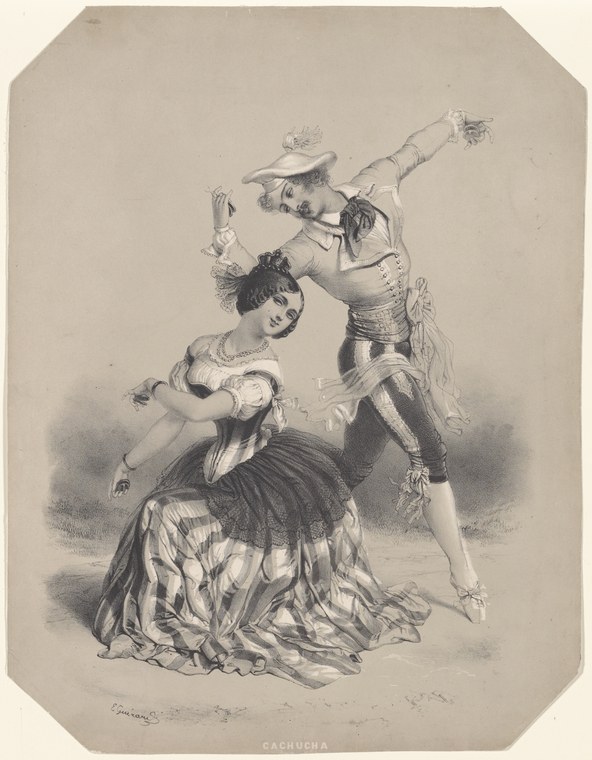
A man and woman perform an energetic dance in a classical interior or stage setting. The woman wears a dark skirt with voluminous white undergarments visible at the hem, a white corseted bodice, and has her hair styled up with feathers or ornaments. The man wears a military or theatrical costume with a fitted jacket, breeches, and boots, and holds one arm raised dramatically. The woman is captured mid-movement, her body inclined forward, while the man supports and directs her with commanding gestures. The composition is diagonal and dynamic, with the figures positioned against a neutral background that emphasizes their movement. The engraving employs careful shading to suggest volume in the costumes and musculature, and conveys a moment of theatrical vitality and partnered choreography typical of 19th-century dance spectacle.
The dancing
The man stands upright in a commanding posture, his raised arm extended outward in an emphatic gesture while his body provides support and direction to his partner. The woman leans forward into a deep incline, her weight shifted toward him, her posture suggesting rapid movement and trust in her partner's lead. Their bodies are in close proximity but not in a formal closed hold; instead, the connection is dynamic and suggests rotation or a lifting phrase. The woman's skirts billow, indicating swift action and the moment of turn or flourish frozen mid-sequence.
The dance depicted
The title identifies this as the Cachucha, a Spanish solo dance for women that became a showpiece in European theatrical dance during the 1830s–1840s. The Cachucha gained fame through performances by Fanny Elssler and other Romantic-era ballerinas who incorporated it into their programs as a character dance. Here it is depicted as a partnered performance, suggesting a theatrical staging rather than the dance's traditional solo format. The military costume of the male figure and the theatrical setting indicate this is a professional stage performance, likely from a ballet or operatic production where the Cachucha served as a featured divertissement.
How it was made
This is an engraving, identifiable by the parallel hatching lines and fine linear work used to create tonal depth and shadow, particularly visible in the folds of the woman's skirt and the modeling of the figures' limbs. The technique allows for precise rendering of costume detail and movement, and the composition's clarity suggests this was created for reproduction and circulation, likely as a print for theatrical audiences or dance enthusiasts. Engravings of this quality and subject matter were typically produced in France or Britain during the Romantic era and distributed widely through print shops.
About this work
This engraving captures a moment from a theatrical performance of the Cachucha, the Spanish character dance that became central to European Romantic ballet in the 1830s–1840s. The image documents not the dance's original solo form but its adaptation for the professional stage, where it was performed as a spectacular divertissement with male partnering. The print exemplifies 19th-century dance documentation: a snapshot of a celebrated performance moment, preserved in a medium designed for reproduction and reaching audiences who might not have seen the live performance.
The work belongs to a broader tradition of theatrical dance prints that served as souvenirs, advertisements, and records of celebrated dancers and choreographic moments. Its presence in the NYPL's dance print collection places it among documents that show how Romantic-era ballet incorporated Spanish and other non-classical forms into its repertory, and how print culture made dance visible to publics beyond the theatre.
How to look at it
Attend to the moment of action the engraver chose: not a static pose but a turn or lift in progress, with the woman's body leaning into her partner's support and her skirts caught in mid-swirl. Notice the contrast between the woman's apparent lightness and forward momentum and the man's grounded, commanding stance—this captures the essential dynamic of 19th-century partnering, where the male dancer provided both technical support and theatrical authority. The costume detail—the woman's white underskirts, the man's military dress—tells us this is a staged theatrical performance rather than a social or folk version of the dance, and was designed for a paying audience.
The artist
The artist is not recorded. The engraving technique and subject matter suggest a French or British theatrical print maker working in the 1830s–1850s, when such prints were produced in quantity for theatrical audiences. The quality of the work and the care taken with costume detail indicate a professional hand familiar with both dance and printmaking.
The period
The Cachucha emerged as a theatrical phenomenon during the Romantic ballet era (1830–1850s), when European dancers and choreographers incorporated Spanish and other folk-derived material into classical ballet as a form of exoticism and dramatic contrast. Fanny Elssler performed the Cachucha throughout Europe to great acclaim beginning in the 1830s, making it one of the most widely known and imitated dances of the period. This print was likely produced during or shortly after the height of the Cachucha's popularity, when theatrical prints served as primary media for circulating images of celebrated dancers and choreographic moments to paying audiences and collectors.
Where it lives
This print is held in the NYPL's Prints Depicting Dance collection. It is part of a broader holdings of theatrical prints from the 19th century, documenting celebrated performances and dancers of the period.
Dance in this work
Questions about this work
What is the Cachucha?
The Cachucha is a Spanish solo dance that became famous in European theatrical dance through performances by Fanny Elssler and other Romantic-era ballerinas in the 1830s–1840s. It was performed as a divertissement (a solo or featured sequence) within ballets and operatic productions, and was celebrated for its vivid Spanish character, rhythmic footwork, and dramatic flair. This print shows a theatrical adaptation of the dance with male partnering, rather than its traditional solo form.
Why was the Cachucha so popular?
During the Romantic era, European audiences were fascinated by dances from other cultures, and the Cachucha offered theatrical spectacle, exotic appeal, and a showcase for a star dancer's technique and presence. Fanny Elssler's performances of it made her an international celebrity and created demand for the dance in theatres across Europe. Prints like this one helped sustain that popularity by allowing audiences to own images of famous performances.
Is this a solo or partnered dance?
The Cachucha is traditionally a solo female dance, but this print shows a theatrical staging with male partnering. This reflects how professional ballet of the period adapted folk and character dances for the stage, adding men's roles and partnered sequences to increase dramatic impact and showcase multiple dancers.
More dance artwork





