49 works in this view — arrow keys or swipe to move between them.
Dance in Art
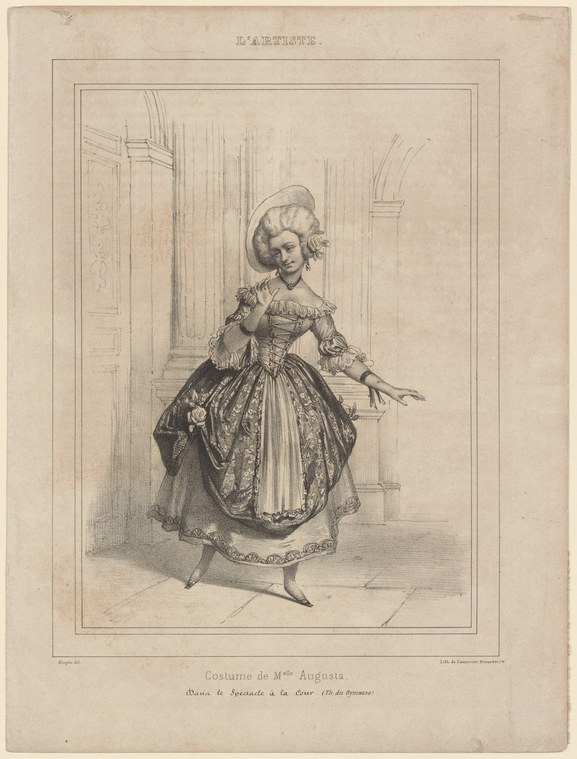
Costume de Melle. Augusta. Dans le Spectacle à la cour.: (Th. du Gymnase)
Unknown artist
- Collection:
- Prints depicting dance
- Source:
- New York Public Library
- Rights:
- Public domain — free to use, share and adapt.
- Recorded as:
- Public Domain
This work documents the visual culture of Romantic-era theatrical dance and the costume conventions that shaped how audiences saw and understood female performers on stage. It is a primary source for understanding the aesthetics of the period—what elegance, grace, and theatrical femininity looked like in practice. For dancers and historians, it offers concrete evidence of how the body was dressed, framed, and presented in this foundational moment of ballet's history.
What you are looking at
A young woman in theatrical dress stands alone in a columned interior, her body angled in a graceful contrapposto pose. She wears an elaborate costume of the Romantic era: a fitted bodice with short puffed sleeves, a full skirt gathered at the waist and falling to mid-calf, with a darker overdress or drapery caught up at one side. Her hair is styled in the fashionable ringlets of the period, crowned with a small bonnet or headdress. She holds a fan in one hand, her other arm extended with an open, welcoming gesture. The setting is spare—classical columns recede behind her, suggesting a palace or grand interior—and the composition focuses entirely on her figure and costume. The engraving is finely detailed, with careful attention to the texture of fabrics and the play of light across the folds of her skirt.
The dancing
The dancer stands in a three-quarter view, her weight settled on one leg while the other is lightly planted, creating an elegant, poised stance without obvious strain. Her arms are held with the soft carriage typical of early Romantic ballet: not rigidly geometric, but graceful and expressive, one arm dropping naturally while the other opens to the viewer. Her posture is upright but fluid, the torso gently curved. There is no indication of violent movement or high elevation; this is a moment of stillness or gentle promenade rather than a leap or turn.
The dance depicted
This appears to be a Romantic-era theatrical dance costume, likely from a French court spectacle or theatrical production of the 1830s–1840s. The title indicates the dancer is Mlle. Augusta, performing in a court theatrical (Théâtre du Gymnase). The costume—with its fitted bodice, full gathered skirt, and modest sleeve length—is consistent with the early Romantic ballet aesthetic, though the emphasis on theatrical elegance and courtly grace suggests this may be a solo or featured character role rather than corps work. The engraving serves as a record of costume and stage presence, a common form of theatrical publicity in this period.
How it was made
This is a finely executed engraving or possibly a lithograph on paper, printed in black ink. The technique allows precise rendering of fine detail—the weave of the fabrics, the curl of the ringlets, the architectural background—and would have been produced in multiple impressions for circulation. The delicate cross-hatching and fine lines are characteristic of mid-nineteenth-century theatrical prints, which served as both documentation and promotion for performers and productions. The quality and finish suggest this was a professional publication, likely sold to patrons or preserved as a record of the performance.
About this work
This engraved portrait documents a performer named Mlle. Augusta in costume for a theatrical spectacle presented at the Théâtre du Gymnase in Paris during the Romantic era. It is not a photograph of a moment of choreography, but rather a formal costume print—a genre that rose alongside the theatrical dance profession in the early nineteenth century. The image captures the aesthetic and material reality of Romantic stage dress: the silhouette, the restraint, the emphasis on graceful bearing rather than athletic display. Such prints were both merchandise and historical evidence, circulating among patrons and preserving a record of how dancers looked and how they were marketed to audiences.
How to look at it
Observe the stillness and poise the artist has chosen to capture: this is not a moment of action or leap, but of presentation and beauty. Note the emphasis on the costume itself—the precise rendering of the bodice fit, the gather and weight of the skirt, the delicate headdress—which tells us that costume was integral to the performer's identity and appeal. The classical columned setting and the three-quarter pose are conventions of formal portraiture applied to a theatrical context, elevating the dancer to the status of an individual artist rather than a generic corps member.
The artist
The artist is not recorded in the catalogue. The print bears a signature or attribution mark typical of mid-nineteenth-century Parisian theatrical prints, but it is not deciphered in the available record. Such prints were often produced by commercial engravers working for theatrical or publishing houses, creating standardized portraits of popular performers for sale to the public.
The period
The 1830s–1840s were the height of the Romantic ballet era, when Marie Taglioni and other stars reshaped the aesthetic of theatrical dance toward ethereal, otherworldly femininity. Costumes became more elaborate and more central to the public image of dancers: the tutu was still emerging, and full skirts, careful drapery, and ornamental headdresses were the markers of theatrical status. Theatrical portrait prints, like this one, were mass-produced and widely circulated, making dancers into recognizable public figures and their costumes into fashionable reference points. The Théâtre du Gymnase, where Mlle. Augusta performed, was a venue for spectacle and entertainment in Paris during this period.
Where it lives
The print is held in the New York Public Library's collection of prints depicting dance. It is part of a larger body of theatrical costume prints from the nineteenth century, a documentation practice that was widespread among European theaters and publishing houses.
Dance in this work
Questions about this work
What was Mlle. Augusta dancing?
The print does not specify the ballet or theatrical work. It documents her costume for a court spectacle at the Théâtre du Gymnase, but does not name a particular role or choreography. Theatrical prints of this kind were often issued without detailed narrative context.
Is this a Romantic ballet costume?
The silhouette and details are consistent with early Romantic-era theatrical dance dress—the fitted bodice, puffed sleeves, and full gathered skirt are typical of the 1830s–1840s. However, this appears to be a court theatrical costume rather than a costume for a major ballet production, suggesting a different aesthetic context and audience.
Why is there no artist credited?
Theatrical prints were often produced by commercial engravers working in ateliers for publishing houses or theaters. The artist's name was not always deemed important enough to preserve or emphasize, and many such prints circulated without clear attribution.
What does the fan tell us?
The fan was a standard accessory in theatrical costume of the period, contributing to the overall impression of elegance and courtly refinement. It also provided the dancer with a prop for gesture and movement, extending the arm and creating visual interest without demanding technical virtuosity.
More dance artwork





