49 works in this view — arrow keys or swipe to move between them.
Dance in Art
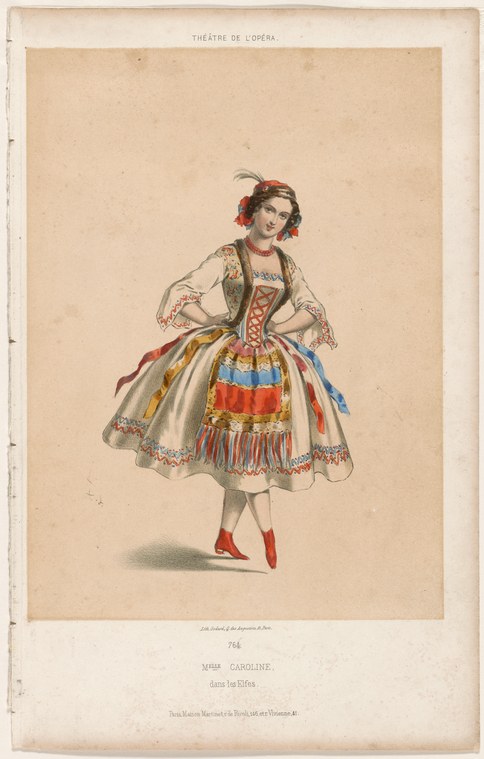
Melle Caroline, dans Les elfes. Théâtre de l'Opéra
Unknown artist
- Collection:
- Prints depicting dance
- Source:
- New York Public Library
- Rights:
- Public domain — free to use, share and adapt.
- Recorded as:
- Public Domain
For dancers and historians, this print is a primary source for understanding how character roles were realized on the 19th-century stage: the cut and decoration of costumes, the footwear, the hair and adornment, and the postural conventions of performers. It also names a performer and documents her role, contributing to the fragmentary historical record of women in professional dance during the Romantic era.
What you are looking at
A single female dancer is shown in a three-quarter pose against a plain background, captured mid-performance. She wears an elaborate costume of the mid-19th century: a white or cream chemise with short, puffed sleeves, a richly decorated corset in rust and gold tones with intricate embroidery or appliqué, and a full skirt composed of horizontal bands of color—red, blue, and other hues—with deep scalloped edges and decorative fringe at the hem. Her hair is dressed fashionably for the period, adorned with feathers or plumes that angle upward. She wears red heeled shoes. Her posture is upright and dignified, with her body angled slightly away from the viewer, one arm extended loosely at her side and the other positioned near her skirt as though gathering or presenting the fabric. The total effect is that of a performer in stage costume, frozen in a moment of choreographed elegance rather than vigorous movement.
The dancing
A single dancer of mature years, standing in an almost stationary pose. Her weight appears evenly distributed, with no marked shift to either foot or indication of traveling movement. The arm carriage is relaxed and natural rather than formally held; her hands are not clasped or raised high, and there is no sense of a strict balletic frame. Her relationship to the picture plane is frontal but not frontal—a quarter-turn that permits the viewer to read both her face (turned toward the audience) and the full silhouette of her costume. The pose conveys presentational display rather than kinetic momentum.
The dance depicted
This is a costume study for an opera or theatrical ballet, likely depicting a character role rather than a principal ballerina. The costume, bearing stylistic markers of Eastern European or Scandinavian folk dress—the embroidered bodice, the banded and scalloped skirt, the heeled shoes—suggests this may represent a character from a romantic-era ballet, possibly a sylph, fairy, or enchanted maiden of non-classical origin. The absence of pointe shoes and the earthed stance are consistent with character dancing or folk-influenced choreography of the mid-1800s rather than classical ballet vocabulary. The image serves as a record of both costume and performance convention for a specific named role.
How it was made
This is a hand-colored lithographic print or engraving, evidenced by the fine linear detail in the embroidery and feathering, the subtle tonal gradations in the fabrics, and the characteristic way color is applied in discrete zones rather than blended. The document itself appears to be a theater souvenir or costume documentation sheet, printed with the title and performer information at the foot. The technique permitted rapid reproduction and distribution of costume imagery, making such prints key records of 19th-century stage design and dress. The hand coloring (visible in the variation of application and the way it sits on the surface) indicates this was a luxury item intended for collectors, aficionados, and the theater world itself.
About this work
This is a dated theatrical costume print documenting the appearance of a specific performer, Mlle Caroline, in the role of an elf or supernatural creature in a production at the Opéra (Paris). It is neither a scene of action nor a record of choreography, but rather a formal presentation of a character in full costume—a type of documentation that served both as memorabilia and as a record of the visual and material culture of 19th-century opera and ballet. The work belongs in a gallery of dance because it documents the costume, styling, and stage presentation conventions of a major performance tradition, and because it preserves the image of a named performer at a specific historical moment.
How to look at it
Note the precision with which the costume is rendered—every seam, every embroidered detail, every stripe in the skirt is clearly legible. This is not an imaginative artwork but a documentary one, made to preserve and circulate an exact image of the stage costume. Observe how the pose is neither a movement nor a rest, but a presentation: the body is arranged to display the costume to maximum advantage, with the skirt spread to show its construction and the bodice visible frontally. The face, turned toward the viewer, is styled and composed rather than caught in the moment of performance. This represents a convention of theatrical costume documentation distinct from modern photography.
The artist
The artist is not recorded. The print was likely produced by a Paris print publisher specializing in theatrical and operatic imagery—a common commercial practice in the 19th century. Such prints were often created by lithographers or engravers working from life drawings or costume sketches, sometimes based on sketches made during dress rehearsal or performance.
The period
This print dates from the mid-19th century, the era of Romantic ballet and the dominance of supernatural and fairy-tale subjects on the opera and ballet stage (c. 1830–1870). The costume and styling are consistent with the mid-1840s–1850s. During this period, the Opéra in Paris was the center of European operatic life, and performers and roles were documented in vast numbers of prints, lithographs, and engravings for sale to the public. Character roles and character dances—often performed in folk or exotic costumes—were integral to the repertory and afforded opportunities for narrative mime and spectacular staging beyond the classical vocabulary.
Where it lives
The print is housed in the New York Public Library's collection of prints depicting dance, a holding that includes thousands of theatrical and operatic costume studies, lithographs, and engravings from the 18th century onward. Such collections were formed partly as historical records and partly as repositories of visual ephemera from the theater.
Dance in this work
Questions about this work
Who was Mlle Caroline and what was 'Les elfes'?
The catalogue record identifies only the performer name and the ballet title. Without additional archival research, the specific biographical details of Mlle Caroline and the plot and production history of Les elfes cannot be established. The Opéra archives in Paris may contain more information.
Is this a ballet or an opera?
The title page reads 'Théâtre de l'Opéra,' which in 19th-century Paris could refer to either operatic or ballet performances held at the Opéra house. The costume and the use of the word 'elfes' (elves/fairies) suggest a ballet or a divertissement within an opera, but the distinction cannot be made with certainty from the image alone.
Why are there no pointe shoes?
Character roles in 19th-century ballet, especially those representing creatures from folklore (elves, sylphs, country maids), were often performed in soft shoes or heeled shoes rather than on pointe. Pointe work was reserved for the principal classical roles; character dancers displayed different vocabulary and footwear.
How was this print made?
This is a hand-colored lithograph or engraving, a common method of producing theatrical costume documentation in the 19th century. The print was likely made from a drawing of the costume, then hand-colored in a workshop. Prints like this were sold to audiences as souvenirs and to collectors interested in theater, fashion, and performers.
More dance artwork





