49 works in this view — arrow keys or swipe to move between them.
Dance in Art
Eccellenze ed onorevoli
Unknown artist
- Collection:
- Prints depicting dance
- Source:
- New York Public Library
- Rights:
- Public domain — free to use, share and adapt.
- Recorded as:
- Public Domain
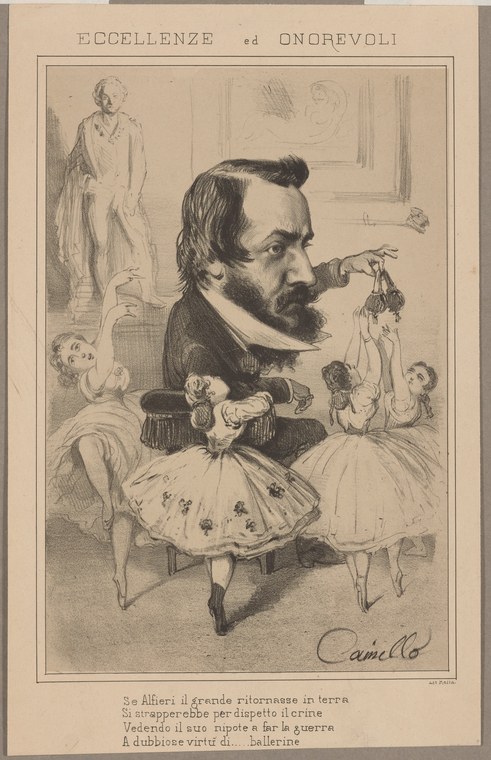
This work demonstrates that dance imagery in 19th-century visual culture was not confined to celebration or documentation—it was a sophisticated language for satire and political commentary. For historians of both dance and print culture, it reveals how ballet, by then firmly established as a sign of theatrical refinement and artificiality, could be weaponized as a tool for mocking authority.
What you are looking at
A caricature engraving depicting a grotesquely exaggerated male head and torso in profile, dominating the composition. The figure wears military dress with epaulettes and a high collar, his expression haughty and nose absurdly elongated. His massive head and shoulders emerge from what appears to be the body of a small dancer or ballet figure in a tutu. Around him cluster smaller figures: two or three women in ballet skirts with raised arms in classical poses, and several cherub-like putti or child figures, some appearing to play musical instruments or engage in playful antics. In the background, classical statue-like figures in flowing robes are sketched more lightly. The title and Italian text at top and bottom suggest this is a political or social satire, likely mocking a military or political figure of the era through the incongruity of his grotesque head mounted atop a theatrical dance scene.
The dancing
The central male figure dominates through exaggeration rather than naturalism; his anatomy is distorted for comic effect. The surrounding dancers (the women in tutus and the putti) adopt classical ballet positions—raised arms, lifted postures—that contrast sharply with the caricatured head. The smaller figures are rendered with more anatomical accuracy, suggesting their dance poses were understood and intentional, even as the overall composition mocks the central figure. The frame and spacing suggest the dancers are meant to be both literally supporting and figuratively diminishing their subject.
The dance depicted
The ballet figures—the women en pointe or en attitude, the children in playful movement—represent theatrical ballet of the 19th century, likely Romantic ballet given the tutus and the classical poses. The integration of dancers into a political caricature suggests this was a satirical print mocking a contemporary military or governmental figure, using the spectacle and artifice of ballet as a metaphor for his inflated importance or false authority. The dance itself is not the subject but the vehicle for satire.
How it was made
This is an engraving or etching, rendered in fine cross-hatched lines with careful attention to tone and shadow, particularly in the modeling of the grotesque head. The technique allowed for sharp social commentary and was the standard medium for political satire and caricature in 19th-century Europe. The detailed background architecture and the delicate line work suggest this was a sophisticated print, likely from a published series, intended for educated viewers familiar with both dance and political figures of the day.
About this work
This is a political or social caricature engraving in which ballet dancers—in classical tutus and poses—are incorporated into a grotesque portrait of a military or political figure. The work uses the conventions of Romantic-era theatrical ballet (the tutus, the raised arms, the classical framing) as props in a satire, creating a visual metaphor for the absurdity or false grandeur of its subject. The print belongs in a dance art collection not because it celebrates dance, but because it uses dance imagery as a language of social criticism and because it documents how ballet was understood and deployed in 19th-century visual culture.
How to look at it
Attend first to the violent clash between the grotesquely exaggerated head and the delicate, classically posed ballet figures surrounding it. The artist has frozen a moment of simultaneous elevation (the dancers in their raised poses) and degradation (the monstrous head). Notice how the two registers of the image—the caricatured portrait and the ballet scene—occupy the same space without reconciling: the dancers do not support the figure so much as diminish it through contrast. The inscription at the bottom, which you should read, will clarify the target and intent of the satire.
The artist
The work is signed 'Camelot' (lower right), but the artist is not recorded in the holding institution's catalogue. The style and execution suggest a mid-19th-century satirical printmaker working in the tradition of Honoré Daumier and other caricaturists of the period who used dance, theater, and social spectacle as vehicles for political critique. The engraving technique and the sophistication of the composition indicate a trained artist producing for a cultivated audience.
The period
This engraving dates from an era when Romantic ballet was at its height in European theaters, characterized by ethereal tutus, pointe work, and themes of sylphs and exotic women. Simultaneously, 19th-century political and social satire flourished in print, with caricaturists using theatrical imagery to mock military leaders, politicians, and social pretenders. The work sits at the intersection of these two phenomena, using the visual language of ballet—which was associated with artificiality, spectacle, and feminine grace—as a counterpoint to masculine military authority.
Where it lives
The work is held in the New York Public Library's Prints collection, where it is catalogued as part of a broader collection of prints depicting dance. The holding suggests this was one of many such satirical or theatrical prints circulating in 19th-century European and American visual culture, preserved not as fine art but as documentary evidence of the period's visual language.
Dance in this work
Questions about this work
Is this actually about ballet, or is ballet just background?
Ballet is integral to the satire's meaning. The artist chose ballet imagery—the tutus, the classical poses, the theatrical setting—because ballet was a recognized language of artificiality and spectacle. Using dancers to frame or support the grotesque head was a deliberate visual strategy that would have been understood by the print's contemporary audience as a cutting insult to the subject's pretensions.
Who was this person supposed to be?
The Italian text at the bottom would identify the subject, but the artist's name is also not recorded in the holding institution's information. Without further research or access to 19th-century Italian political and military history, the specific target cannot be determined from the image alone. The style and uniform suggest a military or political figure of the period.
Why use ballet to mock someone? What would that have meant?
In 19th-century visual culture, ballet was associated with artifice, vanity, spectacle, and feminine elegance—in short, with everything opposed to masculine military virtue. Using ballet dancers to flank or diminish a military figure was a way of suggesting he was vain, false, or absurdly theatrical. The satire works by juxtaposition: the 'reality' of military power is exposed as mere performance, no more real than ballet.
More dance artwork





