49 works in this view — arrow keys or swipe to move between them.
Dance in Art
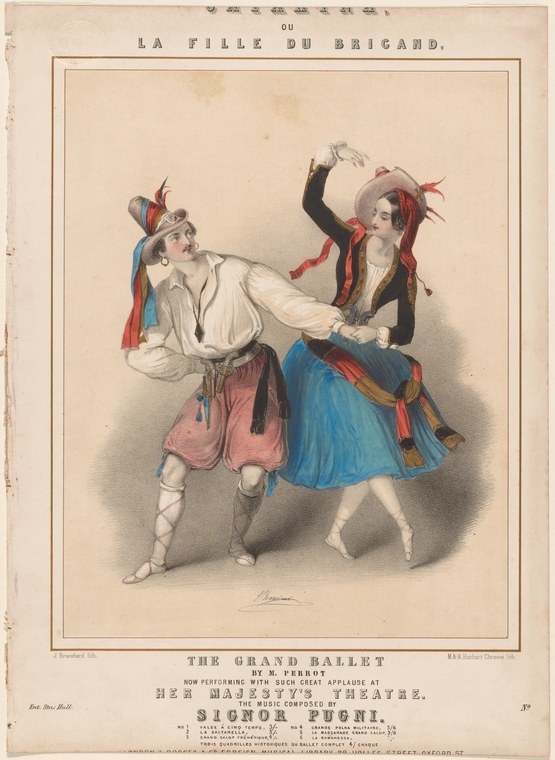
Catarina, ou La fille du brigand, the grand ballet by M. Perrot: now performing with such great applause at Her Majesty's Theatre
Unknown artist
- Collection:
- Prints depicting dance
- Source:
- New York Public Library
- Rights:
- Public domain — free to use, share and adapt.
- Recorded as:
- Public Domain
This image is evidence of what Romantic ballet actually looked like on stage: the specific poses, costumes, spatial relationships, and emotional registers of a celebrated work. It shows a male dancer in an active, expressive role rather than as a mere support—a reminder that male dancing was central to the theatrical ballet of this period. The engraving also documents the international circulation of dance: Perrot's French choreography performed in London, recorded in print, and preserved in American collections.
What you are looking at
This is a hand-colored engraving depicting a dramatic moment from a theatrical ballet. Two dancers occupy the composition against a plain background: on the left, a male dancer in pale breeches, white shirt, and a plumed hat leans back in apparent surprise or distress, his body weight thrown backward; on the right, a female dancer in a blue skirt with red trim reaches upward, her arm extended dramatically overhead, her red-ribboned hair flying. Both wear the soft ballet shoes and fitted garments typical of early nineteenth-century Romantic ballet. The composition captures a moment of high emotion and interaction between the figures, with the woman's gesture of reaching or grasping and the man's recoil creating a narrative tension. The delicate hand-coloring picks out the blues, reds, and flesh tones against the pale paper, lending theatrical immediacy to the scene.
The dancing
The male dancer, positioned at left, is captured in a sharp backward lean with one leg extended and arms raised in a gesture of alarm or yearning. His frame is open and unstable, suggesting a moment of loss of balance or dramatic response. The female dancer at right rises on or near the balls of her feet, reaching upward with both arms in an attitude of supplication or ecstatic gesture; her body appears lifted and extended through the torso. Both dancers wear the characteristic soft pointe shoes of the period. The spatial relationship between them—close enough to interact but not in direct contact—and their opposed directions (his retreat, her ascension) suggest a pas de deux moment of high dramatic stakes.
The dance depicted
This depicts a moment from *La Fille du brigand* (The Brigand's Daughter), a Romantic-era ballet choreographed by Jules Perrot and performed with great success at Her Majesty's Theatre in London (likely 1830s). The work belongs to the Romantic ballet tradition, characterized by ethereal female dancers, emotional narrative, and the pointe work visible here. The title suggests a dramatic plot involving abduction or rescue—plausible given the gestures of yearning and distress shown—and the costumes are consistent with Romantic-period conventions: the male dancer in character dress (Turkish or brigand costume implied by the plumed hat) and the female in the tulle skirt and ribboned coiffure typical of the era. The image records an actual stage work in performance, not an idealized study.
How it was made
This is a hand-colored engraving, a common medium for theatrical publicity and record in the early nineteenth century. The engraved line is delicate and precise, capturing anatomical detail and fabric texture; the hand-coloring in watercolor or gouache was applied after printing, allowing for variation and approximation in hue. Engravings of dance scenes were widely circulated as theatrical prints, affordable to middle-class audiences and used to advertise performances and celebrate celebrated dancers. The medium's precision suited the documentation of costume and pose while its portability and multiple impressions made it the primary visual record of stage works before photography.
About this work
This engraving documents a moment from *La Fille du brigand*, one of the most celebrated ballets of the Romantic era, choreographed by Jules Perrot for the London stage. The work is a theatrical record—a performance announcement and artistic documentation combined—showing not an imagined scene but an actual moment witnessed by London audiences. Romantic ballet, which flourished from the 1830s through the 1850s, centered on supernatural or exotic female characters, pointe work, and narrative drama; this image crystallizes all three. The engraving's circulation as a print made the ballet visually present to those who could not attend the theatre, extending the reach of elite artistic culture.
How to look at it
Attend to the moment the artist chose: not a static pose but the instant of dramatic rupture between the two dancers—the moment when one figure recoils and the other reaches. Notice how the engraver used line weight and cross-hatching to suggest volume and musculature, especially in the male dancer's legs and torso. The hand-coloring, while summary, picks out the key elements: the brilliant blue skirt and red ribbons of the female dancer (likely identifying her character) and the warm flesh tones of both figures. The composition is staged frontally, as it would be seen from the audience, making the spatial relationship between the dancers—their emotional distance despite their physical proximity—immediately legible.
The artist
The artist is not recorded in the catalogue. The engraving bears the credit line 'Eng'd by [artist name]' at lower left, but this is not clearly legible in the image. The style and execution are consistent with the output of London theatrical print shops in the 1830s–1840s, which produced hundreds of such engravings of celebrated performers and scenes. The hand-coloring may have been done by a separate workshop or by the print seller.
The period
This engraving dates to the height of Romantic ballet, the period following the success of *La Sylphide* (1832) when European audiences were entranced by ethereal female dancers and emotionally charged narratives. The 1830s and 1840s saw the rise of the ballerina as the dominant figure on stage, with choreographers like Perrot creating increasingly spectacular roles. London's Her Majesty's Theatre (and its predecessor, the King's Theatre) was one of Europe's premier venues, attracting celebrated dancers from the Continent and commissioning works from major choreographers. The theatrical print trade was at its height, with engraved images serving as souvenirs, advertisements, and records for audiences and collectors.
Where it lives
This engraving is held in the New York Public Library's collection of prints depicting dance, a collection formed largely from theatrical archives and private print collections. Such theatrical engravings were produced in multiple impressions, hand-colored to order, and sold at the theatre or by print dealers; they survive in variable condition and often without complete documentation of publisher or artist.
Dance in this work
Questions about this work
Who were the dancers in this ballet?
The catalogue record does not identify the performers. Jules Perrot's *La Fille du brigand* was danced by leading dancers of the period, likely including Perrot himself in the male role; prominent ballerinas who may have danced the title role include dancers from the Italian and French schools. Without a dated inscription or contemporary review cross-reference, the specific cast cannot be determined from the image.
Is this a real moment from the ballet or an imagined scene?
This depicts an actual moment from the choreography, not an invented fantasy. The specificity of costume, pose, and the print's function as a theatrical advertisement and record suggest this is a documented stage moment, likely witnessed by the artist or drawn from description by someone familiar with the work.
What does the engraving tell us about how Romantic ballet was danced?
The image shows the characteristic lifted, extended quality of Romantic ballet bodies—the upward reach of the female dancer, the open frame and emotional expressiveness of both figures. The softness of the pointe shoes and the absence of rigid geometric line suggest a style prioritizing fluidity and drama over mechanical precision.
Why is this an engraving rather than a painting?
Engravings were far cheaper to produce in multiple copies than paintings, making them the primary medium for theatrical publicity and record. A single engraving plate could print hundreds of impressions, which were then hand-colored and sold as affordable souvenirs and advertisements—the Instagram of nineteenth-century theatre.
More dance artwork





