30 works in this view — arrow keys or swipe to move between them.
Dance in Art · 2019
La polka danseuse
Unknown artist
- Medium:
- Lithograph
- Dance:
- Polka
- Era:
- Late 1800s (Victorian Ballroom)
- Source:
- New York Public Library
- Rights:
- Public domain — free to use, share and adapt.
- Recorded as:
- public_domain
The polka was the first truly international, mass-market ballroom dance, and images like this one are primary evidence of how the dance was understood and performed in its heyday. For anyone studying Victorian social dance, the bodily mechanics visible here—the characteristic hop, the couple's relative positioning, the woman's active role—provide concrete visual documentation that complements written dance manuals. This Philadelphia-published lithograph also reveals how American dancing masters and music sellers promoted fashionable European dances to a growing middle-class clientele in the nineteenth century.
What you are looking at
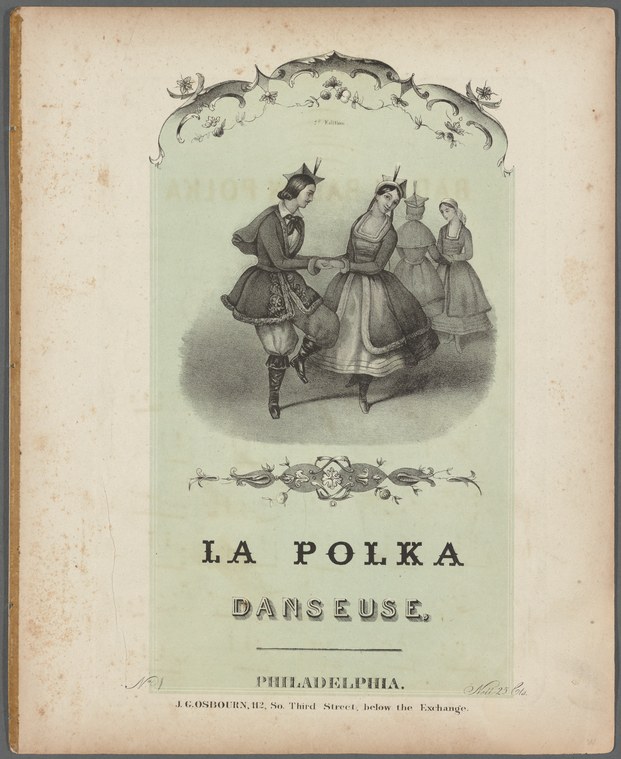
A lithographed title page presents a fashionable dance scene set in what appears to be a ballroom or social gathering space. At the center, a woman in an elaborately layered skirt with a fitted bodice and decorative headdress executes a dynamic polka step, leaning into the movement with her body angled forward and one leg extended. Her male partner, dressed in a dark jacket and patterned trousers, faces her with one hand extended toward her waist, his posture mirroring her engaged movement. Behind them, two additional female figures in similar period dress observe or await their turn. The composition is framed by ornate decorative borders—a flourishing rococo-style cartouche at the top and a floral garland at the bottom—typical of mid-to-late nineteenth-century commercial sheet music covers. The lithographic technique renders the figures in soft grayscale tones against a pale greenish background, creating an elegant, promotional aesthetic.
The dancing
The male dancer maintains a closed or semi-closed ballroom hold with his partner, his upper body controlled and his weight distributed to support her energetic movement. The female dancer is captured mid-rise, with her body leaning forward and her leg extended or lifting—a characteristic polka figure. Her arms are positioned to maintain connection with her partner while allowing rotational freedom. The secondary figures are rendered with less detail but suggest the social context of the ballroom and the sequence of couples waiting to dance. The positioning and gesture demonstrate understanding of the polka's characteristic hop and rise mechanics.
The dance depicted
This is a polka, one of the most fashionable and widely danced ballroom dances of the mid-to-late nineteenth century. The polka originated in Bohemia in the 1830s and became an international craze by the 1840s, particularly dominant in Victorian ballroom culture. The image captures the essential character of the dance: the characteristic rise-and-fall action, the rotational progression around the room, and the energetic tempo that made the polka thrilling to its contemporary audiences. The title *La Polka Danseuse* (The Dancing Polka) emphasizes the female dancer as the central subject, consistent with how the polka was marketed and taught—often as a dance that showcased the woman's agility, vitality, and fashionable bearing.
How it was made
This is a lithograph, a planographic printing process that allowed rapid, affordable reproduction of commercial imagery. The technique is well-suited to the soft modeling of fabric and flesh visible here, and the delicate ornamental borders. As a published title page (presumably for sheet music or a dance instruction manual), this object circulated widely and inexpensively—far more so than a hand-colored engraving or an oil painting. The publisher is identified as J. Cosbourn's of Philadelphia, locating this work within the American print trade. Lithography became the dominant medium for popular dance imagery in the nineteenth century precisely because it enabled mass distribution to the middle-class ballroom dancers and teachers who formed the primary market.
About this work
This is a mid-nineteenth-century commercial lithograph promoting the polka, one of the defining dances of the Victorian ballroom era. The image captures both the mechanical character of the dance—the rise-and-fall action, the closed hold, the rotational movement—and the social context in which it was performed: a ballroom of fashionably dressed couples engaged in a sequence of turns. The ornamental framing and promotional design signal that this was a published object meant for circulation: a title page for sheet music, a dance manual, or a broadside announcing an upcoming ball. It belongs in a gallery about dance because it documents not only what the polka looked like in motion but how the dance was marketed, taught, and imagined by the American public at a specific historical moment.
How to look at it
The artist has frozen the polka at the moment of rise—the characteristic upward surge of energy that defined the dance's character and made it feel so modern and vital to Victorian dancers. Notice the woman's extended leg and forward-tilting torso, which capture the dynamic momentum of the hop. The decorative borders, ornamental rather than functional, signal this as a commercial object designed to appeal to prosperous amateur dancers who could afford to purchase sheet music and dance instruction. The secondary figures in the background, rendered less distinctly, place the central couple within a larger social event and suggest the structured sequence of dancing that the ballroom demanded.
The period
The polka emerged from Bohemian folk traditions in the 1830s and swept through European ballrooms in the 1840s before arriving in America in the 1850s. By the time this lithograph was published (likely mid-to-late 1850s or 1860s), the polka was competing for dominance in American ballrooms with other fashionable couple dances including the waltz, the schottische, and the quadrille. The Victorian ballroom was a site of strict social choreography, and the polka's relatively simple hop-and-turn action made it accessible to large segments of the dancing public while still offering scope for virtuosic variation. Lithographed images of dances were a major genre of commercial print in this period, circulating as frontispieces to sheet music, as independent teaching aids, and as souvenirs of memorable balls.
Where it lives
This lithograph is held in the New York Public Library collection. It was published by J. Cosbourn's, No. 3 North Street, below the Exchange, in Philadelphia, and likely served as either a title page for a polka composition in sheet music format or as an independent promotional print advertising the dance or a specific ball or dancing academy.
Dance in this work
Questions about this work
What exactly is the polka, and why was it so popular?
The polka is a couple dance in 2/4 time built on a characteristic hop-and-turn action. It originated in Bohemia in the 1830s and became an international phenomenon by the 1840s because it was relatively easy to learn, thrilling to dance, and felt modern and energetic compared to earlier couple dances like the minuet. By the Victorian era, it was a staple of ballroom culture from London to New York.
How can you tell this is a lithograph and not an engraving?
Lithographs produce softer edges and more gradual tonal transitions than engravings, which use hatched lines to create shadow. The delicate modeling of the fabric textures and the even grayscale tones visible here are characteristic of lithographic printing. Additionally, the relatively light hand and painterly quality of the ornamental borders suggest the stone-based process rather than the more linear technique of engraving.
Why is the female dancer so prominent in this image?
By the mid-nineteenth century, Victorian ballroom dancing culture increasingly centered the woman's body and movement as the visual focus of the dance, even in couple dances. The polka, with its energetic hop and rotational action, was marketed as a dance that displayed the woman's vitality, fashionable dress, and physical agility. Dancing masters' manuals and commercial imagery often emphasized the woman's active role and visible movement.
What would this have been used for?
This lithograph likely served as a title page for a published polka composition in sheet music, or as a standalone promotional print. Dancing teachers, ballroom proprietors, and amateur musicians all purchased such images. They advertised the fashionability of the dance, provided visual reference for learning the steps, and served as souvenirs or decoration in the homes of people engaged with ballroom culture.
More Polka artwork