49 works in this view — arrow keys or swipe to move between them.
Dance in Art
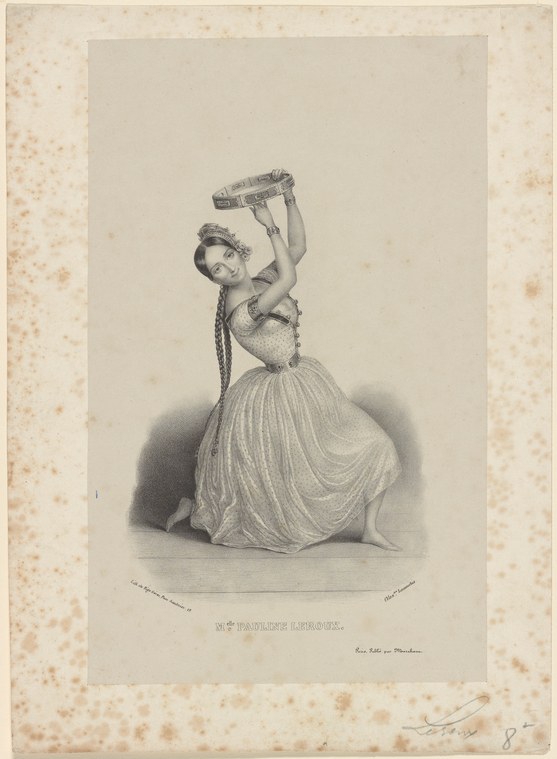
Melle. Pauline Leroux
Unknown artist
- Collection:
- Prints depicting dance
- Source:
- New York Public Library
- Rights:
- Public domain — free to use, share and adapt.
- Recorded as:
- Public Domain
This image is essential evidence for understanding how Romantic-era ballet was actually performed and marketed. Character dances with props and exaggerated theatrical gesture were central to the genre, yet they are often invisible in later classical ballet history; this print captures that practice directly. It also shows the crucial role of reproductive prints in creating and sustaining the celebrity of nineteenth-century dancers before the age of photography.
What you are looking at
A single female dancer is shown in a theatrical pose against a plain background. She wears a voluminous skirt of classical drapery and has her long dark hair arranged in a period style, with braids or coils at the back of her head. Her body is captured mid-movement: she leans backward with considerable extension, her right arm raised overhead holding what appears to be a telescope or opera glass, while her left arm is bent at the elbow. The drapery of her skirt falls in elegant folds that suggest movement, pooling slightly at her feet. The composition emphasizes the verticality of her pose and the interplay between her arched torso and the weight of the fabric. The image has the refined quality of a mid-nineteenth-century engraving or lithograph, with careful attention to tone and shadow to model her form and the fabric's volume.
The dancing
A single dancer in a dramatic, extended arabesque-like position with a pronounced backward arch of the torso. Her supporting leg is straight, while her free leg is lifted; her arms frame the upward lean of her body. The pose suggests balletic training and vocabulary—the elongation through the spine, the turnout implied by the hip position, the extension rather than flexion. The raised arm holding the telescope breaks the classical line with a theatrical, almost comedic gesture that suggests this is a character dance or pantomime rather than pure ballet.
The dance depicted
This appears to be a theatrical character dance or pantomime number, likely from mid-nineteenth-century Romantic ballet, in which a ballerina performs a named solo role. The prop—the telescope—and the comedic, exaggerated attitude of the pose suggest a whimsical or satirical character, not an abstract classical variation. The style of the arabesque and the vocabulary of the body align with the Romantic era of ballet (1830s–1850s), when such character dances were increasingly common within longer narrative ballets. Without identifying the specific role from the name alone, the image shows a trained ballet dancer executing a recognizable theatrical vocabulary with clear dramatic intention.
How it was made
This is a black-and-white engraving or lithograph, a reproductive print technique that allowed wide circulation of theatrical imagery in the nineteenth century. The fineness of the line work and the subtle modeling of form through cross-hatching and tonal gradation are characteristic of fine engraving. Such prints were typically produced and sold as souvenirs of performances, allowing theatergoers and distant audiences to own an image of a celebrated dancer in a memorable role. The technique's precision and accessibility made it an ideal medium for dance imagery aimed at an educated middle-class public.
About this work
This is a theatrical print documenting a named dancer in a Romantic-era ballet solo, preserved in the New York Public Library's collection of dance imagery. The work combines the technical vocabulary of classical ballet with the character pantomime that was central to mid-nineteenth-century theatrical dance. As a mass-produced engraving, it is both an artwork and a document of performance practice—evidence of how dancers moved, what audiences paid to see, and how the theater industry marketed its stars to a public hungry for images of celebrated performers.
How to look at it
Notice the deliberate artificiality of the pose: the telescope held aloft, the exaggerated backward arch, the theatrical expressiveness of the gesture. This is not a moment of natural movement but a held attitude—the kind of tableau the audience would recognize and applaud as a signature moment in the character's arc. The engraver has chosen to freeze not the climax of a step sequence but a moment of pure character and attitude, suggesting this was how the role was remembered and marketed. Observe how the drapery is rendered to suggest motion even within the still image—the skill of the engraver lies in making stillness look dynamic.
The artist
The engraver's name is not recorded in the catalogue, but the quality of the line work and the inscription at the bottom of the print suggest a professional house engraver working for a Parisian or London theater publisher in the mid-nineteenth century. Such prints were typically produced quickly after a premiere or benefit performance to capitalize on public interest, often by anonymous or apprentice engravers working from sketches or the director's instructions rather than direct observation.
The period
The 1830s–1850s saw an explosion of Romantic ballet across Europe, with elaborate narrative ballets featuring multiple dance styles—classical variations, character dances, pantomime, and spectacle. Simultaneously, the commercial theater industry developed a robust market for prints, lithographs, and engravings of celebrated dancers and scenes. These prints were affordable enough for a broad audience but fine enough to appeal to connoisseurs, making them one of the primary ways the public engaged with and remembered theatrical performances. The costume and hairstyle in this image are consistent with the late 1830s or 1840s.
Where it lives
The print is held in the New York Public Library's collection of prints depicting dance, a broad curatorial category that includes theatrical imagery, instruction books, and documentary evidence of performance. The inscription at the bottom of the print indicates it was professionally produced and distributed, likely for sale as a theatrical souvenir.
Dance in this work
Questions about this work
Was this a solo or part of a larger ballet?
Almost certainly part of a longer narrative ballet, likely in two or three acts. Character dances like this were inserted into full-length works as moments of variety, comedy, or local color. The telescopic prop suggests a comic scene, possibly involving a chase, a misunderstanding, or a moment of vanity.
Who was Pauline Leroux?
The catalogue identifies the subject by name but provides no biographical information. She was evidently a professional dancer known enough to merit a printed souvenir, and the quality of the technique displayed in the engraving suggests she was trained in classical ballet. Many mid-nineteenth-century dancers achieved considerable fame during their lifetimes but left little historical record.
How do we know this is ballet and not some other form of dance?
The posture, the vocabulary of the body (the extended leg, the turnout, the elongation through the spine), the theatrical costume, and the performance context all point to ballet. The telescope is a theatrical prop, not an instrument integral to the dance form itself, but the physical language is unmistakably balletic.
Why hold a telescope?
Without the original scenario, we cannot know for certain, but in Romantic-era comedic ballets, such props were often used to establish character or situation: a stargazer, a spy, a vain person admiring themselves, or a character caught in a moment of comic confusion. The exaggerated pose suggests the humor of the moment was physical as well as narrative.
More dance artwork





