49 works in this view — arrow keys or swipe to move between them.
Dance in Art
Propos de coulisses [selections]
Unknown artist
- Collection:
- Prints depicting dance
- Source:
- New York Public Library
- Rights:
- Public domain — free to use, share and adapt.
- Recorded as:
- Public Domain
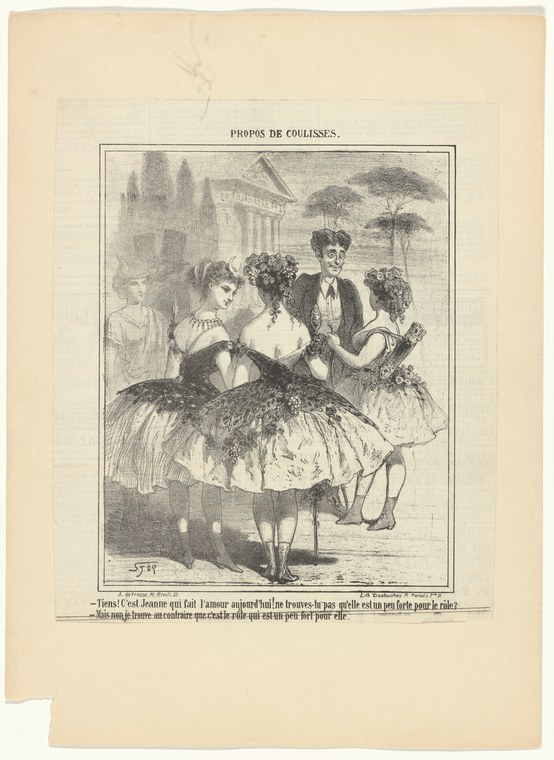
This image documents not how ballet was officially celebrated but how it was actually understood and satirized in popular culture—a crucial perspective for understanding the social context of 19th-century dance. The caricatural treatment reveals contemporary anxieties about professionalism, physicality, and female performers that the official iconography of ballet carefully suppressed. For anyone studying the gap between artistic aspiration and social reality in 19th-century theatre, this is primary evidence.
What you are looking at
A satirical engraving depicting backstage theatre life, likely from the mid-to-late 19th century. Four female figures occupy the composition: a central dancer in a tutu caught mid-leap or extension, attended by three companions in various stages of dress and undress. The setting is theatrical—a classical colonnade and building are visible in soft focus at left, while an acacia tree frames the right side, suggesting an exotic or fantastical backdrop. The central figure's tutu is rendered in fine parallel lines suggesting gossamer fabric; her body is elongated and exaggerated in a way that mocks classical ballet proportions. The surrounding figures gesture with theatrical abandon, their expressions animated and knowing. The overall tone is one of burlesque comedy: the caption promises backstage gossip ("Propos de coulisses"), and the anatomical distortions and the casual proximity of the figures suggest the work is satirizing the pretensions, physicality, and offstage behaviour of professional dancers.
The dancing
The central dancer is rendered in a balletic pose—raised on her supporting leg with the other extended high, arms positioned in an attitude suggesting classical ballet port de bras. However, the proportions are grotesquely exaggerated: her limbs are impossibly elongated, her torso compressed, her head small, all deliberate distortions characteristic of caricature. The three attendant figures surround her in poses of attention, admiration, or gossip, their bodies leaning inward. None of the figures show the disciplined verticality or restraint of actual ballet technique; instead, they exhibit the looseness and informality of backstage leisure. The work suggests an artist well acquainted with ballet's conventions, exaggerating them precisely to mock.
The dance depicted
This is a satirical image of theatrical ballet, almost certainly French Romantic or post-Romantic ballet (mid-to-late 19th century). The tutu, the classical pose, and the theatrical setting all point to the corps de ballet or soloists of the Paris Opéra or similar establishment. The work mocks not the dance itself but the mythology and pretension surrounding it—the cult of the ballerina, the gap between onstage illusion and offstage reality, the physicality and reputation of professional female dancers. It belongs to a tradition of theatre satire and backstage commentary that was popular in French caricature and illustrated periodicals. The title "Propos de coulisses" (Backstage Gossip or Chatter from the Wings) promises anecdotal rather than decorative content.
How it was made
This is a wood engraving or lithographic print, likely from a French illustrated periodical or book of theatre satire. The technique is characteristic of 19th-century reproductive printmaking: fine parallel lines build form and shadow, facial features and costume detail are economical and expressive rather than illusionistic, and the composition is designed for legibility at small scale. The signature at lower left appears to read "S Trey" or similar. The medium allowed for rapid production and wide circulation, placing the work in the context of popular illustrated press and caricature albums rather than fine art printmaking. The style—the particular emphasis on exaggeration of form, the caricatural heads, the witty linear handling—suggests the hand of a trained satirist working in the mid-Victorian period.
About this work
This is a theatrical satire depicting the backstage world of mid-to-late 19th-century ballet, rendered as caricature. The central figure, a female dancer in tutu and ballet pose, is surrounded by attendants in a scene that privileges gossip and physicality over grace and illusion. The work belongs to a rich French tradition of theatre commentary and caricature, where the gap between onstage performance and offstage reality is mined for comedy and social critique. It is evidence of how ballet was understood, represented, and consumed in popular visual culture—not as high art alone, but as a spectacular, morally ambiguous, and intensely corporeal spectacle.
For a dance historian, the work is valuable precisely because it is not reverent. It captures attitudes toward professional female dancers that coexisted with the Romantic ideal: skepticism about their physicality, interest in their private lives, and a tradition of satirizing their pretensions. The hyperextended limbs and distorted proportions are exaggerations, but they exaggerate what was actually visible in ballet technique—the extraordinary demands on the body, the visibility of musculature and effort beneath the tutu. The work thus reveals both admiration and anxiety about what ballet required of the female body.
How to look at it
Notice the distortions: the hyperextended leg and arm, the compressed torso, the small head, the theatrical spacing and energy of the surrounding figures. These are deliberate caricatural choices, not incompetence. The artist is not trying to capture the illusion of ballet—the grace and effortlessness—but rather to expose what lies beneath it: the extreme flexibility, the physical expenditure, the labor. The classical pose is recognizable, but rendered grotesque. Look at the dress and setting: the tutu is rendered with care, the hair and jewels are detailed, the architectural backdrop is Romantic-theatrical. This is not crude mockery but sophisticated satire, by someone who knew ballet intimately and was using caricature as a tool of critique and comment. The wit lies in the recognition: a contemporary viewer would have known exactly which dancers and which theatrical types were being referenced.
The artist
The work is signed, likely "S. Trey" or similar, but the artist cannot be securely identified from the catalogue record. The style and subject matter suggest a professional theatre satirist or caricaturist working for a Parisian periodical or album publisher in the mid-to-late 19th century. The technical facility—the economy of line, the precise rendering of fabric and anatomy—indicates professional training. The choice of subject and the tone of the commentary suggest someone with insider knowledge of theatre life, whether as a regular patron, journalist, or artist embedded in theatrical circles.
The period
The image dates to the era of Romantic and post-Romantic ballet in France, likely the 1850s–1870s. This was the period when the cult of the ballerina had reached its height, when stars like Marie Taglioni and later dancers commanded enormous fees and public fascination, and when the Paris Opéra was at the centre of European cultural life. It was also a period of intensified scrutiny of performers' private lives and moral status. Theatre satire and caricature were flourishing media in the Parisian illustrated press; periodicals like *Le Charivari* and albums of theatrical criticism and commentary were widely circulated. Ballet itself was evolving: the romantic tutu was becoming standardized, pointe work was becoming normative, and the technical demands on dancers' bodies were increasing visibly. The satirical tradition of representing dancers was thus well established, and the exaggerated physicality captured in caricature reflected real anxieties about what ballet required.
Where it lives
The work is held in the New York Public Library's collection of prints depicting dance. It is catalogued as part of their holdings on theatrical imagery and dance history, but the catalogue record contains minimal information, suggesting it may be one of many similar satirical prints or engravings acquired as a lot or collection. The lack of detailed attribution or dating reflects the status of theatrical prints of this era: widely circulated, quickly consumed, and often treated as ephemera rather than collectible objects.
Dance in this work
Questions about this work
Is this making fun of ballet?
Yes and no. The artist is not rejecting ballet but exposing the gap between the romantic fantasy onstage and the physical reality and social context of dancers' lives offstage. The exaggerations are witty and informed, not crude. The work belongs to a tradition of theatre satire that assumed an educated audience—people who knew ballet well enough to catch the jokes.
What does the title 'Propos de coulisses' mean?
"Coulisses" refers to the wings of a theatre—the space offstage. "Propos" means chatter or gossip. So the title promises backstage commentary and scandal—the real talk that happens when the curtain is down. This signals the work's satirical intent from the outset.
What era is this from?
The style, dress, and subject matter suggest the mid-to-late 19th century, most likely 1850s–1870s. The tutu style, the theatrical setting, and the caricatural technique are all consistent with this period. Without a dated signature or publication information, the attribution is not certain, but this is the most probable window.
Was this widely circulated?
Almost certainly yes. The technique (engraving or lithography) and the subject matter (popular theatre, scandal, satire) suggest it was published in a periodical or satirical album. Thousands of such prints were produced and distributed in 19th-century Paris. Most were consumed quickly and discarded, which is why they are now relatively rare in institutional collections.
More dance artwork





