49 works in this view — arrow keys or swipe to move between them.
Dance in Art
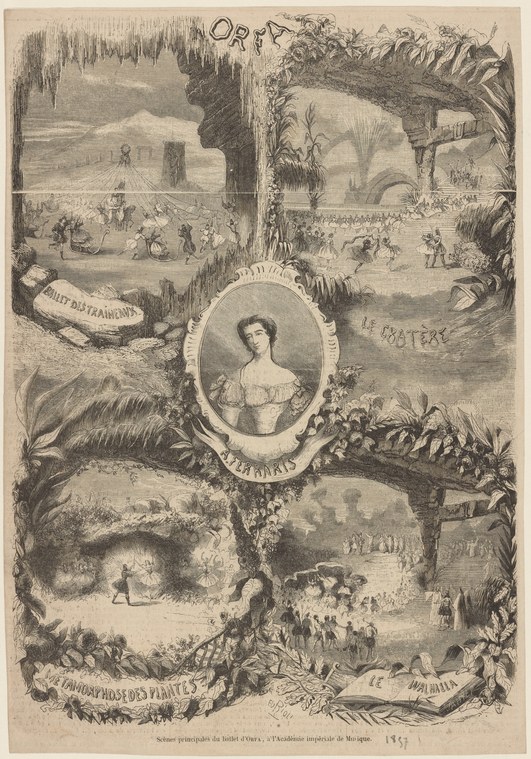
Orfa: ballet des traineux, le cratère, metamorphose des plantes, la Walhalla
Unknown artist
- Collection:
- Prints depicting dance
- Source:
- New York Public Library
- Rights:
- Public domain — free to use, share and adapt.
- Recorded as:
- Public Domain
This work documents the scale and ambition of eighteenth-century theatrical dance production and the celebrity status of female dancers who commanded resources for elaborate spectacles. It shows that dance was not an isolated art form but integrated into complex stage machinery, architecture, and visual transformation—what later became the vocabulary of romantic ballet.
What you are looking at
This is an allegorical composite engraving celebrating a named female performer through a series of theatrical scenes arranged around her portrait. At the center sits an oval portrait of a woman in classical dress, framed by an ornamental garland. Surrounding this central image are five distinct scenes arranged in the composition: mountainous landscapes with waterfalls and architectural ruins occupy the upper corners; a large ornate interior space with a vaulted ceiling and crowds of spectators dominates the upper right; a classical temple or pavilion scene with assembled figures appears upper left; a grotto or cave setting with cascading water fills the lower left; and a formal garden or palace courtyard with assembled spectators occupies the lower right. Each scene depicts performers or crowds, suggesting different settings in which the named subject danced. The engraving employs fine parallel line-work typical of the period, creating dramatic contrasts of light and shadow across the architectural elements and natural features. The overall composition is densely packed with narrative detail, presenting a visual biography of a celebrated performer across multiple theatrical and natural settings.
The dancing
The dancers visible in the peripheral scenes are rendered small relative to their architectural settings. In the interior theater scenes, figures are arranged in formation facing toward a performance space or stage area. The few dancers whose movement is legible appear to be in upright, formal postures consistent with eighteenth-century theatrical convention rather than the turned-out positions of classical ballet technique. The crowds suggest spectators arranged in tiers or galleries watching performances, which was standard for court and public theater of the period. The central portrait shows the named performer in a formal three-quarter pose, her bare shoulders and classical drapery indicating her status as a professional entertainer rather than a society amateur.
The dance depicted
The title references 'Orfa' (possibly a stage name or operatic character), with subtitles suggesting a ballet in multiple acts or scenes: 'ballet des traineux' (possibly referring to sledges or drawn vehicles), 'le cratère' (the crater or amphitheater), 'metamorphose des plantes' (transformation of plants), and 'la Walhalla' (the Norse afterlife or palace, suggesting grandiose theatrical spectacle). This appears to document a specific production or a performer's signature role, rendered as a composite image that celebrates her in multiple dramatic contexts. The theatrical settings and crowds suggest this was a major public performance, likely at a court or significant civic theater. Without date or artist attribution, the style and printmaking technique suggest mid-to-late eighteenth century, though the engraving may commemorate an earlier performance.
How it was made
This is an engraving executed in fine line-work, almost certainly made from a copperplate. The technique is legible in the parallel hatching used to render shadow, texture, and atmospheric perspective—visible especially in the water, fabrics, and architectural details. The fineness of line and complexity of the composition suggest a skilled reproductive engraver working from a larger design or painting; such works were expensive to produce and aimed at a wealthy, educated audience interested in theater history and celebrity. The presence of the formal title cartouches and the allegorical arrangement suggest this was a commemorative or promotional print, possibly sold to collectors or mounted in theatrical archives.
About this work
This engraving is a theatrical portrait in the eighteenth-century allegorical tradition, presenting a named female performer through scenes depicting the scope of her dramatic ambitions. The work celebrates a specific dancer or performer known for ambitious, spectacular productions that included elaborate stage machinery, transformations, and architectural spectacle. It belongs to the print culture of theatrical celebrity, showing how dancers of the period were memorialized and circulated among patrons and cognoscenti.
The image is valuable not as a record of any single dance or technique, but as evidence of how theatrical dance in the eighteenth century was embedded in large scenic productions, how female performers could achieve celebrity status commanding multi-act spectacles, and how that celebrity was monetized and distributed through the luxury print market.
How to look at it
Examine the peripheral scenes for clues to the nature of the dances performed: note the formal interior theater with its tiers of spectators (suggesting court or municipal theater), the presence of architectural and natural scenery (indicating ambitious stage machinery), and the classical or allegorical subjects referenced in the title. The small scale of the dancers within these grand spaces is instructive—it reflects the eighteenth-century theatrical hierarchy in which spectacle, music, and scenic machinery were often more important than the movements of individual dancers. The engraving's technique itself—the fine gradations of light and shadow—celebrates the skill and resources deployed in theatrical production.
The period
The engraving dates to the era of court ballet and the emerging public theater, when dance was closely allied with opera, pantomime, and elaborate stage decoration. The mention of 'Walhalla' and other grand themes suggests the influence of Enlightenment aesthetics and the taste for ambitious allegorical or classical subjects. The composite allegorical portrait was a standard format for commemorating celebrated performers—actors, opera singers, and dancers—in prints aimed at a theater-going public with means to purchase such works. Female dancers in this period were beginning to achieve independent celebrity and to command resources for productions bearing their names.
Where it lives
Held by the New York Public Library in its collection of prints depicting dance. This is likely a commemorative or promotional print, possibly distributed during the performer's lifetime or shortly after, to celebrate a signature role or production.
Dance in this work
Questions about this work
Who was Orfa?
The catalogue record does not identify the performer by any name other than 'Orfa,' which may be a stage name or character name. The engraving's style and technique suggest an eighteenth-century figure, but without further documentation, her identity cannot be established from the image alone.
What kind of dance did Orfa perform?
The work suggests ambitious theatrical productions involving elaborate scenery, architectural settings, and possibly mythological or allegorical narratives. The formal theatrical interiors and crowds indicate court or public theater rather than social dance. The specific steps and technique cannot be discerned from the scale and style of the engraving.
Why is this structured as a composite image?
The allegorical composite portrait was a standard format for celebrating celebrity performers in the eighteenth century. By showing the performer in multiple theatrical settings or contexts, the engraving presents a visual summary of her ambitions, roles, or signature productions—functioning as a kind of theatrical biography.
When was this engraved?
The catalogue record gives no date. The style, technique, and subject suggest the mid-to-late eighteenth century, but the engraving may commemorate an earlier performance. The fine line-work and allegorical composition are consistent with high-quality theatrical prints of that era.
More dance artwork





