49 works in this view — arrow keys or swipe to move between them.
Dance in Art
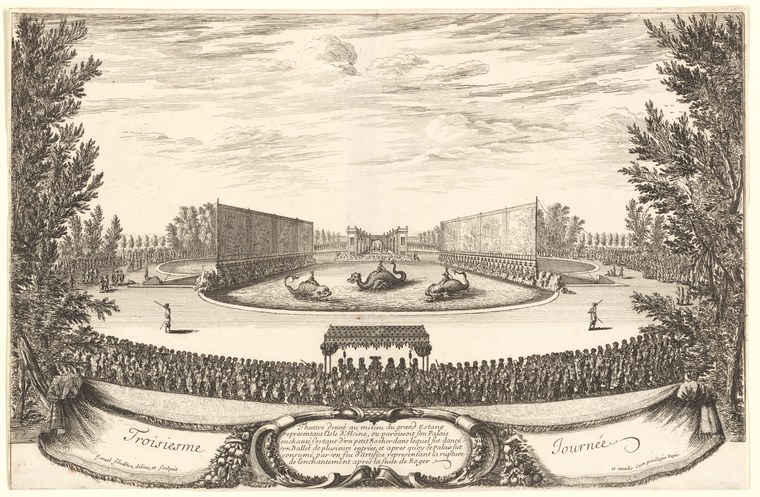
Troisiesme journée: theatre dressé au milieu du grand Estang ...
Unknown artist
- Collection:
- Prints depicting dance
- Source:
- New York Public Library
- Rights:
- Public domain — free to use, share and adapt.
- Recorded as:
- Public Domain
This image is crucial for understanding court spectacle as a medium in which dance was one element within a larger political and artistic statement. It shows how Renaissance courts invested enormous resources and engineering in entertainment as an expression of authority and cultural refinement. For historians of dance, it raises essential questions about movement in spaces we can document but cannot directly observe—what dances filled that pool-side space, and how did performers navigate formal gardens while being watched by hundreds of seated spectators?
What you are looking at
This is an engraved bird's-eye view of an elaborate water pageant or aquatic entertainment staged in a formal garden setting. A large circular pool occupies the center, with three elaborate floating structures or boats arranged within it, their designs suggesting mythological or allegorical themes. The pool is ringed by formal hedging and geometric plantings; tall cypress or poplar trees frame both sides of the composition. A massive semicircular grandstand or viewing structure dominates the foreground, packed with hundreds of spectators arranged in rows, all facing the water. The precision of the engraving allows us to distinguish individual figures in the crowd, though they are rendered at a distance that reduces them to silhouettes. Beyond the pool, formal gardens, parterres, and architectural structures recede into the background, with more hedging and architectural features lining the far edges. The sky occupies the upper third of the composition and is rendered with fine parallel lines suggesting calm weather. A decorative cartouche at the bottom bears an inscription in French (partially legible as 'Troisiesme journée' and 'Journée'), indicating this is the third day of a multi-day festival or celebration.
The dancing
The dancers or performers, if present on the floating structures, are rendered too small at this scale to read their specific gestures, holds, or frames. The primary visual focus is on the massed spectators in the foreground grandstand, arranged in orderly rows facing the spectacle. The few larger figures visible near the water's edge appear to be standing or processing; without magnification it is not possible to determine whether the bodies on the floating structures are in motion or static tableau. The entire composition emphasizes scale and hierarchy rather than the articulation of individual movement.
The dance depicted
This engraving documents a court spectacle or festival rather than a recognizable dance form. The three floating structures suggest mythological or allegorical pageantry typical of 16th- and 17th-century court celebrations, which often combined music, dance, aquatic effects, and elaborate machinery. If dancers were part of the performance, they would most likely have performed formal court dances such as pavane, branle, or galliard in the spaces around or upon the floating structures. The image cannot identify a specific dance style because the performers are too distant to observe. The inscription 'Troisiesme journée' (Third Day) indicates this was one segment of a longer festival, possibly lasting several days, in which different dances and entertainments would have alternated.
How it was made
This is an engraving, identifiable from the fine parallel hatching used to create tone and shadow, the crisp linear perspective, and the precision of the architectural detail. The technique allowed for multiple prints to be distributed to courts across Europe, documenting spectacles that were otherwise ephemeral. The scale of the composition—showing the entire scene from above—suggests this was engraved after the event to commemorate and record it for posterity, and possibly to display the patron's wealth and artistic ambition to other rulers. The level of detail and the formal title cartouche indicate this was a formal publication, likely bound into a volume documenting the entire festival.
About this work
This engraving preserves a record of an elaborate courtly water pageant held over multiple days, of which this image documents the third day's entertainment. The composition prioritizes spectacle and ceremony over the movements of individual dancers, yet it constitutes invaluable evidence of how Renaissance or early Baroque courts orchestrated multi-sensory festivals combining dance, music, water effects, and mythological or allegorical narrative. The image belongs in a dance archive precisely because it documents the context, scale, and social function of courtly dance in a period when such spectacles were central to aristocratic power and diplomacy. The precision of the engraving allows modern historians to study the arrangement of performance space, the role of massed spectators, and the integration of dance within broader festive programs.
How to look at it
Attend to the composition's hierarchy: the hundreds of spectators in the foreground are rendered with far more detail than the floating structures and their performers. This tells us that witnessing spectacle collectively was as important as the spectacle itself. Note the precision of the architectural setting and the geometric gardens—this was not a spontaneous entertainment but an engineering feat requiring months of planning. The three distinct floating structures suggest a narrative or symbolic progression across the day's entertainment. Look for any sign of movement or process in the distant figures, but recognize that at this scale and in this medium, the engraver's priority was to document the scale and organization of the event, not the fine points of the dances themselves.
The period
This engraving documents a festival culture that flourished in European courts from the 16th through 18th centuries. Multi-day festivals combining dance, music, poetry, machinery, and elaborate costume were central to courtly life and to the political ambitions of Renaissance and Baroque princes. The French court was particularly celebrated for such spectacles, especially under the patronage of rulers like the Medici in Florence and later the Bourbon kings in France. Dances like the pavane, galliard, branle, and minuet featured prominently in such celebrations. The engraved documentation of these events was itself a form of courtly propaganda, circulating images of the spectacle to courts that could not attend. By the 17th century, such festivals were becoming more theatrical and less participatory for the audience, with professional performers replacing courtiers as dancers.
Where it lives
The work is held in the New York Public Library's collection of prints depicting dance. The French inscription and style suggest this is part of a bound volume or series documenting a specific festival, likely published shortly after the event as a commemorative record for distribution among European courts.
Dance in this work
Questions about this work
What is happening in the water?
Three elaborate floating structures or allegorical floats occupy the center of a formal pool. They likely carried performers, musicians, and symbolic scenery. The exact nature of the spectacle—whether it was primarily dance, music, spoken drama, or a combination—cannot be determined from the engraving alone, though all were typical components of court festivals.
Where and when did this take place?
The French inscription suggests a French court setting, though the specific location and date are not provided in the available record. The style of the engraving and the gardens suggest the 16th or 17th century. The reference to 'Third Day' indicates this was part of a multi-day festival, suggesting a major state occasion such as a royal wedding or diplomatic celebration.
Who were the dancers?
At this distance and level of detail, individual dancers cannot be identified. Court festivals of this period typically featured both professional performers and members of the aristocracy. Given the elaborate machinery and floating structures, at least some performers were likely professional entertainers or musicians.
Why is the grandstand so large?
The hundreds of seated spectators indicate this was a major public or semi-public event, not an intimate court entertainment. Watching and being seen was central to courtly display and social hierarchy. The size of the audience reflects both the patron's wealth and the cultural importance of such spectacles.
More dance artwork





